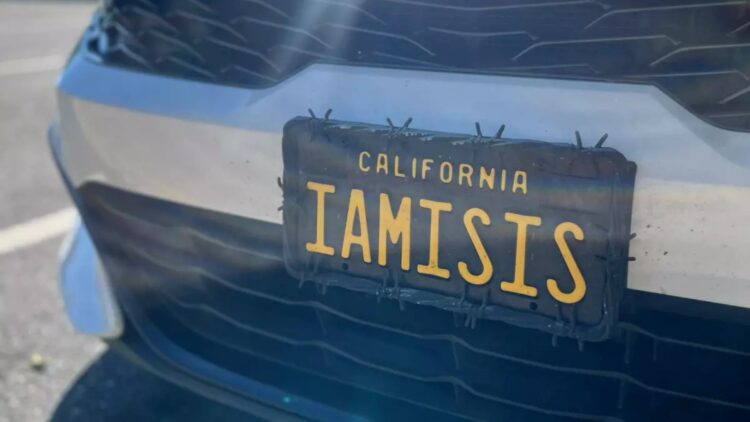
A California woman is contesting the decision of the state’s Department of Motor Vehicles (DMV) to revoke her personalized license plate, which features a name linked to an ancient goddess. Isis Wharton, a resident of Sacramento, has held the plate reading “IAMISIS” since 2022, but the DMV deemed it offensive, claiming it poses a potential risk of inciting violence.
Wharton, who has paid $50 annually for her plate, expressed her shock upon receiving the DMV’s letter. The agency argued that the plate could be interpreted as an affiliation with the Islamic State of Iraq and Syria, a notorious terrorist organization. In her defense, Wharton stated that her name originates from the Egyptian goddess, symbolizing healing and maternal love, and should not be tarnished by any negative associations.
DMV’s Justification and Regulations
The DMV has a mandate to ensure that personalized license plates adhere to state regulations, which include rejecting any phrases deemed offensive, profane, or potentially inciting violence. A spokesperson for the DMV emphasized that language can have different meanings across cultures, stating, “What may be a term of affection in one context can be perceived differently in another.”
The DMV’s rejection process is guided by strict criteria. Plates may be declined if they contain sexual or scatological meanings, profane terms, or messages related to race, religion, or sexual orientation. Additionally, phrases that could be interpreted as threats or references to illegal activities are also prohibited.
Wharton’s case is not isolated. In 2020, five other California residents raised similar concerns after their personalized plates were rejected. Steve Gordon, the director of the DMV, received complaints arguing that the rejections constituted unconstitutional restrictions on free speech as protected by the First Amendment. In those cases, a court ruled in favor of the drivers, asserting their plates were a form of private speech.
Previous Controversies and Public Response
The rejected plates in those earlier cases included terms such as “OGWOOLF,” which the DMV claimed referenced a band, and “SLAAYRR,” labeled as potentially threatening. Other rejected terms included “QUEER,” deemed degrading, and “DUKNA,” which the DMV said resembled a vulgarity. The controversy has sparked discussions on the balance between public safety and individual rights.
Wharton has committed to contesting the DMV’s decision, stating, “I choose to fight because I believe this could be a great example of bringing back the powerful and peaceful name Isis and not giving all the negative power to the terrorist group.” Her determination highlights the ongoing debate surrounding personalized license plates and the complexities of language interpretation in a diverse society.
The outcome of Wharton’s appeal may serve as a significant benchmark for how personalized license plates are regulated and the extent to which freedom of expression is upheld in similar cases across the country.