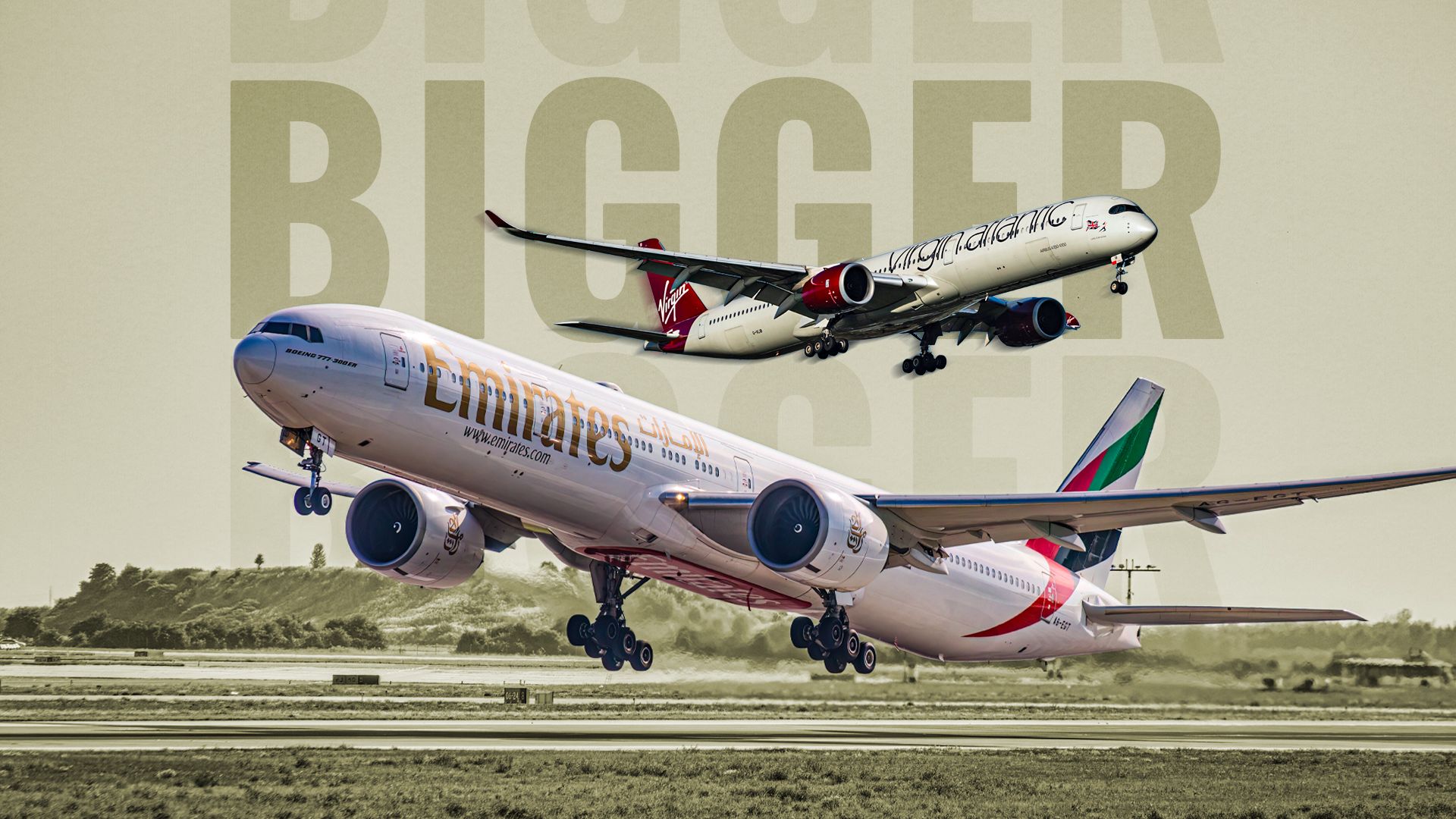
The Boeing 777-300ER and Airbus A350 represent two of the most advanced twin-engine passenger aircraft in the aviation industry. While both models boast impressive specifications, significant differences exist in size, capacity, and operational efficiency. The Boeing 777-300ER, measuring approximately 242 feet 4 inches (74 meters) in length, presents a larger appearance when compared to the Airbus A350-1000, which is slightly smaller at 242 feet 1 inch (73.8 meters). This article explores the key differences between these aircraft and their respective roles in global aviation.
Boeing 777-300ER: Specifications and Features
The Boeing 777-300ER, launched in 2004, is a hallmark of modern widebody design. It features a wingspan of 212 feet 7 inches (64.8 meters) and a tail height of around 60 feet 8 inches (18.5 meters). With a maximum takeoff weight (MTOW) of approximately 775,000 lbs (351 tonnes), this aircraft is capable of carrying a substantial payload while achieving a range of up to 7,370 nautical miles (13,650 km).
Powering this aircraft are two General Electric GE90-115B engines, each producing around 115,000 lbs (52,200 kg) of thrust, establishing it as one of the most powerful engines ever certified for commercial use. Airlines typically configure the 777-300ER to accommodate between 360 and 400 passengers, often in a two-class layout, which highlights its capacity for high-density routes.
This aircraft’s robust design and capacity have made it the backbone of many airlines’ long-haul fleets. For instance, Emirates operates over 120 Boeing 777-300ERs, utilizing them on key routes to major international hubs.
Airbus A350: A Modern Alternative
In contrast, the Airbus A350 is a newer generation aircraft that entered service in 2015. The baseline A350-900 measures 220 feet (66.8 meters), while the A350-1000, designed to compete directly with the 777-300ER, has a similar length but boasts a more aerodynamic profile. The A350-1000 is equipped with a MTOW of 679,000 lbs (308 tonnes) and offers a range of 8,000 to 8,700 nautical miles (14,800 to 16,100 km), depending on configuration.
The A350 is notable for its use of advanced carbon-fiber composites, which enhance fuel efficiency and reduce overall weight. This aircraft typically accommodates 300 to 410 passengers, depending on the airline’s chosen configuration. Its interior design focuses on passenger comfort, with wider seats and more spacious cabins compared to the 777-300ER’s ten-abreast economy layout.
Airlines like Singapore Airlines and Qatar Airways have integrated the A350 into their fleets, recognizing its efficiency and comfort advantages, especially on long-haul routes.
Comparative Analysis: Capacity and Efficiency
While the Boeing 777-300ER is physically larger, the operational needs of airlines influence the choice between these two aircraft. The 777-300ER excels as a high-capacity workhorse, ideal for busy trunk routes where passenger numbers are paramount. Its robust structure facilitates high cargo volumes, making it an attractive option for airlines serving slot-constrained airports.
Conversely, the Airbus A350 is designed for efficiency and adaptability. Its lower fuel burn and longer range make it suitable for both high-demand and thinner routes, allowing airlines to optimize operational costs. The choice between these two models often comes down to specific route demands and airline strategies.
As of early 2025, more than 800 Boeing 777-300ERs have been delivered worldwide, while the Airbus A350 has gained traction with over 630 units in operation. Notably, some airlines have transitioned from the 777-300ER to the A350, indicating a shift towards newer, more efficient aircraft.
In summary, both the Boeing 777-300ER and Airbus A350 have carved out significant roles in the aviation market. The Boeing 777-300ER’s size and capacity make it a preferred choice for many airlines, while the Airbus A350’s emphasis on efficiency and passenger comfort positions it as a strong competitor. As the aviation landscape evolves, both aircraft are likely to remain integral to long-haul travel for years to come.