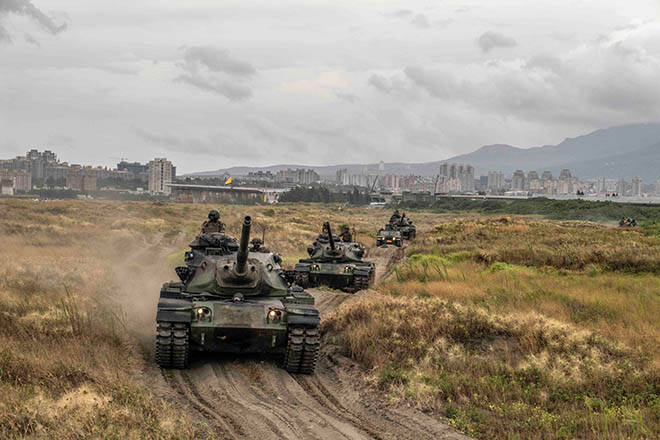
The Trump administration has formally requested Congress to approve an arms package for Taiwan valued at over $11 billion. This significant military aid aims to bolster the self-governing island’s defenses amid ongoing tensions with China, which has long been viewed as a potential aggressor. If Congress grants approval, this package would surpass the $8.4 billion in arms sold to Taiwan during the Biden administration, according to data from the research arm of the UK’s House of Commons.
The scale of this proposed arms sale would account for more than half of the $18.3 billion in arms provided to Taiwan during President Trump’s first term. The request is expected to gain bipartisan support in Congress, reflecting a shared commitment to Taiwan’s security against perceived threats from Beijing.
Details of the Arms Package
The arms package, recently cleared by the Pentagon’s Defense Security Cooperation Agency, includes significant weaponry such as high mobility artillery rocket systems (HIMARS) and M109A7 self-propelled howitzers, each valued at over $4 billion. Additionally, it encompasses more than $700 million for Javelin and TOW anti-armor missiles, alongside Altius kamikaze drones produced by military technology firm Anduril.
In a statement, the Pentagon emphasized that the proposed sale aligns with U.S. interests by aiding Taiwan in its modernization efforts and enhancing its defensive capabilities. Taiwan’s Defense Ministry also released a statement asserting that this arms package would provide “strong deterrence and deterrence combat capabilities” along with “asymmetric combat advantages.”
China’s Response and Regional Implications
The Chinese government swiftly condemned the proposed arms sales, viewing them as a violation of its claimed sovereignty over Taiwan. Chinese Foreign Ministry spokesperson Guo Jiakun stated that these sales would only escalate tensions, warning that they could “hasten pushing Taiwan toward the perils of war.” The ongoing arms support from the U.S. is a contentious issue between Washington and Beijing, particularly as President Xi Jinping seeks to stabilize relations ahead of Trump’s anticipated visit to China in April.
U.S. officials and analysts have noted that Xi appears determined to regain control of Taiwan, with military preparations suggesting a potential invasion could be a future objective. Despite the lack of formal recognition of Taiwan as a sovereign state, the United States has provided arms to the island for decades, maintaining a policy of “strategic ambiguity” regarding its defense commitments.
As the proposed arms package advances through Congress, Taiwan’s President Lai Ching-te is simultaneously advocating for an annual budget and an additional $40 billion special budget aimed at enhancing military capabilities through 2033. The opposition Nationalist Party in Taiwan has voiced concerns regarding previous delays in arms deliveries and potential waste, hinting at possible challenges to Lai’s military spending proposals.
Nevertheless, there is an expectation that the special budget will eventually pass, potentially after modifications requested by opposition lawmakers. Taiwan’s Ministry of Foreign Affairs reaffirmed its commitment to deepening cooperation with the United States and other partners to enhance its defense capabilities.
The outcome of this proposed arms sale will likely have lasting implications for Taiwan’s security and its relationship with both the United States and China, further influencing the regional balance of power in East Asia.