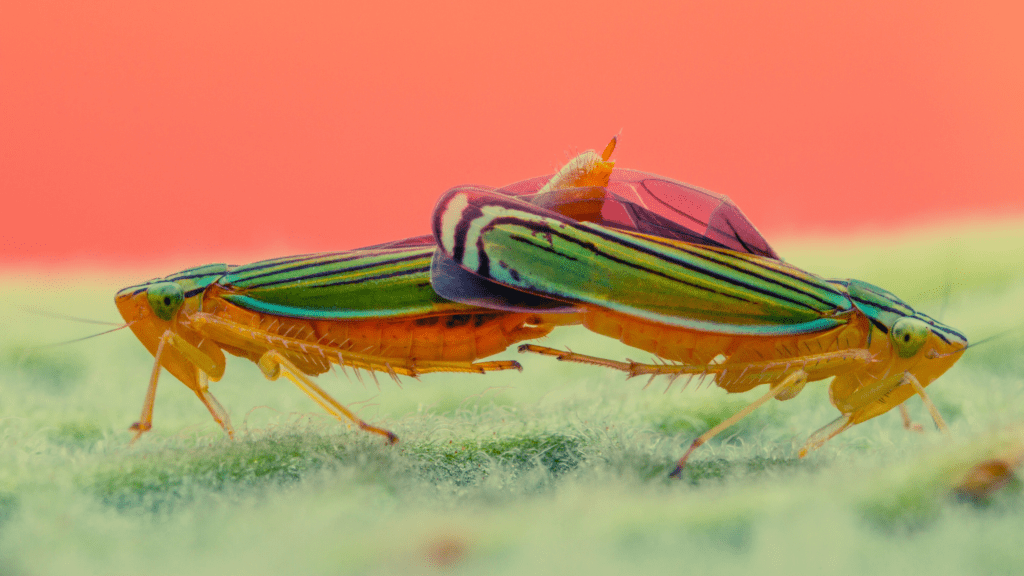
BREAKING: In a groundbreaking development, scientists at Penn State University have successfully replicated the natural ability of leafhoppers to turn ‘invisible.’ This remarkable feat was detailed in a study published in ACS Nano on October 15, 2023, and could revolutionize various industries by reducing glare and enhancing camouflage.
Leafhoppers, common insects often overlooked, utilize an extraordinary method to blend into their surroundings. They coat their bodies with microscopic particles called brochosomes, which can reduce glare significantly, making them nearly undetectable to predators. The Penn State team discovered that these particles can diminish reflected light by an impressive 80 to 96 percent across both visible and ultraviolet spectrums, enhancing the insect’s survival.
Utilizing a novel chemical approach, the researchers constructed a microfluidic system that produces these hollow particles at an astonishing rate of over 100,000 particles per second. This innovative method allows for the creation of particles resembling the natural brochosomes found on leafhoppers, which have a unique structure that scatters light instead of reflecting it directly.
The team’s ability to fine-tune the size and shape of these particles opens the door to numerous applications. From improving energy device efficiency to developing advanced optical materials with better glare control, the potential uses are vast. While military camouflage remains a popular suggestion, the researchers caution that practical applications will require further testing.
In addition to these possibilities, the study hints at biomedical applications, particularly in drug delivery systems, due to the particles’ shape and surface properties. Although this aspect remains in its infancy, the implications for healthcare are significant.
What makes this research even more compelling is the simplicity of its origin. A seemingly ordinary backyard insect has inspired a new avenue in technology, revealing the intricate link between nature and innovation. As scientists continue to explore these findings, the potential for real-world impact becomes increasingly apparent, making this study a pivotal moment in materials science.
WHAT’S NEXT: Researchers will continue to refine their methods and explore the full range of applications for these replicated particles. The ongoing quest to harness nature’s designs could lead to transformative advancements in various fields, making this a story to watch closely.
Stay tuned for updates on this exciting intersection of biology and technology, as the implications of this research unfold.