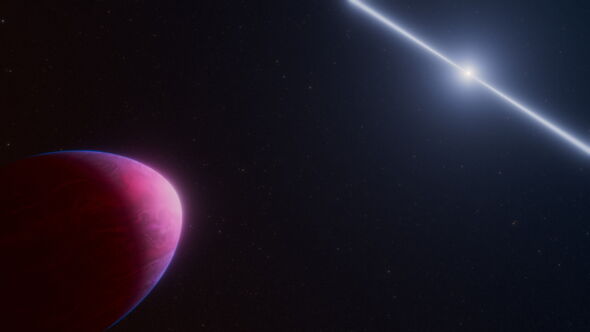
Astronomers using the James Webb Space Telescope (JWST) have made a remarkable discovery of a unique exoplanet, designated PSR J2322-2650b. This newly identified planet exhibits a peculiar lemon-like shape and features an atmosphere unlike anything previously encountered in the study of exoplanets. The characteristics of this planet have left scientists puzzled regarding its formation and composition.
PSR J2322-2650b is comparable in mass to Jupiter and orbits a pulsar, a type of dead star known for its rapid rotation and strong gravitational forces. It is situated approximately 1 million miles from its pulsar parent star, completing an orbit every eight hours. This proximity to the pulsar results in tidal forces that contribute to the planet’s unusual ellipsoid shape.
Surprising Findings from a Unique Atmosphere
The atmosphere of PSR J2322-2650b is primarily composed of helium and carbon, differing significantly from the more familiar molecules found in other exoplanet atmospheres, such as water and methane. The research team, led by Michael Zhang from the University of Chicago, suggests that the planet might have clouds of carbon soot that condense to form diamonds, which could rain down to the surface.
“This is a new type of planetary atmosphere that nobody has ever seen before,” Zhang stated. The presence of molecular carbon, specifically C3 and C2, indicates a drastically different chemical environment than typically expected.
The research team was surprised by the initial data. Peter Gao, a member of the team from the Carnegie Earth and Planets Laboratory, expressed their astonishment: “After we got the data down, our collective reaction was ‘What the heck is this?’ It’s extremely different from what we expected.”
Insights into a ‘Black Widow’ System
The discovery of PSR J2322-2650b adds to the growing body of knowledge about pulsar systems, which often include a small, low-mass companion. Such systems are typically referred to as “black widow” systems, where a rapidly spinning pulsar gradually destroys its companion through intense radiation and high-energy particles.
In this instance, the companion is classified as an exoplanet by the International Astronomical Union rather than a star. This classification raises intriguing questions about the planet’s origin. Zhang remarked, “Did this thing form like a normal planet? No, because the composition is entirely different.”
The unique nature of this system offers scientists an unparalleled opportunity to study exoplanets. Maya Beleznay, a graduate student at Stanford University, noted, “This system is unique because we are able to view the planet illuminated by its host star, but not see the host star at all. So we get a really pristine spectrum, allowing us to study this system in more detail than normal exoplanets.”
As research continues, the scientific community remains eager to unravel the mysteries surrounding PSR J2322-2650b and its extraordinary atmosphere, marking another milestone in the exploration of the cosmos.