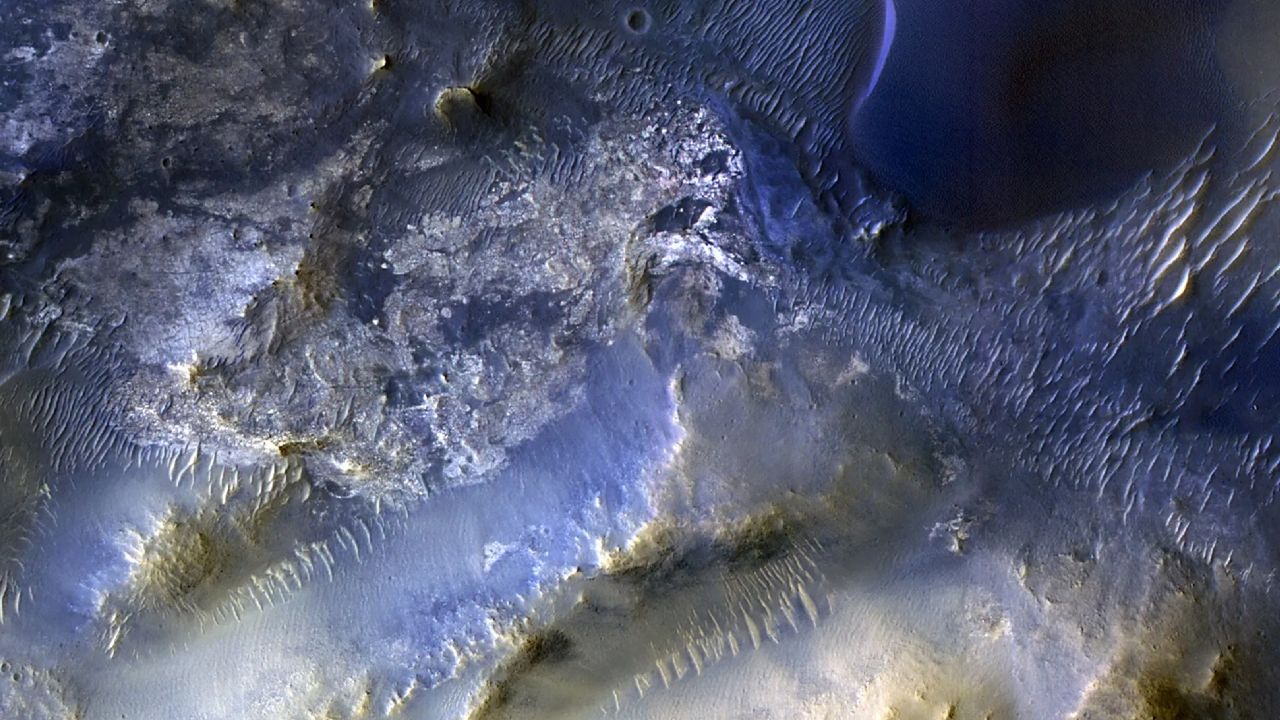
BREAKING: NASA’s Mars Reconnaissance Orbiter (MRO) has just captured its 100,000th photo of the Martian surface, marking a significant milestone in space exploration. This remarkable achievement, celebrated on October 7, 2023, highlights the orbiter’s crucial role in unveiling the mysteries of the Red Planet.
The latest image depicts the shadowy terrain of Syrtis Major, a striking expanse of mesas, craters, and dunes located southeast of the Jezero Crater, where NASA’s Perseverance rover is actively searching for signs of ancient life. This dark region is a prominent feature visible from Earth, earning its place as a focal point in Martian studies.
Since its launch on August 12, 2005, and subsequent entry into Mars orbit on March 10, 2006, the MRO has consistently delivered groundbreaking data, averaging 5,000 photos per year—approximately 14 photos every day. These insights are revolutionizing our understanding of Mars and its environmental dynamics.
“HiRISE hasn’t just discovered how different the Martian surface is from Earth; it’s also shown us how that surface changes over time,” stated Leslie Tamppari, MRO’s deputy project scientist at NASA’s Jet Propulsion Laboratory. This ongoing observation enables scientists to witness phenomena such as migrating sand dunes and avalanches, crucial for understanding Mars’ geological history and potential habitability.
The significance of studying these changes cannot be overstated. Insights gained from this data may help clarify whether Mars was once a lush waterworld, akin to Earth.
In addition to its primary mission, the MRO occasionally captures remarkable celestial events. Earlier this month, the orbiter photographed the interstellar comet 3I/ATLAS, which passed approximately 19 million miles (30 million kilometers) from the spacecraft. This observation provided early confirmation of the comet’s natural characteristics, including its bright coma of gas and dust.
As the MRO approaches its 20th anniversary in 2026, scientists anticipate that it will continue to offer invaluable data and imagery from the Martian surface for as long as its systems remain operational.
Stay tuned for more updates as NASA continues to push the boundaries of space exploration and maintain a steady stream of captivating discoveries from the Red Planet!