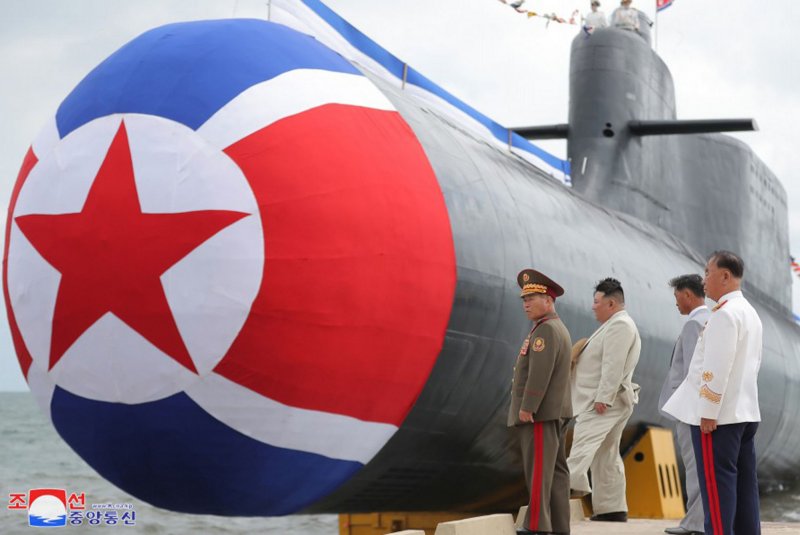
UPDATE: North Korea has just unveiled a groundbreaking development in its military capabilities, showcasing an 8,700-ton nuclear-powered strategic guided missile submarine. This announcement, made on December 25, 2023, marks a significant escalation in the country’s war deterrence strategy, according to state-run media Rodong Sinmun.
The submarine’s construction site was highlighted as a “revolutionary change,” indicating that its exterior is nearing completion. Analysts suggest it may already be equipped with a small reactor, crucial for operational readiness. The conning tower appears to feature potential launch tubes for submarine-launched ballistic missiles (SLBMs), reminiscent of North Korea’s existing 3,000-ton Kim Gun Ok submarine.
During the site visit, North Korean leader Kim Jong-un declared that the nation has developed a “nuclear shield” to fortify national security, asserting the capability to expand its nuclear arsenal as deemed necessary. He emphasized that there will be no shift in North Korea’s security policy and issued a stark warning: any threat to the country’s strategic sovereignty would result in serious repercussions.
This development raises critical questions about North Korea’s ability to operate such a large nuclear submarine. Experts are skeptical about the nation’s mastery of small reactor technology and large-scale submarine construction, even as it continues to enrich uranium. Some analysts speculate that closer ties with Russia since the onset of the Ukraine conflict could provide North Korea with essential technological support.
The timing of this public rollout coincides with a growing debate in South Korea over the potential development of its own nuclear-powered submarines. Analysts interpret North Korea’s announcement as a clear demonstration of force aimed at its southern neighbor, particularly in light of South Korea’s discussions regarding its military capabilities.
According to Cho Han-beom, a senior research fellow at the Korea Institute for National Unification, the visible SLBM tubes on the conning tower suggest that North Korea’s technology remains constrained. He posits that this announcement may have been strategically timed to counter South Korea’s nuclear ambitions.
In a related note, Yoo Yong-won, a lawmaker from the People Power Party, remarked that the altered conning tower appears designed to hold up to 10 SLBMs and bears resemblance to the criticized design of the Kim Gun Ok submarine.
Adding to the context, Rodong Sinmun reported on a congratulatory message sent by Russian President Vladimir Putin to Kim Jong-un on December 18, praising the North Korean military’s “heroic participation” and underscoring the deepening ties between North Korea and Russia across various sectors.
This urgent development underscores the shifting dynamics in the region and highlights North Korea’s determination to enhance its military stature. As the situation evolves, global observers will closely monitor the implications of this submarine unveiling on regional security and international relations.
Stay tuned for further updates as this story develops.