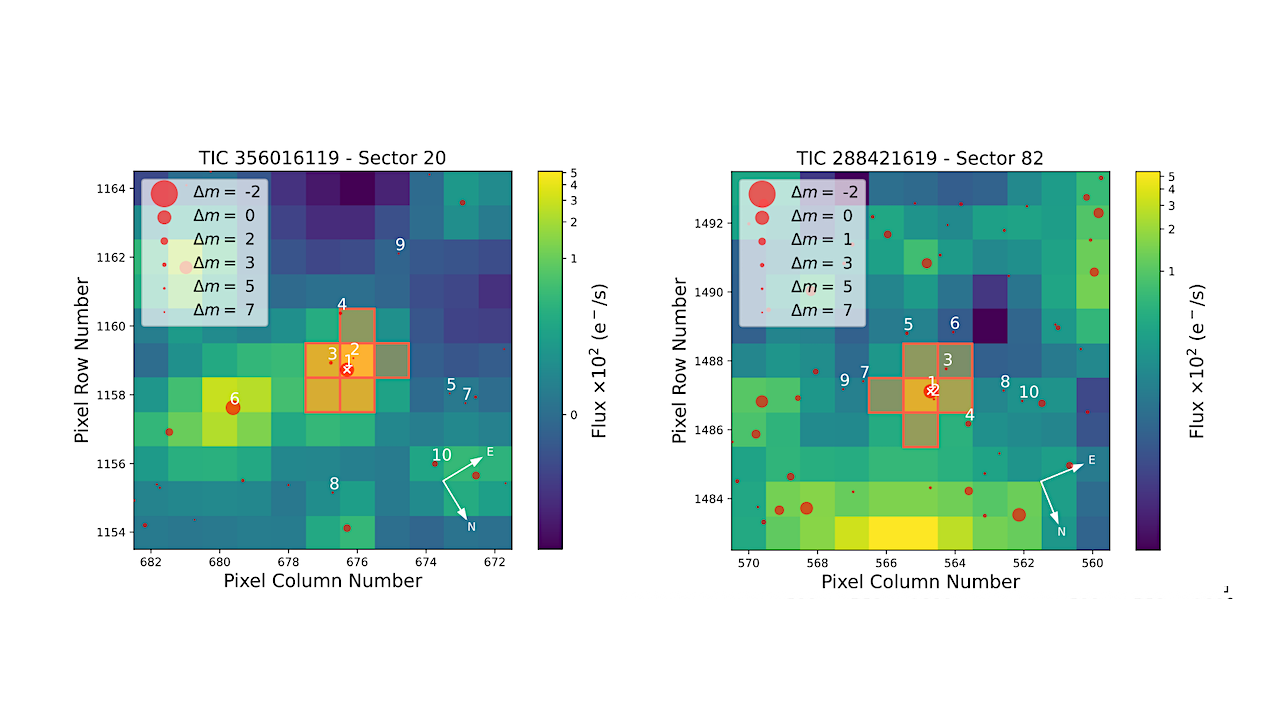
Scientists have confirmed the existence of two mini-Neptunes located within the habitable zones of their host stars. This significant finding, published by a team led by Chengzi Jiang, utilizes multicolour validation through photometric transit observations, providing a promising method to prioritize targets for further investigation. The two planets, designated as TOI-2094 b and TOI-7166 b, are now recognized as valuable candidates for atmospheric characterization.
The study, which combines data from the Transiting Exoplanet Survey Satellite (TESS) and ground-based observations, including measurements from the 10.4-meter Gran Telescopio Canarias (GTC), focused on accurate determination of transit and physical parameters. By employing Bayesian model comparison, the researchers were able to assess the light curves, revealing crucial wavelength-dependent transit depth variations that effectively ruled out potential false positives.
Key Findings on Planet Characteristics
TOI-2094 b, measuring approximately 1.90 R ⊕, orbits its M3V star with a period of about 18.79 days, comfortably situated within the habitable zone with an insolation close to 0.98 times that of Earth. In contrast, TOI-7166 b, larger at approximately 2.39 R ⊕, orbits its M4.5V host star every 12.92 days, placing it near the inner edge of the habitable zone with an insolation of approximately 1.93 times that of Earth.
Statistical estimates suggest that TOI-2094 b may possess a significant amount of volatile compounds, potentially categorizing it as a water-rich or gaseous planet rather than a rocky one. Meanwhile, TOI-7166 b is also likely to be volatile-rich, enhancing its profile for future atmospheric studies.
Both planets present compelling opportunities for detailed atmospheric characterization, particularly with upcoming missions such as the James Webb Space Telescope (JWST) and future Extremely Large Telescopes (ELTs). The next steps will involve precise mass measurements to further explore their compositions and atmospheres.
This research not only contributes to our understanding of exoplanets but also enhances the catalog of habitable-zone candidates, paving the way for future explorations in the search for extraterrestrial life. The findings were detailed in a report available on arXiv, highlighting the ongoing efforts in astrobiology and planetary science.
For more in-depth insights and access to the study, visit the arXiv link: https://doi.org/10.48550/arXiv.2512.06817.