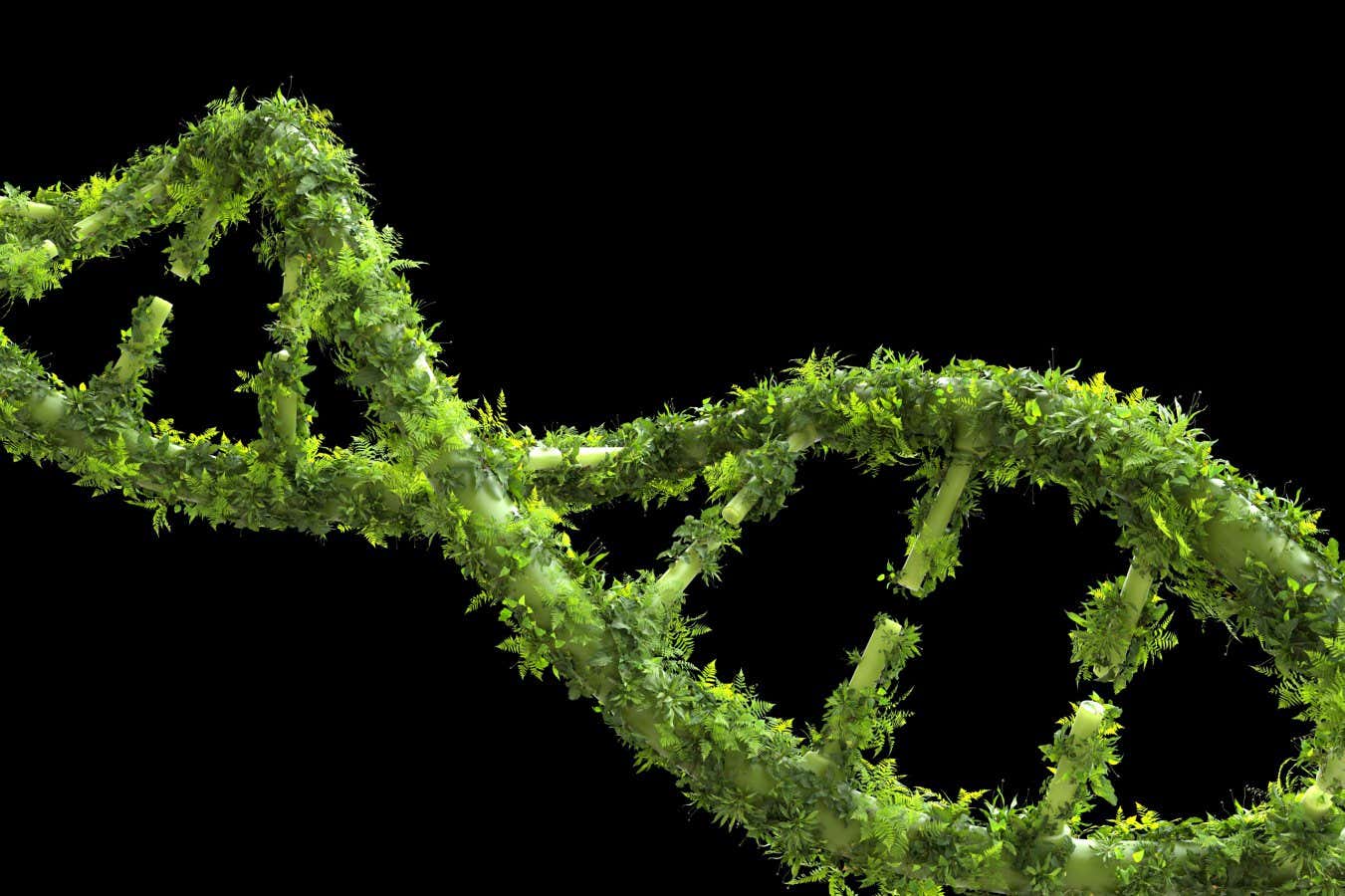
Recent research involving hybrid cells that combine human and plant DNA has provided significant insights into the nature of human genetic material, specifically the debate surrounding non-coding DNA, often termed “junk.” Scientists from the University of Auckland have revealed that a substantial amount of genomic activity may not serve any functional purpose, suggesting that much of the human genome is indeed non-essential.
In a groundbreaking study, researchers created human cells containing 35 million base pairs of DNA from the plant Arabidopsis thaliana. This innovative approach allowed them to examine the activity of plant DNA within human cells. The findings indicated that the plant DNA exhibited a level of activity comparable to that of human DNA, leading to the conclusion that a significant portion of genomic activity could be mere “noise.”
The study challenges the prevailing notion that all active DNA must have a function. As Brett Adey, a researcher at the University of Auckland, stated, “A large amount can simply be explained by background noise.” This perspective aligns with the long-standing hypothesis that much of human DNA does not contribute to biological processes.
Examining the Role of Non-Coding DNA
Historically, it was believed that the primary function of DNA was to code for proteins, the essential molecules that facilitate cellular functions. However, current understanding shows that only about 1.2 percent of the human genome is responsible for protein coding. This raises important questions about the role of the remaining DNA, with many biologists suggesting that it is largely non-functional.
Research dating back to the 1960s has posited that most of this non-coding DNA is “junk.” While some segments are known to have vital functions, the majority are thought to lack any significant purpose. A notable study from 2011 found that only around 5 percent of the genome is conserved across evolutionary time, implying that the rest may not be critical for survival.
Conversely, a project known as ENCODE claimed in 2012 that over 80 percent of the human genome is active, suggesting that non-coding regions could play roles yet to be understood. This led to the concept of “dark DNA,” which refers to these non-coding sections that may hold undiscovered functions.
In response, Sean Eddy from Harvard University proposed the “random genome project,” suggesting that inserting synthetic random DNA into human cells could reveal whether observed genomic activity is genuinely indicative of function.
Insights from Hybrid Cells
The recent study by Adey and his team utilized hybrid cells as a large-scale random genome project. They confirmed that the plant DNA was effectively random, given the evolutionary divergence of plants and animals over the last 1.6 billion years. This randomness allowed researchers to assess the activity of non-coding DNA segments in a controlled environment.
After initial validation, the researchers quantified the number of starting points for RNA synthesis per 1000 base pairs of non-coding plant DNA. The results indicated that the activity level of the plant DNA was approximately 80 percent that of human non-coding DNA. This finding strongly suggests that much of the activity presented in previous studies, such as ENCODE, could indeed consist of background noise rather than functional genomic elements.
Chris Ponting from the University of Edinburgh commented on the significance of these findings, stating, “This is an excellent demonstration of how biology is, indeed, noisy.” Dan Graur from the University of Houston echoed this sentiment, emphasizing that the study provides further evidence supporting the notion that most of the human genome may be non-functional.
The research team recognizes that the additional activity observed in human DNA, which was about 25 percent higher than that of plant DNA, warrants further investigation. While some of this extra RNA may hold functional significance, many potential explanations remain. The researchers are now employing machine learning techniques to differentiate potentially meaningful genomic activity from background noise.
As the implications of this research unfold, the team plans to publish their findings in a peer-reviewed journal, contributing to the ongoing discourse on the complexities of human genetics and the role of non-coding DNA. This study not only challenges existing paradigms but also opens avenues for future exploration in the field of genomics.