UPDATE: A groundbreaking study just released on January 3, 2026, reveals that the ancient fossil Sahelanthropus tchadensis could walk upright, potentially rewriting our understanding of human origins. This urgent discovery, led by researchers at New York University, provides compelling evidence that this seven-million-year-old species was bipedal, marking a significant milestone in the study of human evolution.
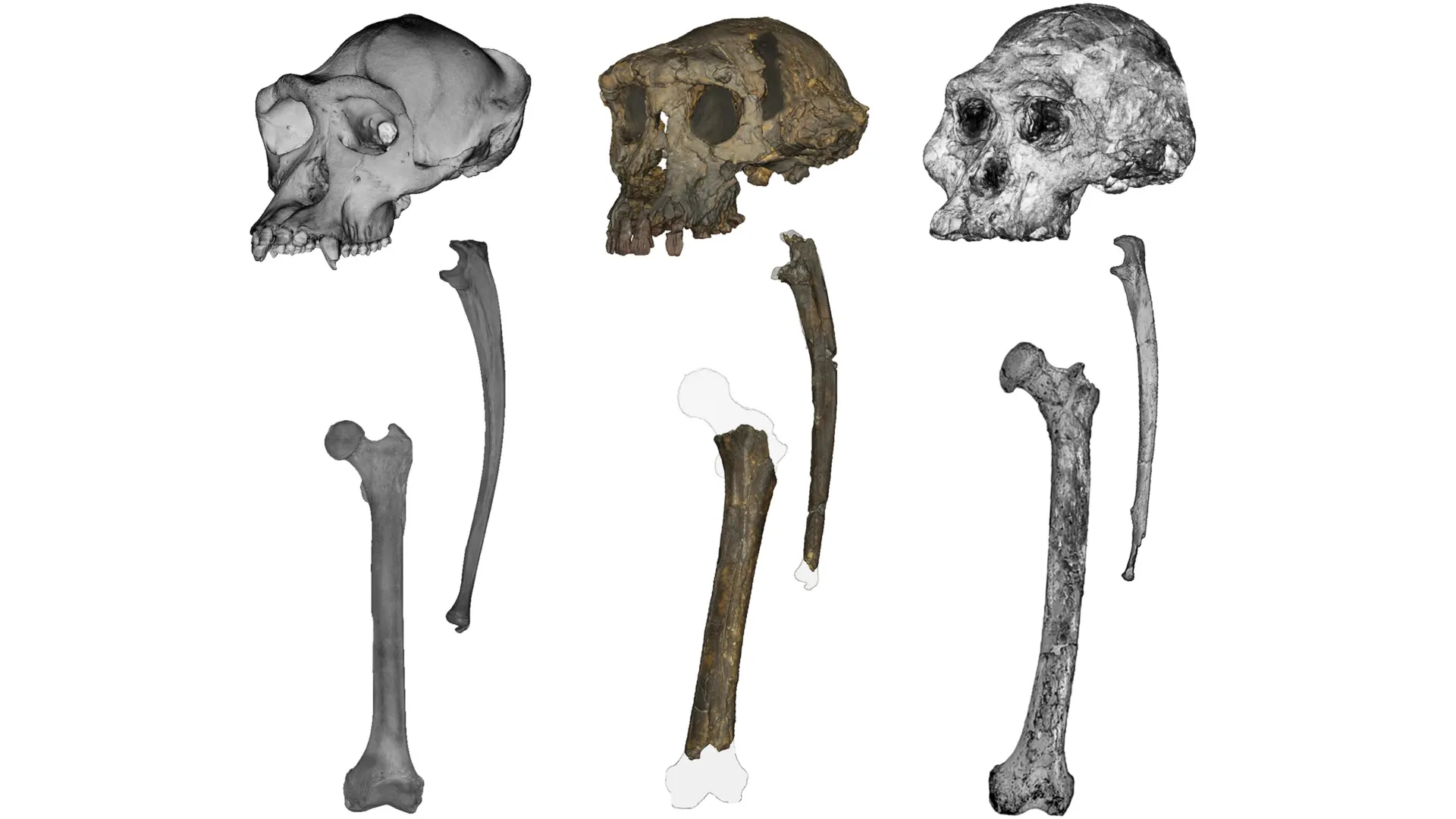
Researchers utilized advanced 3D imaging and analytical techniques to identify a key skeletal feature—a femoral tubercle—unique to bipedal human ancestors. This small but crucial structure is the attachment point for the iliofemoral ligament, the strongest ligament in the human body, essential for upright walking. The findings suggest that Sahelanthropus, although it had an ape-like appearance and a chimpanzee-sized brain, was adapted for movement on two legs.
The team, collaborating with scientists from the University of Washington, Chaffey College, and the University of Chicago, confirmed that this adaptation places bipedalism near the very root of the human family tree. “Sahelanthropus tchadensis was essentially a bipedal ape that likely spent significant time in trees,” stated Scott Williams, lead author and associate professor at NYU.
Previously, the debate surrounding Sahelanthropus focused on its skull, which offered limited insight into its locomotion. However, recent analyses of additional bones, including ulnae and femur, reignited discussions about its capability for upright walking and its classification as a human ancestor.
In the latest study published in Science Advances, the researchers compared the fossils to both living species and other fossil specimens, including the well-known Australopithecus, which lived between four and two million years ago. The analysis revealed three distinct anatomical features in Sahelanthropus supporting bipedalism, including femoral antetorsion and a developed gluteal complex.
Furthermore, the limb proportions of Sahelanthropus indicate a long femur compared to its ulna, which diverges from typical ape characteristics. While Sahelanthropus had shorter legs than modern humans, the limb proportions closely resembled those of Australopithecus, suggesting a pivotal evolutionary step toward upright walking.
“Our analysis provides direct evidence that Sahelanthropus tchadensis could walk on two legs, indicating that bipedalism evolved early in our lineage,” Williams concluded, emphasizing the significance of this finding on our understanding of human evolution.
This study was supported by funding from the National Science Foundation. As the implications of these findings continue to unfold, researchers are poised to explore further the evolutionary timeline of human ancestors.
Stay tuned for more updates as scientists delve deeper into the mysteries of human origins, shedding light on the capabilities of our ancient relatives.