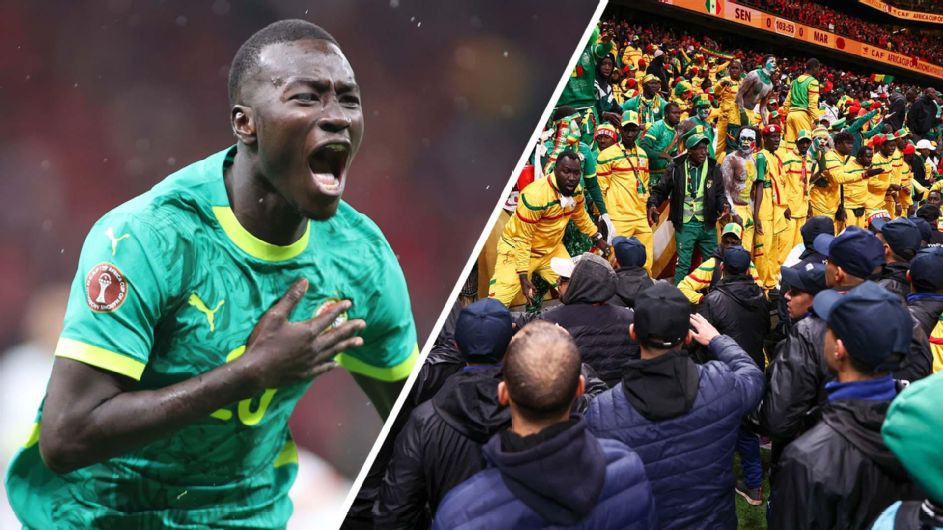
The final of the 2025 Africa Cup of Nations (AFCON) culminated in chaos, with Senegal defeating Morocco 1-0 in a match marred by controversy. This final, held at the Prince Moulay Abdellah Stadium in Rabat, featured a dramatic series of events that overshadowed Senegal’s historic victory, marking their second AFCON title in three tournaments.
Senegal’s Pape Gueye scored the winning goal in extra time, but the match was defined by a series of contentious refereeing decisions. The final moments of the game were filled with tension, as Morocco had a chance to win in stoppage time but missed a crucial penalty. The atmosphere turned electric as emotions ran high, resulting in confrontations between players and fans.
The match began with Senegal experiencing a potential breakthrough in stoppage time when Ismaïla Sarr headed the ball into the net, only to have the goal disallowed by referee Jean-Jacques Ndala due to a foul in the build-up. This decision sparked outrage among Senegalese players and supporters, who felt aggrieved by the officiating.
Morocco responded with their own moment of drama when Brahim Díaz won a penalty after a challenge in the box. The incident led to chaotic scenes as Díaz passionately argued for the decision, rallying his teammates and the home crowd. Ndala eventually decided to consult the VAR, awarding the penalty that could have secured Morocco’s long-awaited title, ending a 50-year drought.
Tensions escalated as Senegal’s players, frustrated by the officiating, began to depart the pitch in protest. Sadio Mané, a key figure for Senegal, attempted to mediate and convince his teammates to return. The situation was precarious, leaving the match hanging in the balance as both sides confronted each other on the field.
After several minutes of uncertainty, the players returned, but the delay had impacted Morocco’s Díaz, who appeared visibly affected as he prepared to take the penalty kick. In a moment of high pressure, he missed the spot-kick, opting for a panenka that was easily saved by Senegal’s goalkeeper Édouard Mendy.
This pivotal moment left fans and analysts questioning the psychological implications of the chaotic environment. Some speculated whether Díaz’s decision to attempt a panenka was a calculated risk or a reflection of his mental state after the tumultuous events leading up to the penalty.
Senegal ultimately sealed their victory with Gueye’s goal in extra time, but the post-match narrative focused heavily on the controversies that unfolded. Critics described the final as a spectacle of poor sportsmanship and questionable officiating, with both teams accused of unsporting behavior.
Morocco’s head coach Walid Regragui expressed disappointment in the match’s conduct, stating, “What we experienced was shameful for Africa.” His counterpart, Senegal’s coach Pape Thiaw, faced scrutiny for his tactical decisions during the match, particularly for instructing his players to leave the pitch in protest.
The fallout from this AFCON final raises questions about the future of the tournament and its integrity. The chaos seen in Rabat may leave a lasting impact on the perceptions of African football and its governing bodies. As both teams reflect on this tumultuous encounter, the focus now shifts to how such incidents can be prevented in future competitions to preserve the spirit of the game.
With Senegal crowned champions, the memories of this chaotic final will undoubtedly shape the narrative of AFCON and its place in the global football landscape for years to come.