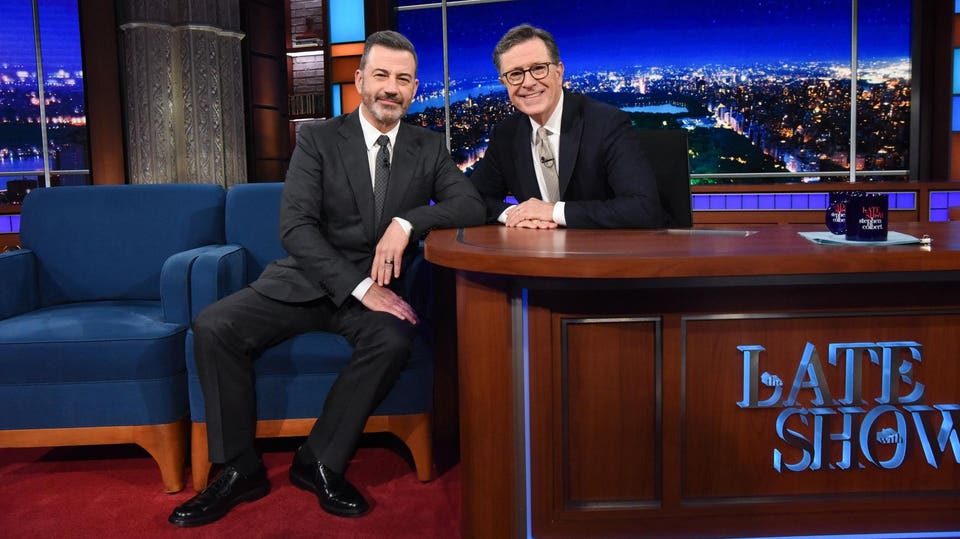
URGENT UPDATE: Late-night hosts Jimmy Kimmel and Stephen Colbert have reacted fiercely to the Federal Communications Commission’s (FCC) newly enforced “equal time” mandate, which requires networks to offer equal airtime to political candidates. This controversial move, announced on July 27, 2023, has been labeled a “crackdown” aimed at silencing late-night shows.
During his monologue on Thursday night, Kimmel accused the FCC of “reinterpreting long-agreed-upon rules to stifle us,” referring specifically to FCC Chair Brendan Carr. He emphasized that this policy, initially designed for an era dominated by radio, is now outdated and irrelevant in today’s shifting media landscape.
Kimmel pointed out that the “equal time” exemption for talk shows has been in place since 2006, when former California Governor Arnold Schwarzenegger appeared on “The Tonight Show.” He declared, “Carr is doing everything he can to shut us up the easy way or the hard way,” decrying the FCC’s actions as a “sneaky little way of keeping viewpoints that aren’t his off the air.”
The ABC host stressed the declining viewership of broadcast TV, stating, “Broadcast TV used to account for 100% of viewing…now it’s like 20%.” He criticized networks like Fox News, Newsmax, and One America News Network for their continuous Trump-centric content, suggesting that the FCC’s move is part of a broader attempt to suppress dissenting voices.
Colbert also weighed in during his show, humorously remarking, “I got to watch what I say about Trump, because Johnny Law is once again coming after your’s truly here.” His comments came shortly after he read a headline from the New York Times describing the FCC’s action as a “new crackdown on late-night TV.”
“This is clearly an attempt to silence me, Jimmy, and Seth,” Colbert added, referencing fellow late-night host Seth Meyers. He jokingly addressed the FCC directly, saying, “Hey, I’m flattered you think that appearing on my show has the power to affect politics in any way.”
As this situation evolves, the implications for late-night television and political discourse remain uncertain. Kimmel’s and Colbert’s responses highlight a growing concern among media figures about government interference in entertainment and news.
As the FCC continues to enforce these regulations, viewers can expect to see how late-night programming will adapt or resist these new rules. The ongoing dialogue surrounding media freedom and political expression is more urgent than ever.