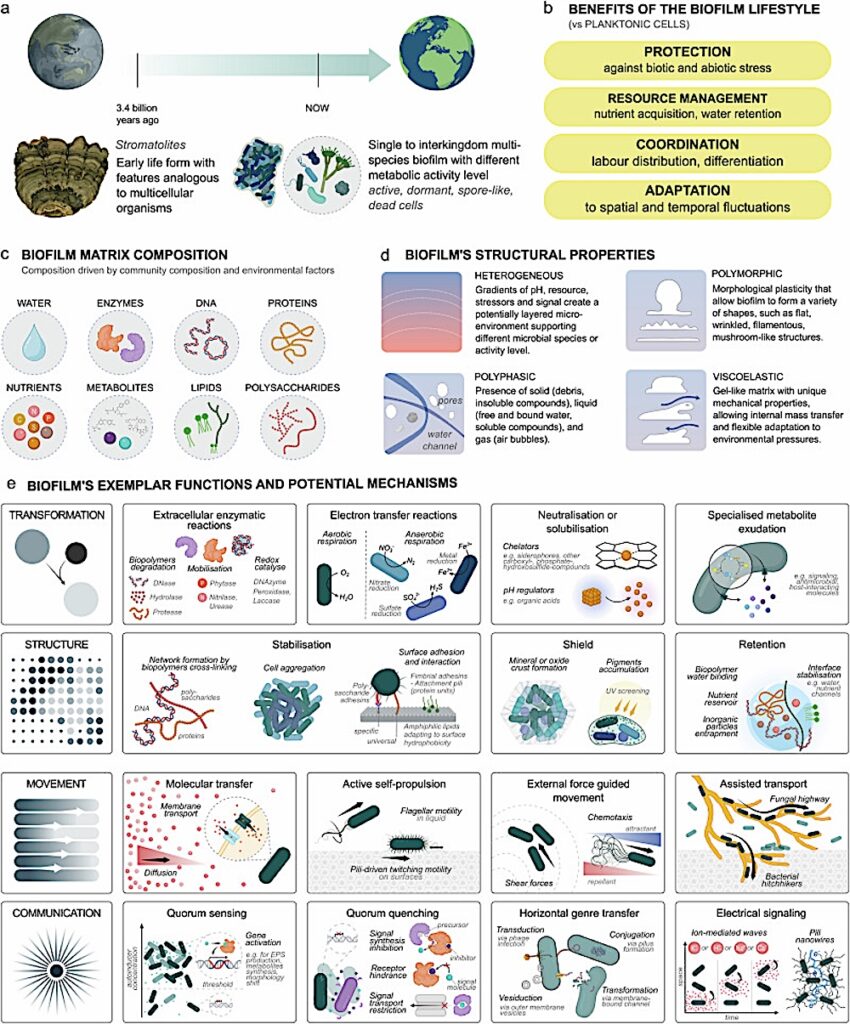
Biofilms, complex communities of microorganisms, play crucial roles in the health of both humans and plants. Recent research has highlighted how these biological structures could be impacted by the unique stresses of spaceflight. Although biofilms have been viewed primarily as potential risks for infrastructure and infection in space, their beneficial functions must not be overlooked. This review examines the adaptability of biofilms to space environments and their significance as life-support systems.
Biofilms and the Emergence of Life
The origins of life on Earth are believed to have involved a gradual transition from simple organic molecules to complex biotic systems. This process likely occurred within surface-attached compartments where local chemical exchanges and physical scaffolding fostered the emergence of early microbial life. Environments rich in minerals, such as hydrothermal vents and hot springs, provided essential catalytic surfaces and energy sources, enabling the formation of organic compounds through non-enzymatic synthesis pathways.
These environments may have facilitated the aggregation of simple organic molecules. Through adsorptive forces and repeated hydration-evaporation cycles, these molecules likely condensed into structured assemblies, laying the groundwork for biofilms. Such assemblies, devoid of membranes but rich in essential building blocks—amino acids, fatty acids, peptides, and monosaccharides—formed interconnected clusters. This spatial proximity allowed for enhanced molecular exchange and initial forms of metabolic cycling.
The internal complexity of these early biofilm-like structures supported rudimentary functions and interactions that would foster the evolution of more complex life forms. Ancestral biofilms, embedded within protocell networks, were pivotal in promoting cooperative and competitive behaviors, allowing these communities to thrive in extreme environments.
Modern Biofilms: Functions and Adaptability
Current biofilms exhibit fundamental functions that contribute significantly to ecological balance. They provide protection against environmental stressors, improve resource management, and facilitate enhanced coordination and adaptability in response to changing conditions. According to a study published in Nature Partner Journals (NPJ) Biofilms Microbiomes, the composition of modern extracellular polymeric substances (EPS) within biofilms varies widely, comprising up to 97% water alongside polysaccharides, proteins, extracellular DNA, lipids, and other metabolites.
The structure of biofilms is influenced by environmental gradients, resulting in varying solid, liquid, and gas phases. These versatile morphologies enable biofilms to maintain structural integrity while adapting to different conditions. The research highlights how crucial these features are not only for survival but also for the emergence of higher-order behaviors among microbial communities.
As scientists continue to explore the adaptability of biofilms to space conditions, their potential as life-support systems in extraterrestrial environments becomes increasingly relevant. Understanding the resilience and functionality of biofilms could inform future missions aimed at sustaining human life beyond Earth.
In summary, biofilms are not only essential to life on our planet but also hold promise for supporting future human endeavors in space. Their complex interactions and adaptability underscore the importance of continued research in this fascinating area of study, bridging the origins of life with the possibilities of life beyond Earth.