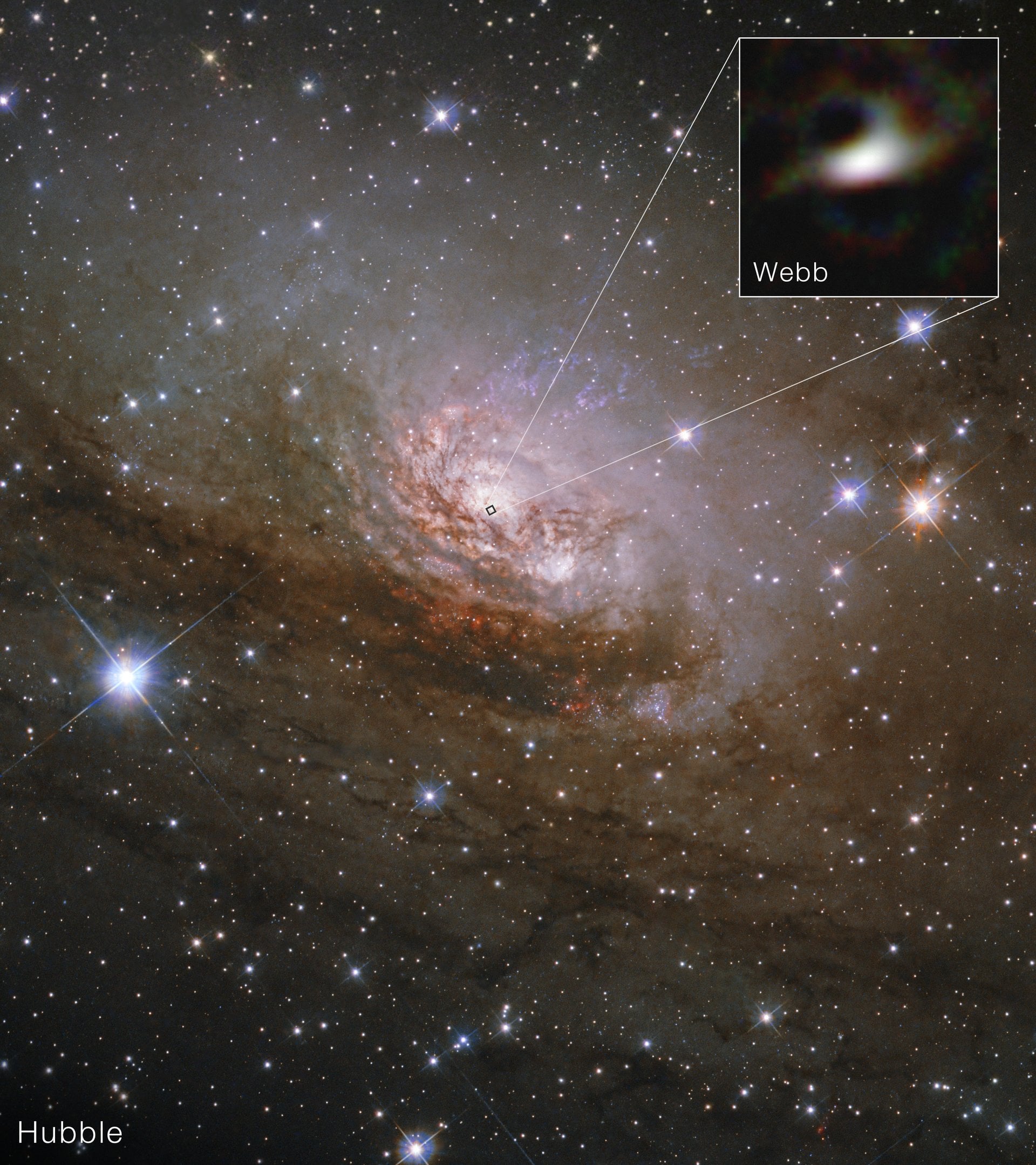
New observations from the NASA/ESA/CSA James Webb Space Telescope (JWST) have provided unprecedented insights into the Circinus Galaxy, located approximately 13 million light-years from Earth. Researchers have successfully peered into the galaxy’s core, revealing significant details about its supermassive black hole (SMBH) and challenging longstanding theories regarding the sources of infrared emissions from this region.
For years, astronomers have understood that SMBHs, which are found at the centers of many galaxies, play a vital role in their evolution. These black holes are thought to power Active Galactic Nuclei (AGNs), which can emit enough radiation to temporarily outshine all the stars within a galaxy. Additionally, they are associated with phenomena such as relativistic jets and outflows that can suppress star formation. However, direct observations of these processes have remained elusive.
The groundbreaking observations from Webb have led to a surprising conclusion: rather than the previously believed primary source of infrared light being superheated outflows, most of the material observed is actually feeding the black hole itself. This revelation could have profound implications for our understanding of galaxy formation and behavior.
Advanced Techniques Illuminate Cosmic Mysteries
The challenges in studying AGNs arise from their intense brightness and the dense material surrounding them, which often obscures critical details. In the case of the Circinus Galaxy, the bright starlight further complicates observations. For decades, scientists have worked to refine models to better understand these regions, but many features remained unresolved.
According to Enrique Lopez-Rodriguez, a lead author from the University of South Carolina, previous models suggested that most of the infrared emissions could be traced to outflows. To validate this theory, astronomers required instruments capable of filtering out obscuring starlight. The JWST’s Aperture Masking Interferometer on its Near-Infrared Imager and Slitless Spectrograph (NIRISS) was instrumental in this effort.
Using a specialized aperture with seven hexagonal holes, the NIRISS instrument could combine light from multiple sources to create interference patterns. This innovative approach allowed researchers to reconstruct the size and shape of features within the Circinus Galaxy’s core with exceptional clarity. The resulting images represent the first extragalactic observations from a space-based infrared interferometer, marking a significant milestone in astronomical research.
Co-author Joel Sanchez-Bermudez from the National University of Mexico noted that the observations revealed a stark contrast to previous predictions. The research indicated that approximately 87% of the infrared emissions from hot dust originate from regions closest to the SMBH, with less than 1% traced to hot dusty outflows. The remaining 12% comes from dust located further away, which had previously been indistinguishable.
Implications for Future Research
The findings from this study not only enhance understanding of the Circinus Galaxy but also open new avenues for research into other black holes. The techniques employed in this investigation could be applied to analyze both outflow and accretion components in nearby black holes, potentially leading to a comprehensive catalog of emission data.
Adding to the excitement, Julien Girard, a senior research scientist at the Space Telescope Science Institute (STScI), emphasized the significance of using Webb in high-contrast mode for extragalactic studies. He expressed hope that their work would inspire other astronomers to utilize the Aperture Masking Interferometer to explore faint, yet intriguing, dusty structures around bright cosmic objects.
The research team’s findings were published on January 13 in Nature Communications, contributing valuable data to the ongoing quest to understand the complex interplay between black holes and their host galaxies. As scientists continue to investigate, the Circinus Galaxy may prove to be a crucial case study in revealing the mysteries of the universe.