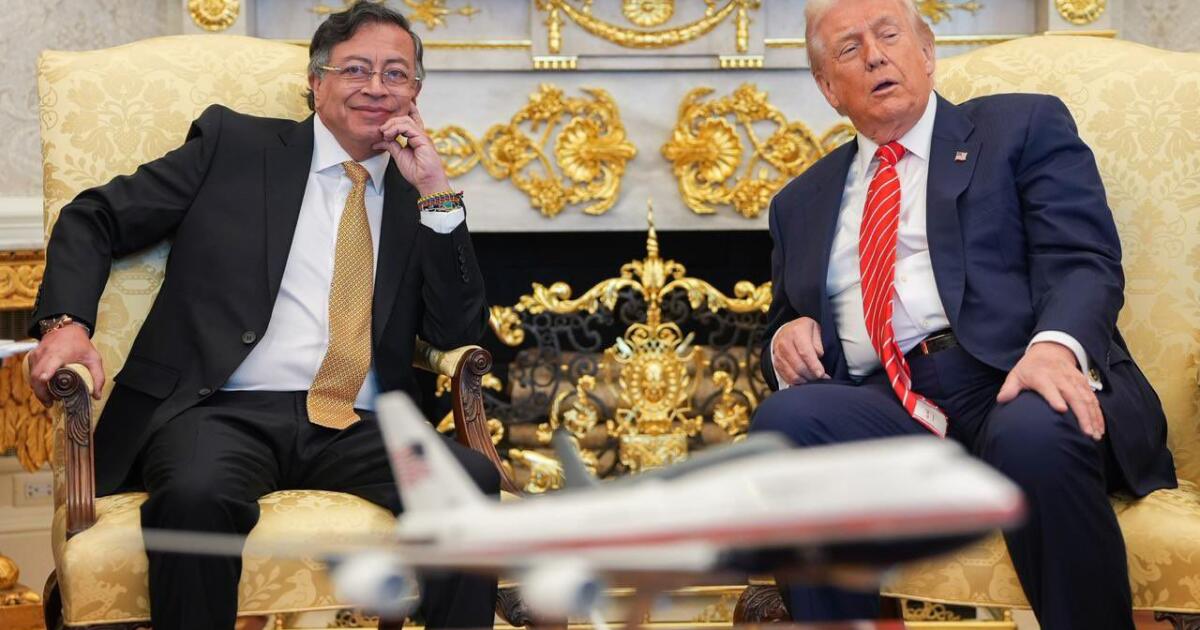
Tensions between Colombian President Gustavo Petro and U.S. President Donald Trump have notably eased following a productive meeting at the White House. This two-hour conversation on January 7, 2024, addressed crucial topics such as energy, bilateral drug trafficking efforts, and the situation in Venezuela. Both leaders emerged from the discussion expressing optimism about their nations’ future collaboration.
During the meeting, Trump described the interaction as “fantastic,” while Petro characterized it as “very positive,” emphasizing its “optimistic and constructive tone.” As a gesture of goodwill, Petro presented Trump with Colombian coffee and a gown crafted by indigenous artisans for First Lady Melania Trump. In return, Trump gifted Petro a framed portrait of the two shaking hands, inscribed with the words: “I love Colombia.”
Despite this thawing of relations, significant political differences remain. Trump advocates for U.S. dominance in the Western Hemisphere, while Petro, a former left-wing guerrilla, opposes U.S. military actions in the region, particularly the recent operation that led to the capture of Venezuelan President Nicolás Maduro. Tensions between the two leaders escalated after Trump’s return to the White House for a second term, particularly over Petro’s rejection of U.S. military flights transporting deported migrants.
“Come get me. I’m waiting for you here,” Petro challenged Trump, after the U.S. military operation in Caracas.
Relations further deteriorated in the wake of Petro’s speech at the United Nations General Assembly, where he criticized U.S. support for Israel and called upon American soldiers to disobey orders from Trump. In response, the U.S. State Department revoked visas for Petro and several family members, leading to heightened diplomatic strains.
As the political climate worsened, Trump accused Petro of failing to curb cocaine production, even labeling him a drug trafficker. Following this, Washington suspended Colombia’s certification for adequate anti-drug efforts, halting assistance that had exceeded $740 million in 2023. In retaliation, Colombia recalled its ambassador to the United States.
The recent military actions against Maduro and Trump’s comments about potential military operations in Colombia added fuel to the fire. However, after a phone call on January 7, the leaders agreed to meet, marking a pivotal moment in their fraught relationship.
Colombian officials noted that Petro planned to focus on his administration’s record in combating drug trafficking, despite an increase in cocaine production. Andrés Idárraga Franco, Acting Minister of Justice, highlighted that Petro’s government has extradited more criminals to the U.S. than any of his conservative predecessors, including an alleged trafficker extradited just last week.
Typically, journalists are permitted to ask questions ahead of meetings in the Oval Office. However, this was not the case during the January 7 meeting. Trump acknowledged their rocky past, stating, “You know, he and I weren’t exactly the best of friends. But I wasn’t insulted because I’d never met him. I didn’t know him at all. And we got along very well.”
After the meeting, Petro addressed journalists at the Colombian Embassy in Washington, discussing topics such as climate change and the U.S. operation in Venezuela. He also criticized what he termed the “genocide” in Gaza. As a memento of their meeting, Trump presented Petro with one of his signature red baseball caps, which Petro humorously altered to read, “Make Americas Great Again.”
The recent dialogue between the two leaders appears to signal a potential shift in U.S.-Colombian relations, which have been characterized by turbulence over the past year. As both leaders navigate their complex political landscapes, the outcome of this newfound cooperation remains to be seen.