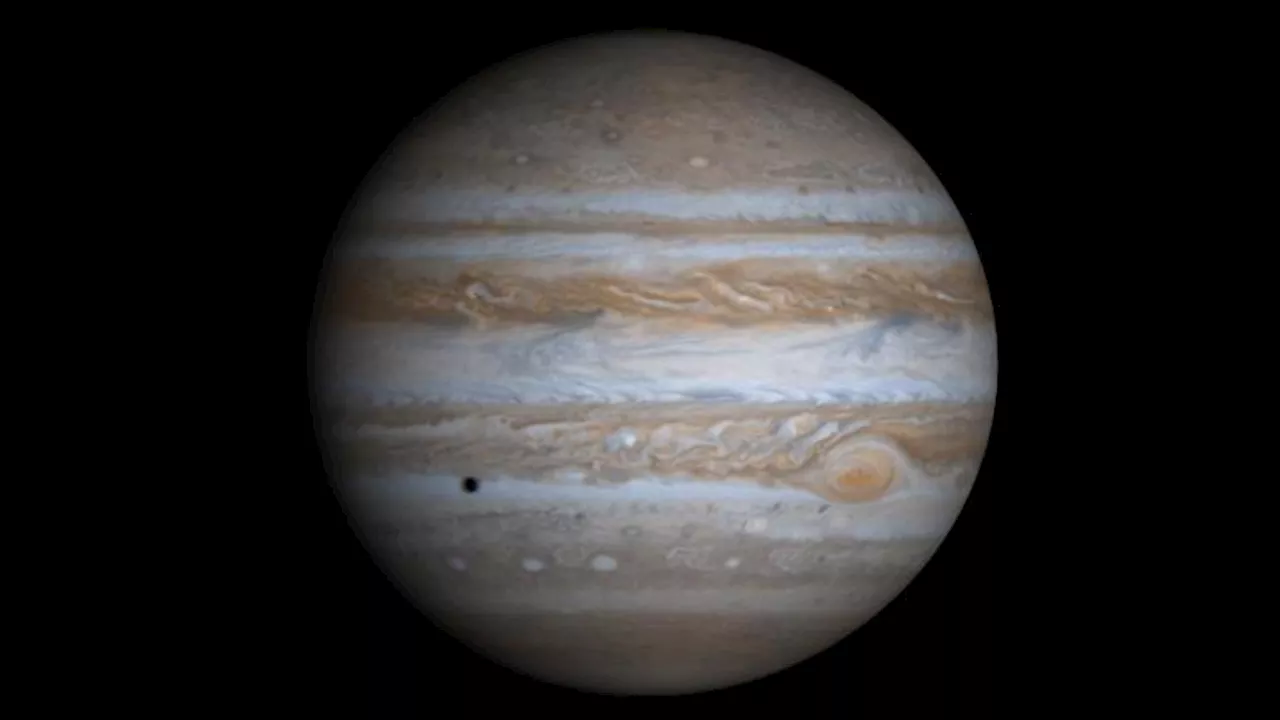
New findings from NASA’s Juno mission indicate that Jupiter, the largest planet in our solar system, is smaller and flatter than previously estimated. The latest data suggests that Jupiter’s equatorial radius is approximately 5 miles less than earlier calculations, while its polar diameter is about 15 miles shorter. This significant adjustment in measurements offers a clearer picture of the gas giant’s shape and size.
Using a technique known as radio occultation, Juno has provided unprecedented insights into Jupiter’s structure. By sending radio waves back to Earth while passing behind the planet, the spacecraft measured how these signals changed as they navigated through Jupiter’s dense atmosphere. The bending and slowing of the signals revealed critical information about the temperature, pressure, and atmospheric dynamics. This technique allowed scientists to refine their understanding of Jupiter’s dimensions, confirming that the planet is more noticeably flattened at the poles than previously thought.
The updated measurements highlight the impact of Jupiter’s rapid rotation, which completes a full turn in less than 10 hours. This swift rotation contributes to the planet’s oblate shape, causing it to be wider at the equator and flatter at the poles. According to NASA, accurately defining Jupiter’s shape is crucial for understanding its massive gravitational field and the energy flow within its atmosphere.
Implications for Planetary Science
These new dimensions not only reshape our understanding of Jupiter but also have broader implications for the study of gas giants and distant exoplanets. Jupiter often serves as a benchmark for researchers examining other planets beyond our solar system. Even small changes in its known dimensions can enhance the interpretation of observations made by telescopes observing exoplanets orbiting distant stars.
Juno, which entered Jupiter’s orbit in 2016, was designed to delve into the planet’s thick cloud cover. Since its arrival, the spacecraft has unveiled numerous mysteries, including insights into Jupiter’s magnetic field, deep atmospheric jets, and complex interior structure. The research findings suggest that our understanding of Jupiter has evolved significantly, though the planet itself remains unchanged.
As scientists continue to analyze data from Juno, the implications of these findings will likely lead to updates in educational materials and scientific literature. With the confirmation that Jupiter is smaller and flatter than previously believed, textbooks will need to reflect these new measurements, ensuring that future generations of astronomers have the most accurate information available.
In conclusion, the Juno mission exemplifies the ongoing quest for knowledge about our solar system’s largest planet. As researchers further investigate the data collected, they will contribute not only to our understanding of Jupiter but also to the broader field of planetary science.