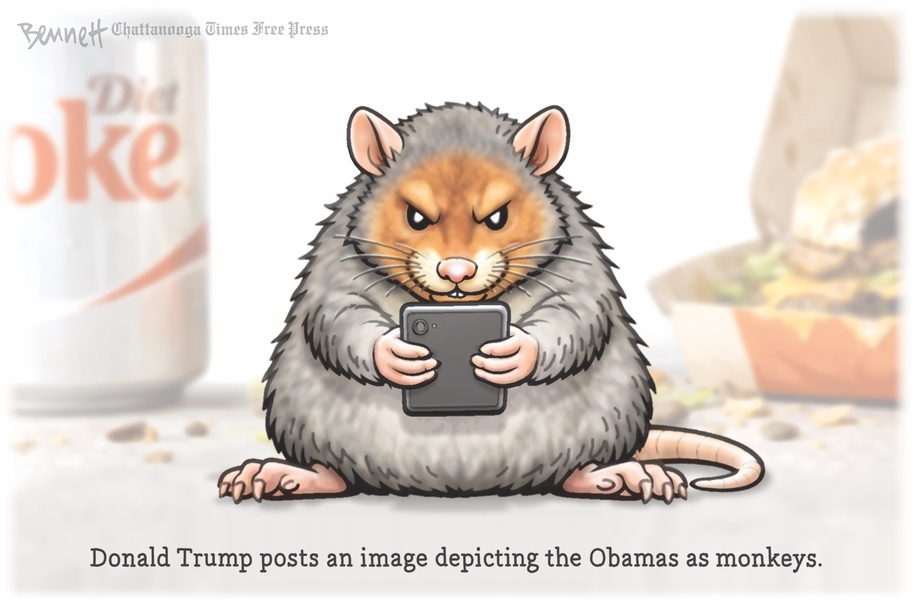
A recent cartoon by artist Clay Bennett has sparked discussions about political polarization in the United States. The illustration, which humorously depicts a “rat race to the bottom,” critiques the current political climate, highlighting the competition among politicians and public figures to engage in increasingly outrageous behavior for attention. This reflects a broader trend where sensationalism often overshadows substantive discourse.
Bennett’s work comes at a time when political tensions are running high, particularly with the recent actions of former President Donald Trump. Trump has faced backlash for posting a controversial video on social media that depicts former President Barack Obama and former First Lady Michelle Obama in a derogatory manner. Critics have called for Trump to apologize, but he has not shown any intention to retract his statement, further fueling the divide in public opinion.
Political Commentary and Public Response
The cartoon serves as a biting commentary on the current state of American politics. Bennett’s portrayal resonates with many who feel that political leaders prioritize sensationalism over meaningful action. It reflects a sentiment that has become increasingly common among voters who are frustrated with the lack of constructive dialogue in political discourse.
Public reactions to Bennett’s cartoon have varied widely, with some praising his ability to encapsulate the frustrations of everyday citizens. Others, however, have criticized the depiction as overly simplistic, arguing that it fails to address the complexities of the political landscape. The political cartoon, while humorous, raises important questions about accountability and the role of public figures in shaping political narratives.
Bennett’s art often engages with current events, providing a lens through which viewers can reflect on societal issues. His recent work has drawn attention not only because of its provocative nature but also due to the broader implications it suggests about the direction of American politics.
The Role of Satire in Political Discourse
Satirical illustrations like Bennett’s play a significant role in shaping public discourse. They can provoke thought and discussion, encouraging individuals to examine their beliefs and the motivations of their leaders. As political polarization continues to rise, such art becomes increasingly relevant as a tool for critique and reflection.
The intersection of art and politics is not new, but its impact is felt more deeply in today’s digital age. Social media platforms amplify these messages, allowing for rapid dissemination and discussion. In this environment, cartoons like Bennett’s can spark conversations that might not occur in traditional news formats, reaching a broader audience.
As the political landscape evolves, the significance of satire and commentary remains unchanged. Artists like Clay Bennett continue to challenge norms and provoke thought, ensuring that the voices of the public are heard amid the clamor of political rhetoric.