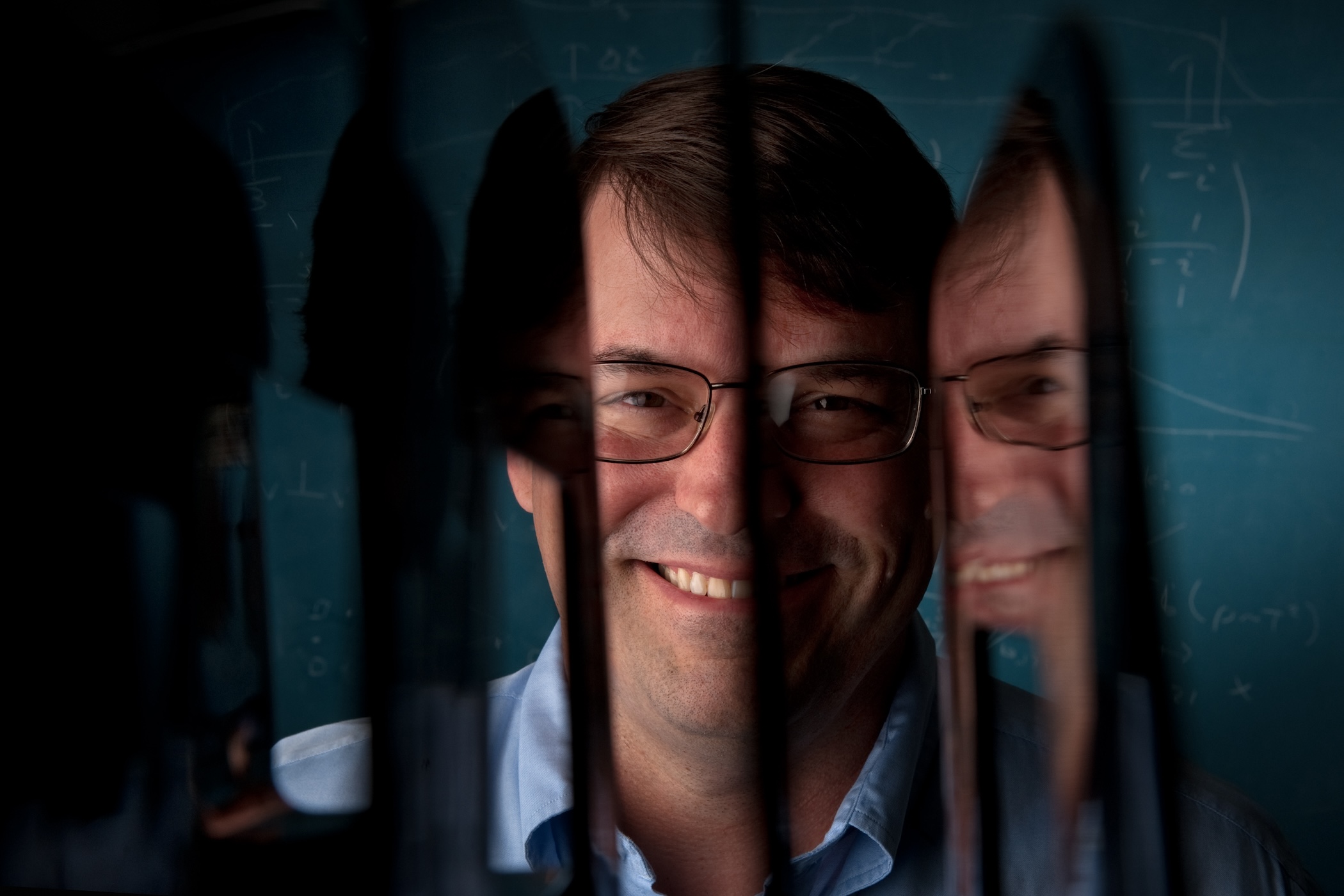
One of the world’s foremost physicists, Steven R. White, will present the 2026 Chhabra-Landau Lecture at the University of Georgia (UGA) on February 26, 2026. The esteemed talk, hosted by UGA’s Center for Simulational Physics, is part of the Provost’s Seminar Series, which highlights prominent figures from the National Academies of Sciences, Engineering, and Medicine, as well as the American Academy of Arts and Sciences.
The lecture is set to take place at 14:55 in the Physics Building, room 202. It is free and open to the public, and a light reception will follow. Phillip Stancil, head of the Department of Physics and Astronomy in the Franklin College of Arts and Sciences, expressed enthusiasm about White’s participation in the event. Stancil noted, “I’m excited that Dr. White’s presentation is not only a part of the highly regarded Provost’s Seminar Series but also the Chhabra-Landau Lecture Series on computer simulations.”
About Steven R. White
White serves as a distinguished professor of Physics and Astronomy at the University of California, Irvine. His research focuses on condensed matter physics, particularly the simulation of quantum systems. White is renowned for inventing the Density Matrix Renormalization Group, a groundbreaking method for simulating quantum systems across various fields in physics and chemistry. He has also developed the first tensor network algorithm.
His accolades include the Aneesur Rahman Prize in Computational Physics, the highest recognition awarded by the American Physical Society for contributions to computational physics. Additionally, White is a member of both the American Academy of Arts and Sciences and the National Academy of Sciences.
Lecture Details
In his upcoming lecture, titled “Combining Monte Carlo and Tensor Networks to Beat the Quantum Exponential,” White will introduce fundamental concepts of both Monte Carlo simulations and tensor networks. He will discuss how scientists have effectively merged these two approaches to tackle complex problems, leading to significant advancements in the field.
For additional details about the lecture, interested parties can contact Phillip Stancil at UGA. This event promises to be a remarkable opportunity for students and the public to engage with cutting-edge scientific concepts and gain insights from a leading expert in the field.