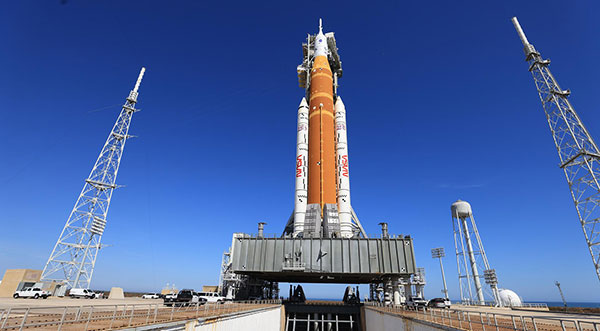
NASA is preparing to potentially roll back the Artemis II rocket and the Orion spacecraft to the Vehicle Assembly Building (VAB) at the Kennedy Space Center in Florida. This decision follows an interruption in the flow of helium to the Space Launch System (SLS) rocket’s interim cryogenic propulsion stage, observed overnight on February 21, 2024. As a result, the agency is now evaluating the implications for the upcoming launch schedule.
In response to the helium flow issue, NASA teams are actively reviewing the data and preparing for rollback procedures. Engineers are determining the best course of action to address the problem. To facilitate troubleshooting at both Launch Pad B and the VAB, preparations are underway to remove access platforms that were installed recently. These platforms are subject to wind constraints, which could complicate their removal due to high winds forecasted for the coming days.
The upper stage of the Artemis II mission relies on helium to maintain optimal environmental conditions for its engines and to pressurize its liquid hydrogen and liquid oxygen propellant tanks. During prior wet dress rehearsals, these systems functioned correctly. However, following the conclusion of the last rehearsal on February 19, teams encountered difficulties in achieving a proper helium flow during routine operations and reconfigurations.
NASA is currently employing a backup method to sustain the necessary environmental conditions for the upper stage engines while ensuring that the rocket remains in a safe configuration. The agency is investigating various potential causes for the helium flow disruption, including possible issues with the interface between ground and rocket lines, a valve within the upper stage, and a filter located between the ground and the rocket. Additionally, NASA is examining data from the Artemis I mission, where similar helium-related pressurization challenges were addressed before launch.
Should a rollback occur, it will effectively eliminate the possibility of launching Artemis II in the March launch window. However, the swift preparations being implemented may allow NASA to target the April launch window, contingent upon the results of ongoing data analysis, repair efforts, and the overall schedule in the coming days and weeks.
The Artemis II mission is a significant step in NASA’s efforts to return humans to the Moon, with astronauts such as Reid Wiseman, Victor Glover, and Christina Koch, along with Jeremy Hansen from the Canadian Space Agency, preparing for the mission. Their readiness is crucial for the success of the upcoming launch, and NASA remains focused on resolving the current issues to maintain the mission’s momentum.