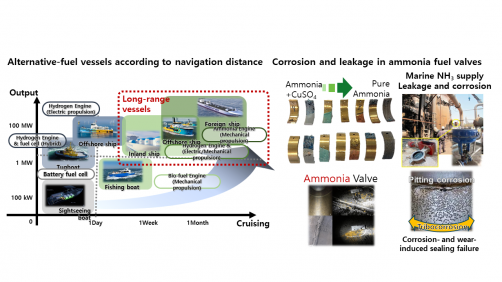
A research team from the Korea Institute of Materials Science (KIMS) has announced a significant advancement in marine technology with the development of a high corrosion- and wear-resistant carbon coating. Led by Dr. Young-Jun Jang and Dr. Jongkuk Kim, and in collaboration with Dr. Sungmo Moon, this innovation addresses the severe corrosion and wear challenges faced by marine metals when exposed to ammonia fuel. This breakthrough is expected to facilitate the commercialization of eco-friendly ammonia-powered ships.
Traditional marine materials, such as stainless steel 440C, suffer from degradation during prolonged exposure to the highly alkaline and chemically reactive nature of ammonia. These conditions compromise the integrity of surface oxide layers, leading to localized corrosion and wear. Critical components including engines, valves, and pumps have been identified as particularly vulnerable, necessitating the development of robust corrosion-resistant technologies.
Innovative Coating Technology
The newly developed carbon coating technology, designated as ta-C:Hx, demonstrates exceptional resistance to corrosion and wear in ammonia environments across a wide temperature range, from cryogenic to medium and low temperatures. Testing revealed that while conventional marine materials present a corrosion current density of approximately 48 μA/cm² in ammonia solutions, the new coating reduces this figure to just 4 μA/cm², achieving an impressive 92% reduction. Furthermore, the corrosive wear rate was reduced from 1.4 × 10⁻⁶ mm³/N·m for traditional SS440C to 1.3 × 10⁻⁸ mm³/N·m under the new coating, marking a remarkable 99.1% reduction in tribocorrosion wear tests.
Conventional coatings, including nitride coatings and wet plating layers, have primarily been designed for seawater and general industrial environments, lacking proven reliability in ammonia’s highly corrosive conditions. These traditional methods often suffer from defects such as pores and thickness non-uniformity, which can act as initiation points for corrosion. In contrast, the innovative coating process developed by KIMS minimizes these defects through pulsed bias control during a filtered arc deposition process. The incorporation of hydrogen also enhances the coating’s internal structure and electrical properties, further preventing corrosion in aqueous ammonia solutions.
Implications for the Marine Industry
This technology represents Korea’s first domestically developed surface coating capable of meeting the corrosion resistance requirements for ammonia-powered ships, aligning with the 2023 IMO Greenhouse Gas Reduction Strategy. This international initiative mandates a transition to zero-carbon fuels in shipping by 2030. Additionally, the Maritime Safety Committee (MSC) has instituted interim guidelines for ammonia-fueled vessels, requiring verification of metallic materials’ corrosion resistance in fuel systems.
Countries like Japan, Norway, and Singapore are already conducting demonstration projects for ammonia-powered vessels, assessing the performance of metallic components in corrosive environments. Recognizing ammonia-powered ships as a strategic focus, South Korea has integrated this sector into its 2050 Green Shipping National Action Plan. Despite achieving Approval in Principle (AiP) for ammonia vessels, the lack of reliable domestic coating technologies presents a significant barrier to commercialization.
The research builds upon KIMS’s extensive expertise in carbon coating technologies and environmental corrosion evaluations. With the advancement of ammonia-specific coatings, KIMS asserts its competitive edge in meeting the stringent corrosion resistance requirements for ammonia fuel systems.
Dr. Young-Jun Jang expressed optimism about the technology’s commercial potential, stating, “If this technology is commercialized, it will provide a practical solution for long-distance operation by significantly improving the efficiency and reliability of key components for eco-friendly shipbuilding and marine vessels.” Co-researchers Dr. Jongkuk Kim and Dr. Sungmo Moon emphasized the importance of internal collaboration at KIMS in achieving this technological advancement, which they believe will strengthen the domestic industrial ecosystem and enhance opportunities in the global market.
This research was supported by KIMS’s in-house program, “Development of Practical Tribology Technologies for Cryogenic Environments,” and by the National Research Foundation of Korea (NRF) through its Nano and Materials Technology Development Program. The findings are set to be published in the esteemed journal Carbon on December 1, 2025. The research team is currently working on stabilizing the coating process, conducting reliability evaluations, and pursuing patent filings, with plans to explore commercialization through partnerships with industry.
The advancements made by KIMS not only mark a significant leap in marine engineering but also position South Korea at the forefront of developing sustainable technologies for the future of shipping.