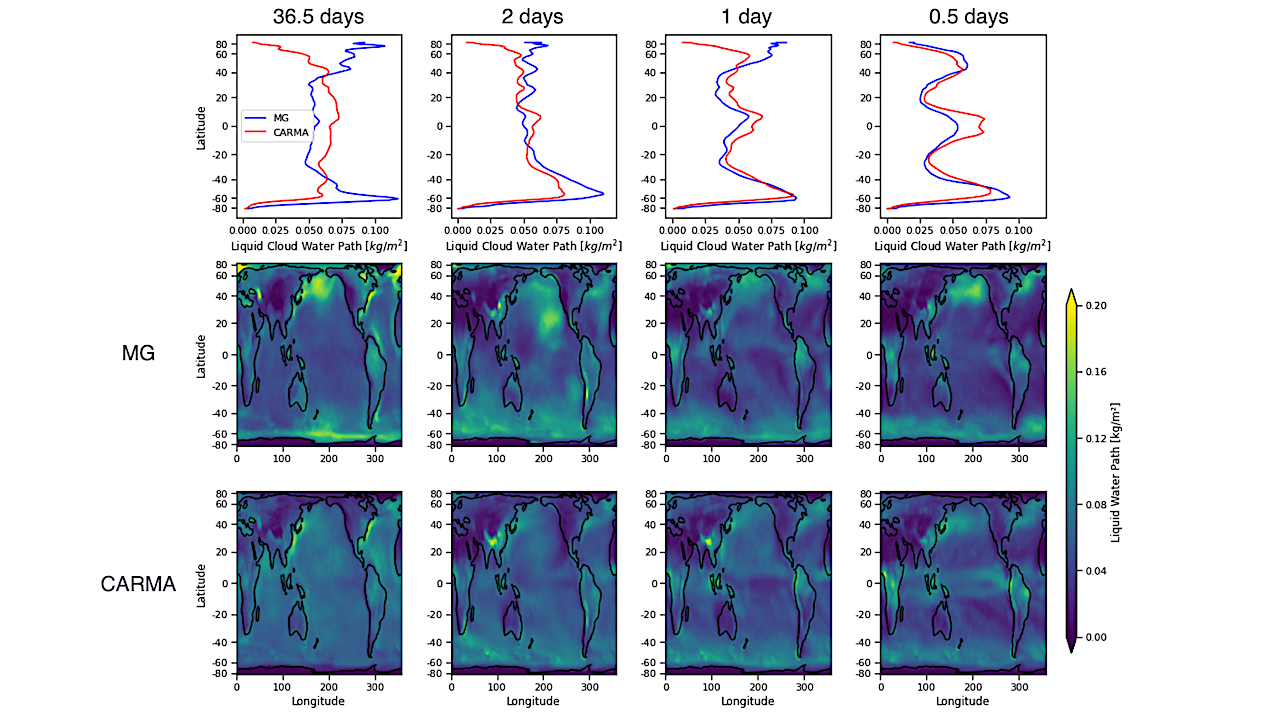
Scientists have made significant strides in understanding the influence of planetary rotation on cloud formation in exoplanetary atmospheres. A recent study utilizes the Community Aerosol and Radiation Model for Atmospheres (CARMA), a bin cloud microphysics model, integrated with the Community Atmosphere Model (CAM6) to examine how varying rotation rates affect cloud dynamics.
Clouds represent a critical source of uncertainty in climate simulations, particularly for exoplanets where observational data is scarce. The study reveals that CARMA generates fewer liquid clouds compared to the native cloud microphysics scheme used in CAM6, known as the Morrison-Gettelman two-moment microphysics (MG). In contrast, CARMA produces a greater number of ice clouds and displays a notably different ice cloud size distribution.
Impact on Climate Simulations
The findings indicate that the application of CARMA leads to a decrease in the net cloud radiative effect (CRE) by approximately 4-10 W/m². This reduction is unlikely to alter the assessment of habitability from a climate perspective for most exoplanets. However, the differences in the size distribution of ice clouds could significantly influence transmission spectral retrievals, which are crucial for interpreting the atmospheres of distant worlds.
The research underscores the potential advantages of using resolved cloud microphysics over parameterized schemes for climate simulations. By applying CARMA, the authors, including lead researcher Huanzhou Yang and co-authors Eric T. Wolf, Cheng-Cheng Liu, Yunqian Zhu, Owen B. Toon, and Dorian S. Abbot, aim to enhance the accuracy of climate models as they relate to exoplanets.
Broader Implications for Astrophysics
This study contributes to a growing body of knowledge that seeks to refine our understanding of exoplanetary atmospheres. The authors assert that while the MG parameterized scheme can yield reasonable climate simulations, the ability to resolve cloud microphysics provides invaluable insights into parameterized models. This approach not only aids in climate simulations but also enhances the interpretation of observational data from telescopes.
The research, consisting of eight pages and featuring seven figures, was published in the Astrophysical Journal on March 4, 2026. The study is part of an ongoing effort to bridge the gap between theoretical models and empirical observations, ultimately enhancing our grasp of habitability beyond Earth.
For those interested in further details, the study can be accessed through the arXiv database under the identifier 2603.03767 and is cited as ApJ 999 184 (2026).