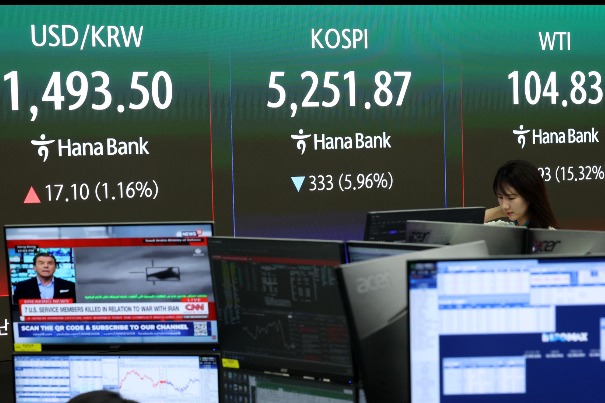
URGENT UPDATE: South Korean equities are in a freefall, with the benchmark Kospi plummeting more than 8% today as fears over rising oil prices and escalating geopolitical tensions shake investor confidence. The index dropped to 5,251.87, triggering a 20-minute trading halt after it briefly dipped below 5,100.
This alarming selloff is driven by a drastic surge in oil prices, with West Texas Intermediate (WTI) crude soaring nearly 26% to $114.49 per barrel. The rapid escalation follows the ongoing US-Israel-Iran conflict, raising concerns that military exchanges in the Middle East could extend longer than anticipated.
Investors are fleeing risk assets in response, leading to significant losses across major sectors. The technology-heavy Kosdaq also faced a sharp decline, closing down 4.5% at 1,102.28 after hitting 1,067.24 earlier in the day.
According to analysts, the current situation reflects a broader trend of volatility in global markets. “Given South Korea’s heavy dependence on energy imports from the Middle East, a spike in oil prices amid a closure of the Strait of Hormuz could intensify risk-averse sentiment,” stated Lee Sung-hoon, an analyst at Kiwoom Securities Co.
The won has also weakened significantly, trading at 1,495.50 per dollar, nearing the critical 1,500 level, the lowest since March 2009 during the global financial crisis. This depreciation is driving up local gasoline prices, which reached 1,897.7 won per liter.
Foreign investors are leading the retreat, unloading a staggering 3.2 trillion won ($2.1 billion) worth of shares, while institutions contributed an additional 1.5 trillion won in sell-offs. Individual investors attempted to stabilize the market by purchasing 4.6 trillion won in shares, but this was not enough to counteract the massive outflow.
Major firms are feeling the heat, with significant drops among household names: SK Hynix down 9.5%, Hyundai Motor Co. down 8.3%, and Samsung Electronics sliding 7.8%. On the Kosdaq, Rainbow Robotics lost 11.2%, amplifying the overall market panic.
The current selloff is part of a broader risk-off trend in global markets, with the Dow Jones dropping over 400 points last Friday due to similar concerns. Analysts warn that the market may face additional volatility, as many factors converge to create an unstable environment.
While some experts believe the market has entered a deep-value zone, others caution that the prevailing conditions could lead to more drastic downturns. “A V-shaped recovery following such sharp declines is rare,” said Lee Eun-taek of KB Securities Co. “History suggests that markets often form a W-shaped bottom as fear is fully priced in.”
As the situation continues to develop, investors are advised to remain vigilant and informed about potential market shifts. The implications of these dynamics could resonate far beyond South Korea, impacting global economic stability as oil prices and geopolitical tensions remain at the forefront of investor concerns.