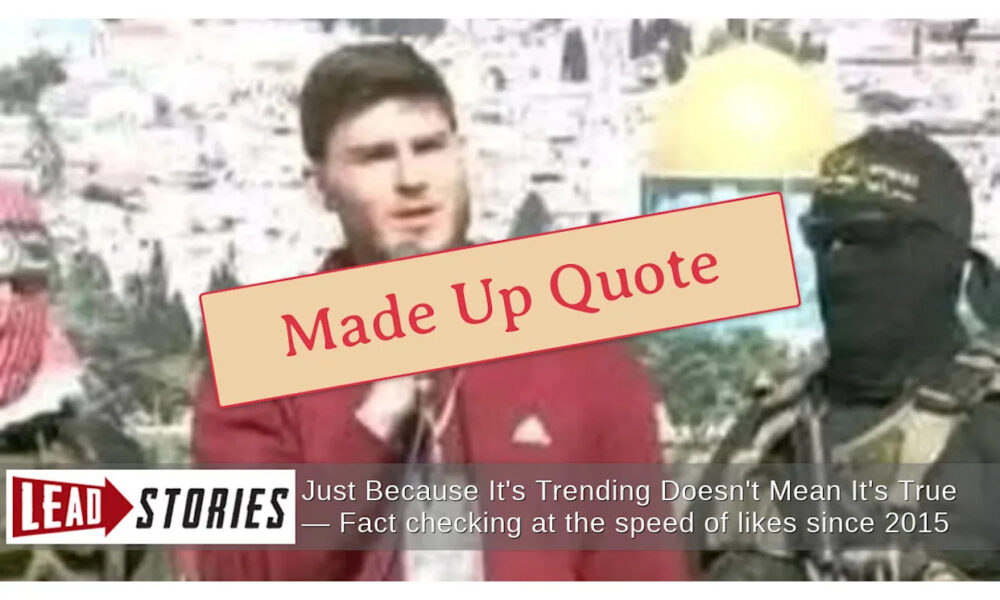
A false quote attributed to an Israeli prisoner, claiming sympathy for his captors, has gone viral, causing significant confusion online. The statement, purportedly made by the released prisoner, was circulated widely on social media following his release on February 15, 2025.
The individual in question is not named Alexander Turbanov, as reported in various posts, but rather Alexander Troufanov. The misattributed quote first gained traction on February 16, 2025, when it was shared on Facebook by the page Towards Understanding Islam. The post falsely claimed, “Your kindness has been engraved in my conscience forever,” and included a fabricated narrative that painted Troufanov in a positive light regarding his captors.
The origins of this misinformation can be traced back to a post by social media influencer Khaled Safi. In a follow-up statement, Safi clarified that he had not quoted Troufanov directly but instead expressed sentiments he believed reflected his condition and feelings of gratitude toward his captors. This clarification, however, did little to quell the spread of the fabricated quote.
In an archived post, Safi wrote, “These are not the words of the captive, but rather I wrote them on his behalf, describing his condition.” The original post attributed to Troufanov included references to heroism and respect for humanity, further complicating the situation as it circulated across platforms.
The reality of Troufanov’s release was documented in a US News & World Report article featuring photographs of the exchange ceremony in Khan Younis, Gaza Strip. The report confirmed the participation of Troufanov alongside two other Israeli hostages, Iair Horn and Sagui Dekel Chen, who were also released during the negotiation process. The image depicted the hostages being handed over to the Red Cross, solidifying the legitimacy of their release.
The confusion surrounding Troufanov’s statements highlights the challenges of information accuracy in the digital age, particularly regarding sensitive geopolitical situations. As misinformation spreads rapidly, it is crucial for individuals and organizations to verify facts before sharing content on social media platforms.
As the narrative surrounding Israel and Hamas continues to unfold, the misattribution of statements like those allegedly made by Troufanov serves as a reminder of the importance of fact-checking and responsible communication in the public sphere.