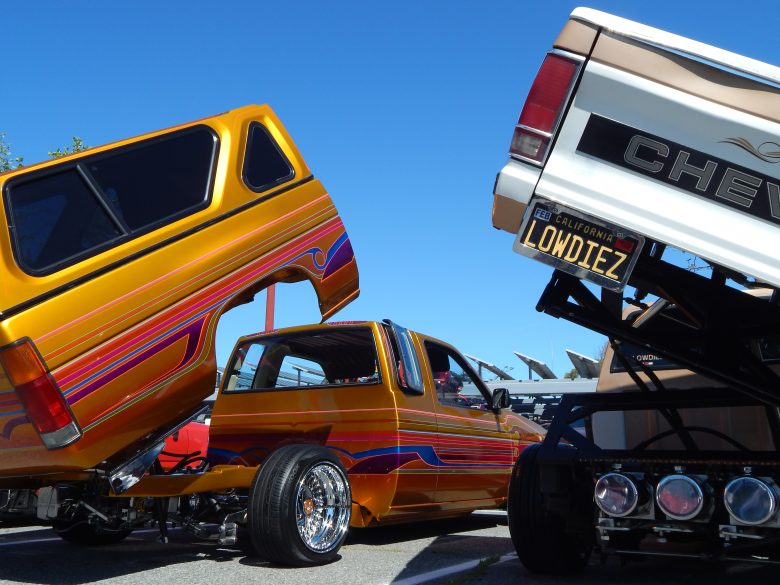
A vibrant celebration of lowrider culture unfolded in Bayview on Saturday as the U.S. Postal Service unveiled a new series of postage stamps dedicated to this unique automotive tradition. Approximately 500 enthusiasts, including members of local car clubs, gathered at the postal office to witness the recognition of lowriding as an important facet of American history and culture.
The event saw notable figures such as Brian Gaines, Director of the USPS Pacific Northwest Processing Division, who emphasized the significance of lowriding in shaping American society. “These stamps signify a significant impact on American history, American society, and American culture,” Gaines stated during the unveiling.
Among the featured photographs on the stamps is a collection captured by Humberto “Beto” Mendoza, the former head photographer at Lowrider Magazine. Mendoza expressed his astonishment at having his work honored in this way. “It’s incredible,” he remarked, reflecting on the evolution of lowrider culture.
Celebrating a Cultural Shift
Historian John Ulloa, who is also a member of Low Creations car club alongside Fernando Velasco, noted the transformation of lowriding from a localized experience to a global phenomenon. “It used to be really confined to a very hyper-localized barrio experience,” Ulloa explained. “Now it’s mushroomed out to all corners of the world.”
The cultural acknowledgment comes at a pivotal time as California’s Assembly Bill 436, signed into law on January 1, 2024, has played a crucial role in normalizing lowrider culture. This legislation has removed restrictions against cruising and lifted minimum height requirements for vehicles, helping to further integrate lowriding into the broader social fabric.
At the event, Francine Mata of the Sacramento Lowrider Commission described lowriders as “rolling art.” She highlighted the personal connection many owners have with their vehicles, noting that each car represents a unique artistic vision. Ulloa shared a similar sentiment, discussing his own vehicle, a 1973 Buick Riviera named Conspiracy, and Velasco’s 1976 Chevy Capri Classic, La Morada, as examples of personal expression.
A Community Celebration
The atmosphere at the unveiling was electric, with performances by Danza Xitlali and a mariachi band adding to the festive spirit. Sam Reveles Sr., a member of City Classics, expressed his pride in the stamp’s release, stating, “I’m very happy with the acknowledgment from the federal government of lowrider culture.” Reveles owns a 1949 Chevy Fleetline Deluxe named La Morena and sees the stamp as a long overdue recognition.
The cultural boundaries surrounding lowriding have also expanded significantly. Ruben Espinel, a painter and founder of Colores Car Club, emphasized that lowrider culture transcends ethnic lines. “There’s an old low-rider saying, ‘It doesn’t matter the color of your skin, it matters the color of your car’,” he explained, reinforcing the inclusive nature of this community.
Attendee Andrew Bayardo shared his personal journey, acknowledging that his passion for lowriding only became active after overcoming substance dependency. “I’m no longer a spectator, I’m a participant,” he proudly stated, showcasing his 1941 Chevrolet Special Deluxe, La Bonita One.
The impact of lowrider culture on personal lives was echoed by Elena M. Vera, who founded the Nuestro Estilo car club. Vera, whose artistic expression manifests through her car, recounted her deep-rooted connection to lowriding, stating, “It became a part of my heart, my whole life, my soul.”
As the event concluded, many attendees left with a sense of pride and validation. The unveiling of the postage stamp not only celebrates the artistry of lowriders but also acknowledges their role in the broader American narrative. The culmination of decades of cultural evolution was on full display, bringing together a community that has long awaited this recognition.