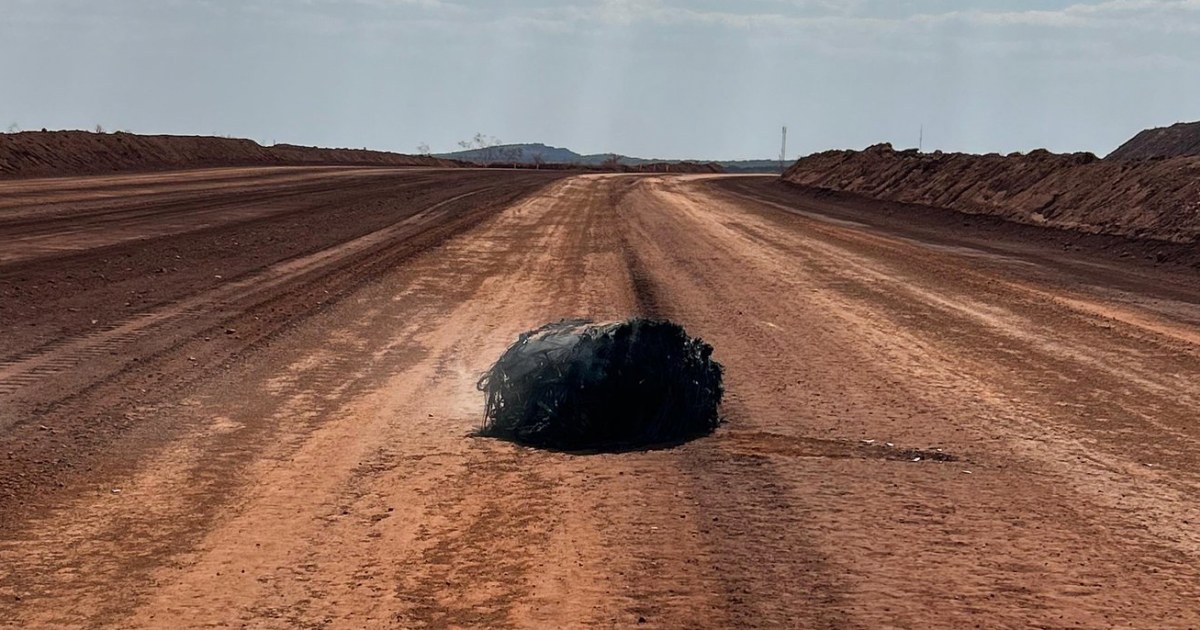
A large piece of suspected space debris was discovered in a remote area of the Pilbara region in Western Australia. The Australian Space Agency confirmed the find on Monday, stating that the charred object was located by workers from a nearby mine on Saturday. Although the exact nature and origin of the debris remain undetermined, officials believe it is likely a spent component from a space launch vehicle.
The Australian Space Agency indicated in a post on X that the object could be a propellant tank or pressure vessel. While specific details regarding the size and weight of the debris have not been disclosed, the agency is collaborating with local authorities and various space organizations to investigate further. The agency asserted that it aims to establish the precise nature and origin of the debris.
Local authorities have assessed the situation and reported that the debris does not pose any immediate threat to public safety. However, further inquiries are ongoing, and the Australian Space Agency has yet to respond to requests for additional information from NBC News.
Understanding Space Debris Challenges
Space debris is an increasing concern for both government and private space agencies. Often, defunct rocket parts and satellites are designed to burn up upon re-entry into the atmosphere. Nevertheless, some fragments do manage to survive the intense heat, leading to rare occurrences of debris landing on land.
Historically, such incidents are uncommon, as the majority of the Earth’s surface is covered by oceans. There have been notable exceptions, such as a 90-pound slab of space debris discovered on a mountain trail in North Carolina last summer. This object was later identified as a component from a SpaceX Crew Dragon capsule, which had previously transported astronauts back to Earth from the International Space Station.
In another incident in March 2024, a 1.6-pound metal fragment penetrated a home in Naples, Florida. Investigations revealed that this debris originated from a cargo pallet intentionally released from the International Space Station to incinerate in the atmosphere.
Tens of thousands of larger pieces of space debris, along with millions of smaller fragments, orbit Earth in low Earth orbit, where many satellites, including those for telecommunications and GPS, operate. These objects travel at speeds approaching 18,000 mph, posing risks to operational spacecraft and astronauts aboard the International Space Station.
Addressing the Growing Problem
Experts have raised alarms regarding the increasing volume of space debris, particularly as the frequency of satellite launches rises. The potential for collisions in orbit prompts dire warnings about the need for debris management. To tackle the issue, NASA and other space agencies have invested in research and technology demonstrations aimed at cleaning up the growing amount of orbital junk.
The Australian Space Agency emphasized its commitment to the long-term sustainability of activities in outer space, including debris mitigation strategies. The agency continues to advocate for responsible space practices on the international stage, highlighting the need for collaboration to ensure a safer environment for space exploration and activities.