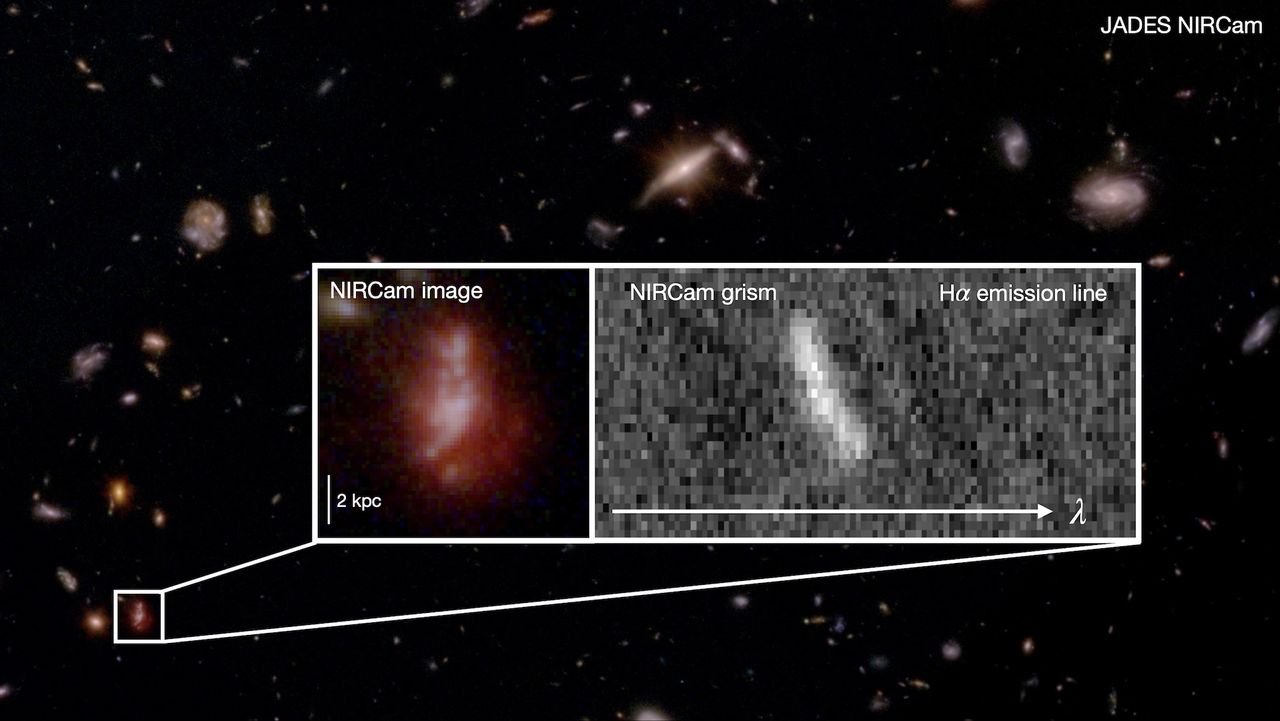
A new study utilizing the James Webb Space Telescope (JWST) has uncovered that galaxies in the early universe exhibited significantly more chaos than previously understood. Researchers analyzed over 250 galaxies from a critical period approximately 800 million to 1.5 billion years after the Big Bang, a timeframe when the cosmos was still evolving. The findings, published on October 21, 2023, in the journal Monthly Notices of the Royal Astronomical Society, suggest that these early galaxies were disorganized, much like “cosmic toddlers” struggling to find stability.
The study’s lead author, Lola Danhaive, a doctoral candidate at the University of Cambridge’s Kavli Institute for Cosmology, noted that the research team focused on less massive galaxies, which had previously been overlooked. This shift in focus revealed what the authors describe as “messy kinematics,” indicating that the galaxies were far from the stable, rotating disks characteristic of more evolved galaxies like the Milky Way.
Danhaive explained that the turbulence observed during this early phase of galaxy formation was underestimated in earlier studies, which primarily targeted larger, more stable galaxies. “We find evidence that this turbulence in the galaxy disk is caused by high amounts of gas, which fuels intense star formation and drives gravitational instabilities,” she stated. The team’s observations provide a clearer picture of how these chaotic structures transitioned into the more ordered formations seen in mature galaxies.
As galaxies evolved, they transitioned from chaotic patterns to a more stable state. Danhaive elaborated, “At early times, galaxies are undergoing a turbulent phase of assembly, where strong bursts of star formation and high amounts of gas disrupt the ordered motions of the gas disk.” Over billions of years, the available gas diminished as it was consumed by stars, allowing structures like the Milky Way to form more recently and grow steadily.
The JWST played a crucial role in this research. Positioned in a stable gravitational location far from the interference of Earth and the Moon, the telescope’s infrared capabilities allow it to delve deeper into space than its predecessors. This unique vantage point enables the discovery of some of the earliest known galaxies.
Looking ahead, the research team plans to further investigate the inflows and outflows of gas within individual galaxies. They aim to trace the chemical enrichment of gas, hypothesizing that incoming gas will be less enriched, or “pristine,” while outgoing gas will carry more complex chemical signatures from individual stars. This research could reveal reasons why some galaxies rotate more rapidly than others.
Danhaive expressed optimism about the ongoing research, stating, “There is so much more to uncover with JWST’s amazing capabilities, and we look forward to exploring many more aspects of early galaxy formation.” The findings from this study not only enhance our understanding of galaxy evolution but also pave the way for future investigations into the dynamics of the universe’s formative years.