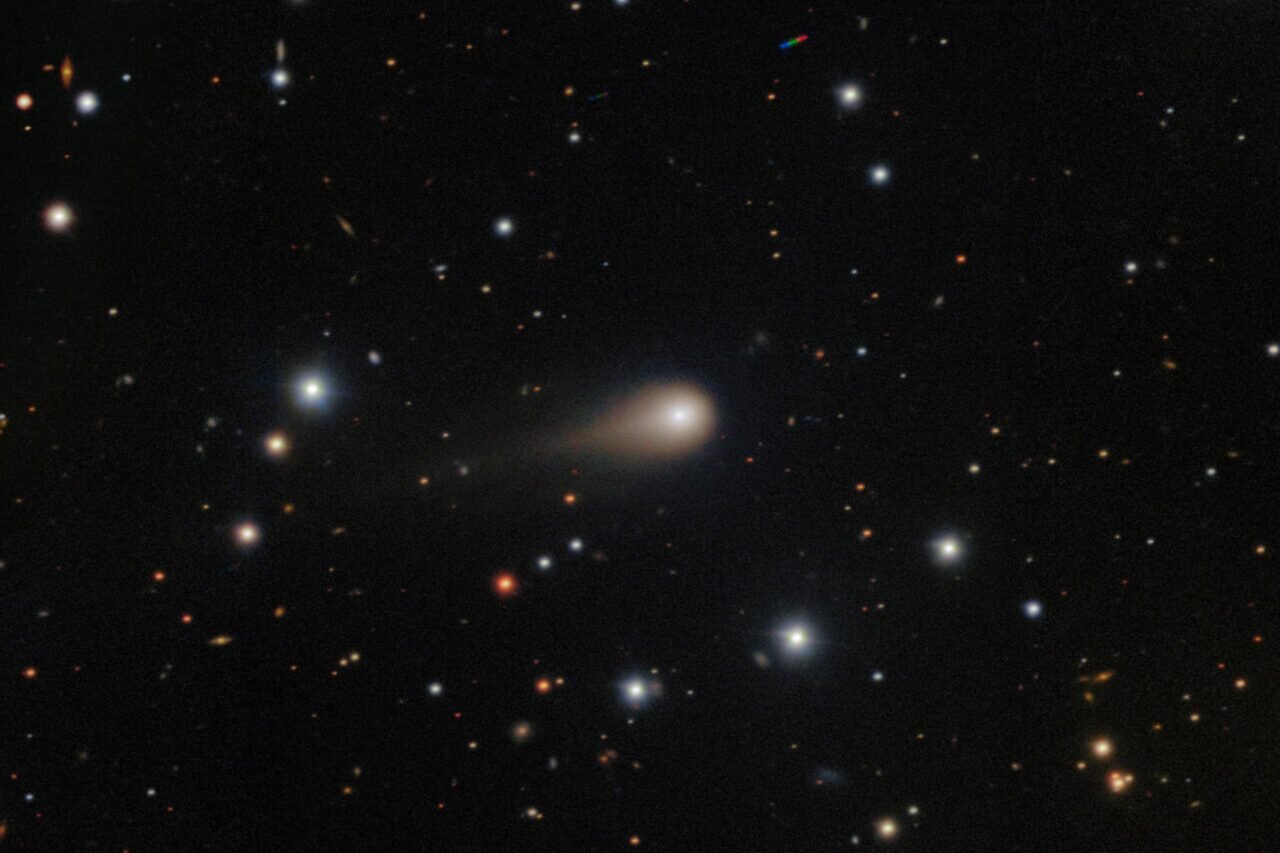
NASA’s Europa Clipper probe may have a unique opportunity to collect material from the ion tail of the interstellar comet 3I/ATLAS. This comet, which is currently traveling through the inner solar system, presents a rare chance for scientists to gather data from an object originating beyond our solar system. Two European researchers have indicated that the Europa Clipper could intercept the comet’s ion tail between October 30 and November 6, 2023.
The research, which has not yet undergone peer review, is available on the preprint server arXiv. The findings suggest that the comet’s tail, which has been expanding since its discovery in early June, could align perfectly with the Europa Clipper’s trajectory. As the comet approaches the Sun, its icy core heats up, releasing gas and dust that form the tail.
Scientific Significance of the Encounter
Co-author Samuel Gran, a postdoctoral researcher at the Finnish Meteorological Institute, emphasized the significance of this potential encounter. “We have virtually no data on the interior of interstellar comets and the star systems that formed them,” he stated. Gran pointed out that sampling the tail would offer insights into a different part of the galaxy, making it a valuable scientific endeavor.
The Europa Clipper is primarily designed to explore Europa, one of Jupiter’s 95 moons, to assess whether there are conditions suitable for life beneath its icy surface. Equipped with advanced scientific instruments, the probe could also analyze the ion tail of 3I/ATLAS. The ion tail consists of charged particles that flow directly away from the Sun, driven by solar wind.
Researchers Geraint Jones, a project scientist at the European Space Agency, and Gran utilized their “Tailcatcher” computer program to determine the probability of the Europa Clipper crossing into the ion tail. Their calculations suggest that the probe could capture “packets” of solar wind containing material from the comet.
Challenges Ahead
Despite the promising predictions, several challenges could impede the mission. Currently, the instruments required for this analysis remain inactive as the probe approaches Jupiter. Due to a government shutdown, it is uncertain whether NASA will be able to activate them in time for the anticipated crossing.
Additionally, the success of the encounter depends on the direction and strength of the solar wind at the time. The comet is expected to reach perihelion, its closest approach to the Sun, on October 29, 2023, which could increase the probability of detecting ions from its tail. However, the exact parameters necessary for a successful sample collection remain complex.
If the Europa Clipper successfully encounters the ion tail of 3I/ATLAS, it would mark a historic moment as the first spacecraft to directly immerse itself in material from an interstellar object. Gran and Jones note that even if direct measurements of the ions are not possible, signatures from magnetic fields and shock waves could still provide valuable information about the structure and composition of the ion tail.
As scientists prepare for this potential encounter, the mission underscores the importance of exploration and the quest to understand the origins of our solar system and beyond.