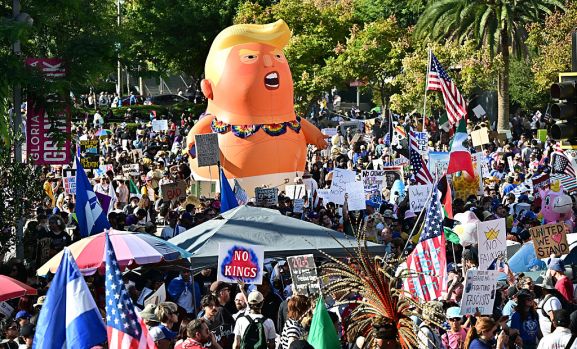
Political commentator Mark Levin recently drew attention during his radio program by comparing current criticisms of President Donald Trump‘s governance to historical actions taken by several former U.S. presidents. Levin’s remarks suggest that many Americans may not fully understand the historical context of presidential authority and the actions that have been taken throughout U.S. history.
During his broadcast, Levin emphasized that some presidents, who are often viewed positively, engaged in actions that could be seen as authoritarian. For example, he cited John Adams, who, under the Sedition Act, imprisoned several individuals, including four journalists. This historical reference serves to illustrate that the use of governmental power to suppress dissent is not a new phenomenon.
Levin also referenced the Insurrection Act, which has been invoked by presidents such as Thomas Jefferson, Andrew Jackson, and Ulysses S. Grant. Grant notably used the act to combat the Ku Klux Klan in the South. These historical precedents indicate that military intervention for political purposes has been employed by various leaders in times of crisis.
In discussing Abraham Lincoln, Levin pointed out that Lincoln took significant measures during the Civil War, including shutting down newspapers that were seen as sympathetic to the Confederacy. He noted that Lincoln suspended habeas corpus, a constitutional right that typically requires a person under arrest to be brought before a judge, emphasizing that such actions were taken without congressional approval.
Levin’s examination continued with a focus on Woodrow Wilson, who he described as a controversial figure due to his racist beliefs and support for eugenics. Levin noted that Wilson’s administration passed the Espionage Act in 1917 and a subsequent Sedition Act in 1918, leading to the imprisonment of approximately 2,000 individuals, including the Socialist candidate for president. This scale of repression, according to Levin, was unprecedented in American history.
The discussion also included Franklin D. Roosevelt, who Levin accused of waging a “war against the press.” Roosevelt established the Federal Communications Commission in 1934 and adjusted broadcast license durations to ensure compliance with government policies. Levin asserted that Roosevelt’s administration even directed the Internal Revenue Service to conduct audits on political opponents, underscoring the lengths to which governmental power was exerted during his presidency.
Levin’s commentary further extended to Lyndon Johnson and Barack Obama, both of whom he claimed utilized government agencies to surveil political opponents. Johnson allegedly authorized the FBI to monitor the campaign of Barry Goldwater and directed bugging operations against civil rights leaders, including Martin Luther King Jr.. Obama was criticized for permitting his Justice Department to subpoena the communications of the Associated Press, which Levin argued represented a troubling trend of governmental overreach.
In conclusion, Levin posited that the actions of these historical figures, particularly those from the Democratic Party, often reflect authoritarian tendencies. He claimed that contemporary Democrats seek to manipulate electoral outcomes, suggesting that they aim to alter the structure of American democracy by advocating for changes like the abolition of the Electoral College.
Levin’s assertions challenge prevailing narratives about presidential conduct and raise important questions about the balance of power in the U.S. government. As he encourages listeners to explore these historical examples, Levin’s message underscores the significance of understanding history as a means of contextualizing current political dynamics.