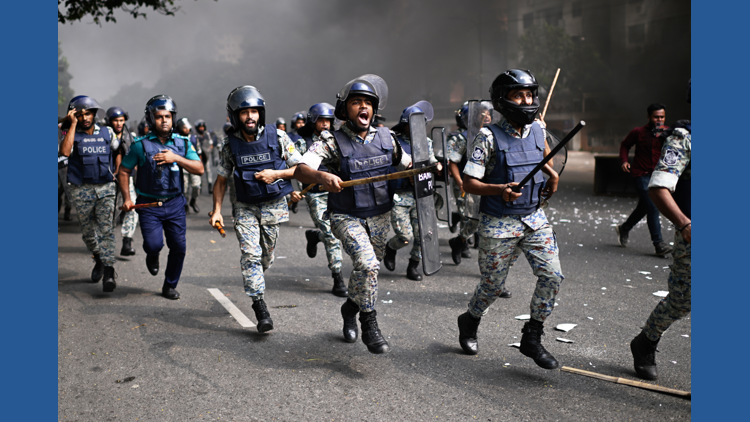
UPDATE: In a striking declaration, Sajeeb Wazed Joy, son of ousted Bangladeshi Prime Minister Sheikh Hasina, urgently called for the interim government to lift its ban on Hasina’s party, warning that any election excluding it would be a “sham.” Speaking from Washington D.C. just hours ago, Joy emphasized that without an inclusive electoral process, Bangladesh will remain steeped in political instability.
“This ban has to be lifted; the elections must be inclusive and free and fair,” Joy stated in an interview with The Associated Press, underscoring the critical nature of this situation as Bangladesh prepares for elections in February 2026. His remarks come as the country grapples with the aftermath of a student-led uprising that ousted Hasina from power last year, ending her 15-year rule.
The interim government, now led by Nobel Peace Prize laureate Muhammad Yunus, has faced growing criticism since it enacted a ban on the Awami League party shortly after taking office. Joy condemned this move as a political manipulation intended to prevent his mother and other leaders from participating in elections. “What is happening now is an attempt to keep my mother and our political leaders from running,” he added, making it clear that the legitimacy of future elections is at stake.
In the wake of the ban, the political landscape in Bangladesh has become increasingly fragmented. While the Bangladesh Nationalist Party, helmed by former Prime Minister Khaleda Zia, is positioned as a primary contender, the Jatiya Party also faces significant restrictions. Moreover, the return of the Jamaat-e-Islami, Bangladesh’s largest Islamist party, threatens to further polarize the political environment.
Human rights organizations have echoed Joy’s concerns, with six groups including Human Rights Watch urging Yunus to end the “broad ban” on Awami League activities. They argue that it excessively restricts freedom of association and has led to the arrests of many supporters engaged in peaceful activities.
Joy, who has lived in the U.S. for 30 years, warned that if the Awami League is not given adequate time to prepare for the elections, the results will lack credibility. “Even if the ban is lifted at the last minute, the elections will be a sham,” he stated emphatically.
The political unrest has led to widespread human rights violations, with Joy claiming that since the uprising, approximately 500 Awami League activists have been murdered, and many more face imprisonment. He characterized the interim government’s human rights record as “brutal,” particularly highlighting the persecution of religious minorities such as Hindus.
Amid these developments, a special domestic tribunal in Bangladesh has sought the death penalty for Hasina, who has rejected the trial process as a “kangaroo court.” Joy criticized this move, calling it indicative of the Yunus government’s broader campaign against Hasina and her supporters.
As Bangladesh approaches its electoral season, the urgent call for an inclusive election resonates deeply within the nation of 170 million people. With political tensions escalating and the future of democracy hanging in the balance, all eyes are now on the interim government to see if they will heed these demands for fairness and justice.
Stay tuned for more updates on this developing story as the political landscape in Bangladesh continues to unfold.