President Donald Trump announced on March 15, 2024, that he has canceled plans for a deployment of immigration enforcement agents in San Francisco. In a post on Truth Social, Trump stated that he made this decision after receiving calls from local residents urging him to reconsider, citing the significant progress made by Mayor Daniel Lurie in addressing community concerns.
Lurie confirmed that he had a conversation with Trump the previous evening, in which the President assured him that there would be no federal deployment in San Francisco. This potential operation had raised alarms among various California officials, who expressed fears over increased tensions in the city.
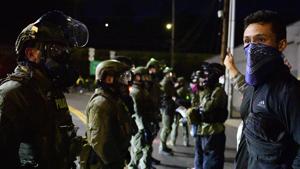
California Governor Gavin Newsom issued a statement on social media condemning the proposed deployment. He characterized it as a tactic straight from “the dictator’s handbook,” suggesting that it aimed to instigate unrest in order to justify the subsequent deployment of the National Guard. “He sends out masked men, he sends out Border Patrol, he sends out ICE, he creates anxiety and fear in the community so that he can lay claim to solving that by sending in the (National) Guard,” Newsom stated.
Reports indicated that approximately 100 federal agents, including members of U.S. Customs and Border Protection, were en route to the U.S. Coast Guard’s base in Alameda, California, before the cancellation. A spokesperson for the Department of Homeland Security had previously confirmed that immigration enforcement would be conducted in San Francisco, targeting what they described as the “worst of the worst” among undocumented immigrants.
In light of the federal plans, Newsom warned that the state would swiftly take legal action to prevent military involvement in San Francisco, emphasizing the need for Californians to remain peaceful. “President Trump and (White House Deputy Chief of Staff) Stephen Miller’s authoritarian playbook is coming for another of our cities,” he remarked, highlighting the potential for chaos.
Trump had previously suggested that San Francisco was next on his list for National Guard deployment, following similar actions in Los Angeles and Chicago. While he indicated that the National Guard would address crime rates, experts noted that the National Guard is generally prohibited from performing domestic law enforcement duties without the governor’s consent. San Francisco District Attorney Brooke Jenkins stressed that the National Guard would not be legally authorized to make arrests or investigate crimes.
Lurie acknowledged the ongoing challenges posed by drug-related issues in the city, particularly concerning fentanyl use, but asserted that the National Guard could not effectively tackle these problems. He maintained that local law enforcement was best suited to address the city’s specific needs.
In prior statements, Trump had criticized cities led by Democratic politicians, claiming they were “unsafe” and in need of federal intervention. He suggested that the National Guard could be utilized for military training in these urban areas. The White House defended the deployment of troops in U.S. cities, citing reductions in crime in places like Memphis and Washington, D.C., following military presence.
Newsom, who served as San Francisco’s mayor before becoming governor, noted that the city is currently experiencing its lowest homicide rate in six decades. He emphasized the city’s progress and economic growth, vowing to continue opposing any federal military interference. “We will push back with clarity and conviction and we’ll continue to win in court,” he concluded, reinforcing the state’s commitment to protecting its communities.
The situation underscores the ongoing tensions between federal and state authorities regarding immigration enforcement and local governance in California, particularly in urban centers like San Francisco.