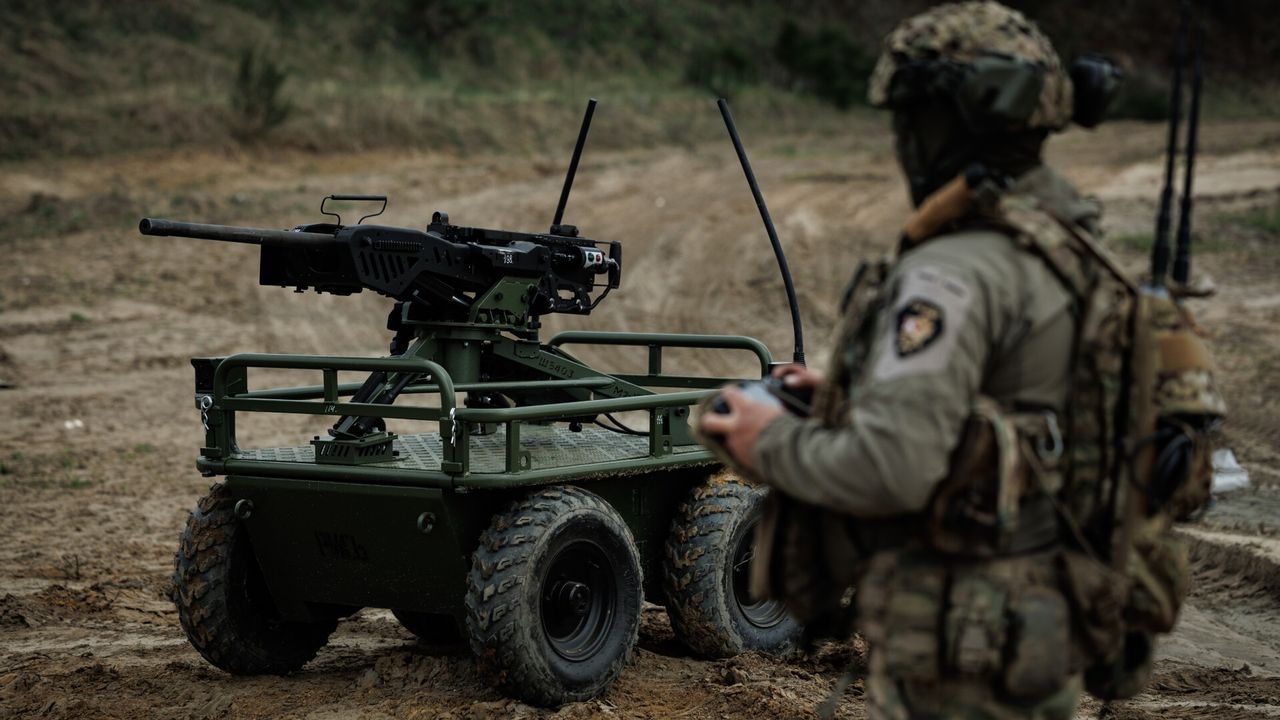
The bandwidth provided by SpaceX’s Starlink satellite network is hindering Ukraine’s ability to effectively deploy ground robots in its ongoing conflict with Russia. As the war intensifies, Ukrainian tech developers are searching for innovative solutions to this critical challenge.
Over the past year, Ukraine has utilized thousands of wheeled ground robots to support frontline military operations, including delivering supplies, evacuating injured personnel, and even engaging enemy troops. However, the limited bandwidth available—sometimes as low as 10 megabits per second—is compromising the quality of video feeds essential for controlling these unmanned ground vehicles (UGVs).
Vadym Burukin, the CEO of drone start-up Huless, highlighted the importance of video quality in controlling UGVs. “If you want to drive fast, you need a frame rate of at least 30 frames per second to be able to control the robot,” he explained. With only ten frames per second, the risk of catastrophic errors, such as driving into a minefield, significantly increases.
Starlink has played a vital role in sustaining communication for Ukrainian forces since the beginning of the conflict. With approximately 200,000 active terminals in the country, Ukraine is the largest user of Starlink services in Europe. Yet, the high demand for bandwidth, particularly on the frontline, limits the operational speed of these robots to around 6 miles per hour (10 kilometers per hour), according to Andriy Dovbenko, CEO of the Ukrainian Tech Exchange network. This slow pace results in extended travel times, often taking up to two hours to navigate the 12-mile-wide (20-kilometer) grey zone where both troops and equipment are vulnerable to enemy drone attacks.
The challenges extend beyond bandwidth. Burukin noted that vibrations from rough terrain can cause Starlink terminals to malfunction, while environmental factors like clouds and rain can further weaken the signals.
To combat these issues, Ukrainian innovators are developing alternative technologies to enhance the performance of ground robots. One promising solution involves the use of tethered drones equipped with signal repeaters. These drones can ascend to 500 feet (150 meters) and extend the range of weak radio signals from just a few kilometers to over 40 kilometers (25 miles). By doing so, these airborne repeaters allow UGVs to operate more effectively and conduct missions deeper into enemy territory without losing connectivity.
Recently, Burukin reported successful operations that reached as far as the Donbas arena in the center of Donetsk, a city controlled by Russian separatists since 2014. The ability to conduct exploratory missions with minimal risk of losing signal is a significant tactical advantage for Ukrainian forces.
Despite the limitations of Starlink, Dovbenko emphasized its ongoing importance. “There are many uses for Starlink in the war, but it has not been specifically developed as a military technology, so it has its limitations,” he said. While acknowledging the need for alternatives, he expressed doubt about the feasibility of producing a large-scale substitute for Starlink.
Innovations in AI-powered autonomous navigation systems are also on the horizon, further enhancing the capabilities of military robots. These systems can mitigate problems caused by signal disruptions, including deliberate jamming. Ukrainian developers anticipate that in the coming years, AI will increasingly manage frontline operations, reducing the need for real-time human oversight and offering resilience against radio signal loss.
While fully autonomous military machines are unlikely to replace human soldiers entirely, they promise to alleviate the risks faced by personnel in the most dangerous areas of the battlefield. As Ukraine continues to navigate the complexities of modern warfare, the integration of advanced technologies will be essential to maintaining operational effectiveness and safeguarding lives.