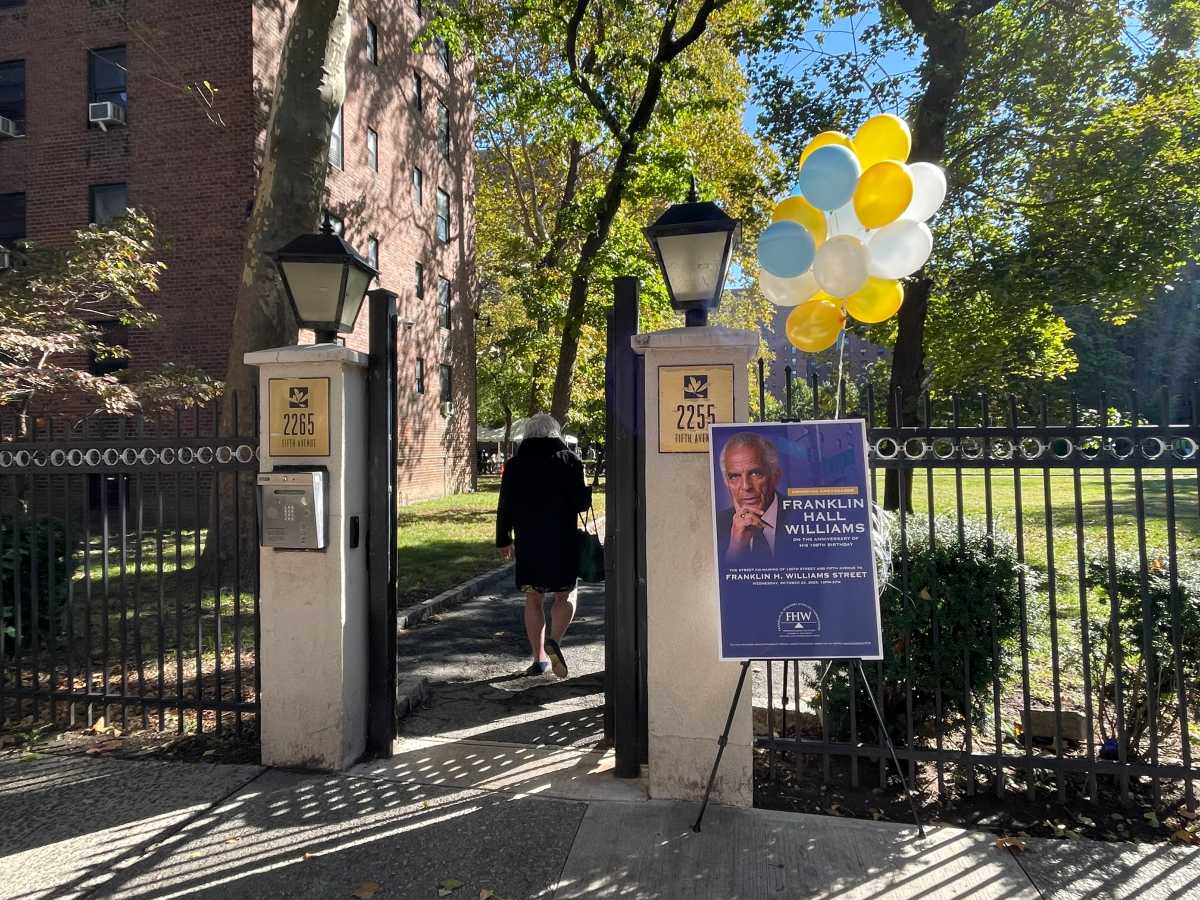
UPDATE: In a historic event just announced, leaders from the judiciary and local government gathered in Harlem to dedicate a street corner in honor of civil rights pioneer Franklin H. Williams on his 108th birthday. The intersection of East 136th Street and Fifth Avenue, adjacent to the Riverton Housing Complex where Williams lived, now bears his name as a tribute to his monumental contributions to civil rights.
On October 22, 2025, judges, political figures, and community organizers congregated to celebrate Williams, a distinguished civil rights attorney and former U.S. ambassador to Ghana. This dedication symbolizes a recognition of his lifelong commitment to dismantling segregation and advocating for justice. The Riverton Housing Complex was established in the 1940s to counteract discriminatory housing practices, reflecting Williams’ fight against systemic racism.
Williams, a native New Yorker and a 1945 graduate of Fordham University’s law school, served alongside Thurgood Marshall as assistant counsel, making significant strides in school desegregation and the fight against racial bias in jury selection—efforts that predated the landmark 1986 Supreme Court ruling in Batson v. Kentucky.
In her remarks at the event, Joyce Hartsfield, former executive director of the Franklin H. Williams Judicial Commission, emphasized the importance of remembering Williams: “If you mention a person’s name and keep their stories alive, then they will be a part of you forever.” This commission, now a permanent entity, advises on issues impacting minority groups in the judicial system and released a critical report in 1991 highlighting racial bias in state courts.
The dedication was attended by notable figures including Rowan D. Wilson, Chief Judge of the New York Court of Appeals, and Shirley Troutman, Associate Judge. They spoke passionately about Williams’ legacy and the ongoing need for reform in the legal system to ensure equity for all.
This street naming serves as more than just a tribute; it stands as a reminder of the ongoing struggle for civil rights and the necessity of representation in all facets of society. The impact of Williams’ work is felt deeply within the community, inspiring future generations to continue the fight for justice and equality.
As the community reflects on this momentous occasion, attention now turns to the ongoing efforts of the Franklin H. Williams Judicial Commission and its pivotal role in shaping a more equitable judicial system.
Stay tuned for further updates on this developing story as the legacy of Franklin H. Williams continues to inspire change in Harlem and beyond.