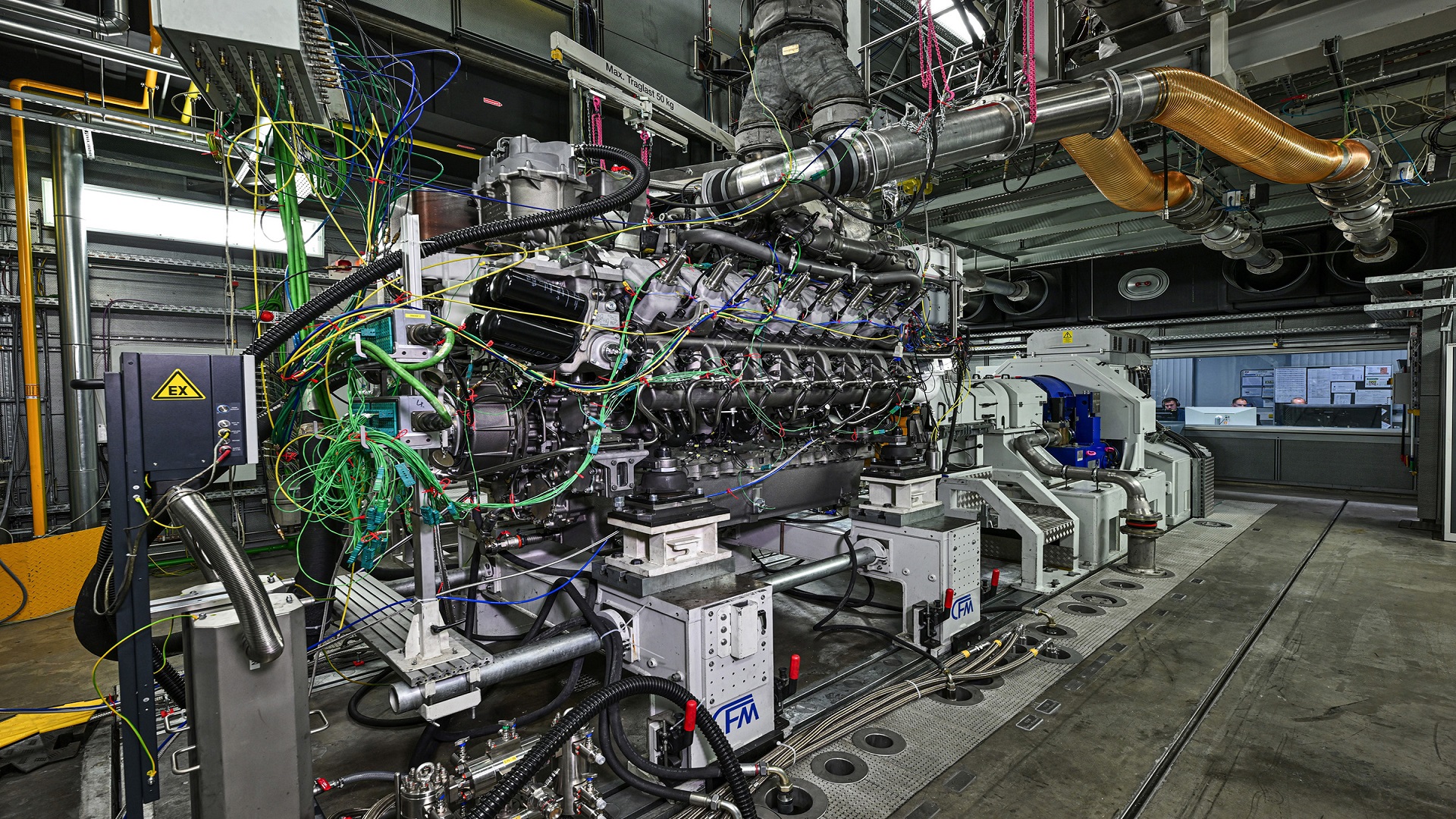
UPDATE: Rolls-Royce has achieved a major milestone by successfully testing the world’s first high-speed marine engine powered purely by methanol. This groundbreaking development, crucial for maritime emissions reduction, took place at Rolls-Royce Power Systems in Friedrichshafen, Germany, as part of the innovative meOHmare research project.
The test, a collaboration with fuel injection specialist Woodward L’Orange GmbH and the research institute WTZ Roßlau, aims to revolutionize ship propulsion and significantly cut carbon emissions across the maritime industry. Funded by the German Federal Ministry for Economic Affairs and Energy, the initiative seeks to establish a comprehensive, CO2-neutral engine concept by the end of 2025.
“This is a genuine world first,” stated Jörg Stratmann, CEO of Rolls-Royce Power Systems AG. “To date, there is no other high-speed engine in this performance class that runs purely on methanol.”
The innovative engine design contrasts sharply with traditional diesel engines. Methanol, a colorless liquid alcohol, requires a completely new injection system. Rolls-Royce engineers have reimagined the combustion process, turbocharging system, and engine controls to accommodate this alternative fuel. “Initial tests show that the engine is running smoothly – now it’s time for fine-tuning,” noted Johannes Kech, head of methanol engine development.
Methanol is emerging as a promising solution for decarbonizing maritime transport. It offers nearly CO2-neutral operation when produced using renewable energy, making it ideal for ferries, yachts, and offshore vessels facing stringent environmental regulations. “We are investing specifically in future technologies to open up efficient ways for our customers to reduce CO2 emissions,” emphasized Stratmann.
The successful test signifies a pivotal moment for sustainable shipping. Denise Kurtulus, senior vice president of global marine at Rolls-Royce, highlighted that the achievement validates green methanol as a forward-looking fuel. “The single-fuel methanol engine is an attractive solution for operators wanting to reduce their carbon footprint,” she stated.
Rolls-Royce plans to expand its marine portfolio with lower-carbon technologies, including a dual-fuel concept that utilizes both methanol and diesel. This transitional technology will support the broader adoption of green methanol as supply chains become established.
As the maritime industry grapples with the urgent need to reduce emissions, this advancement by Rolls-Royce could redefine the future of shipping. “For us, methanol is the fuel of the future in shipping – clean, efficient, and climate-friendly,” Kurtulus concluded.
This revolutionary engine development not only positions Rolls-Royce at the forefront of sustainable propulsion systems but also serves as a catalyst for change in an industry facing pressing environmental challenges. The world will be watching as further advancements unfold in the coming years.