BREAKING NEWS: A team of researchers has just announced a groundbreaking method for underwater communication that mimics dolphin whistles, achieving an impressive 90% recognition accuracy. This innovative technology, developed by experts from Tianjin University and the Shenyang Institute of Automation, aims to enhance covert communication capabilities for maritime military operations.
The researchers have tackled serious limitations faced by conventional communication methods in recognizing signals that employ underwater bionic camouflage covert communication (UBCCC). Traditional systems often misclassify these advanced signals, which are designed to blend seamlessly with natural underwater sounds. The new approach, based on convolutional neural networks (CNN), showcases three core steps to ensure accurate signal identification, a significant advancement that could impact military and research operations immediately.
WHY THIS MATTERS NOW: With rising tensions in maritime regions, effective communication technology is crucial for national security and defense operations. The ability to accurately identify signals mimicking dolphin whistles can provide tactical advantages in underwater environments, making this development vital for ongoing military confrontations.
The innovative recognition method consists of:
1. **Spatial Diversity Combining (SDC)**: This technique enhances the main signal and reduces interference from multipath propagation, crucial for underwater channels.
2. **Time-Frequency Spectrum (TFS) Mask Filtering**: By treating the TFS as a 2D image, researchers can effectively extract whistle signals from noise, significantly improving signal clarity.
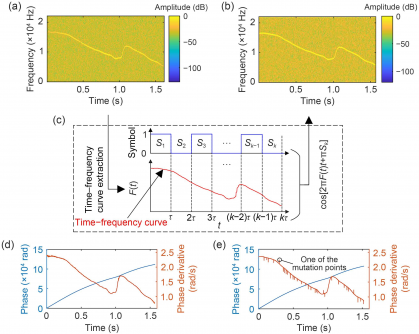
3. **Phase Derivative Spectrum and CNN Recognition**: The Hilbert transform is used to analyze extracted signals, with the CNN applying advanced algorithms to accurately differentiate between various signal types.
The research team conducted extensive validations through numerical simulations and real-world lake experiments, achieving a recognition accuracy of 81% in a controlled setting at Qingnian Lake in Tianjin, where the communication distance was 150 m and the signal-to-noise ratio (SNR) was 6.36 dB. These results demonstrate that the new system can perform effectively even in challenging underwater conditions.
In simulations, the researchers achieved 90% accuracy at a 0 dB SNR, confirming the method’s reliability under variable conditions. The findings indicate that recognition accuracy is higher in deep-water channels compared to shallow waters, an essential factor for future applications.
The paper, titled “Recognition method for underwater communication signals that mimic dolphin whistles using phase-shifting modulation,” authored by Qingwang YAO, Jiajia JIANG, Xiaolong YU, and others, is now available for public access. The full text can be found at https://doi.org/10.1631/FITEE.2400572.
WHAT’S NEXT: Researchers aim to further refine this method and explore its applications in various maritime scenarios. The implications for military strategy and environmental monitoring are vast, making this a critical area for ongoing research and development.
Stay tuned for updates as this story develops and as more breakthroughs in underwater communication technology emerge.