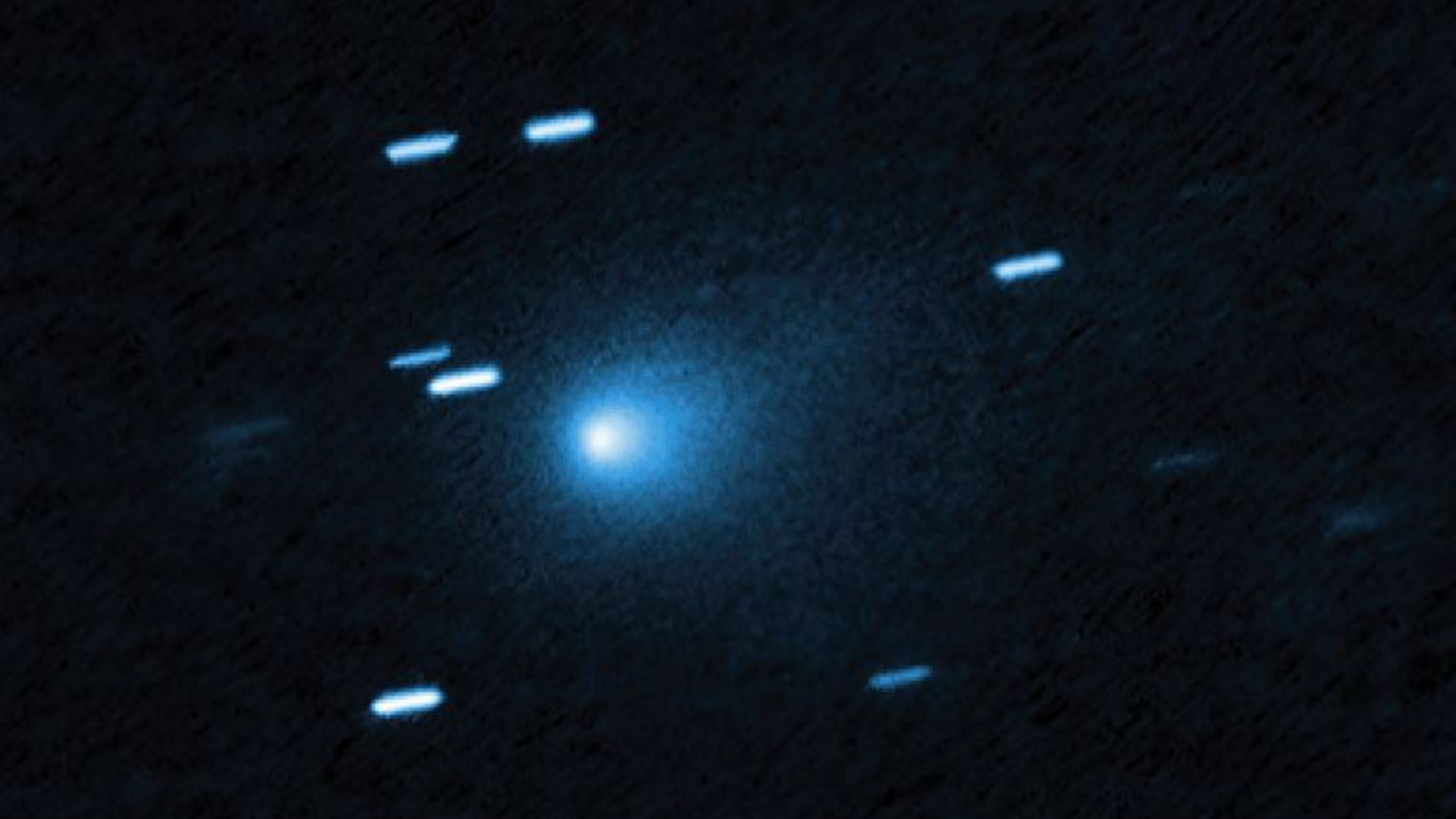
Recent observations from space-based instruments have revealed that the interstellar object 3I/ATLAS has significantly brightened and shifted in color as it approaches its closest point to the Sun, known as perihelion, on October 29, 2025. This change has drawn the attention of scientists who are keen to understand the unusual characteristics of this celestial body.
Despite being obscured from Earth-based telescopes due to its position behind the Sun’s glare, multiple space observatories have continued to monitor 3I/ATLAS. Instruments such as NASA’s STEREO-A, the SOHO observatory, and the weather satellite GOES-19 have provided vital data. These observatories have captured striking images of 3I/ATLAS, which now appears dramatically brighter and bluer than the Sun itself.
Unusual Color Changes Spark Scientific Interest
The shift in color is particularly intriguing. Earlier data analyzed by Harvard astrophysicist Avi Loeb indicated that 3I/ATLAS exhibited a red hue, typical for dusty or carbon-rich objects. Yet, recent observations reveal it now reflects or emits light that is more intense in the blue spectrum. This phenomenon could result from materials that scatter blue light efficiently or from gas or plasma around the object glowing due to sunlight or internal reactions.
Interestingly, the blue tint suggests that light is being emitted rather than merely reflected. This raises questions about the processes at work, as Loeb noted that such behavior “far exceeds what we expect from natural Oort cloud comets.” He emphasized that this could imply that 3I/ATLAS is composed of unfamiliar materials that enable it to withstand close encounters with the Sun.
The data supporting these findings were gathered between September and October 2025. The STEREO-A twin camera components, HI1 and COR2, along with SOHO’s LASCO C3 coronagraph and GOES-19‘s CCOR-1, captured an unusual pattern of brightening. The different positions of these instruments allowed scientists to cross-check the measurements, enhancing the credibility of the results.
Rapid Brightening Compared to Typical Comets
3I/ATLAS’s brightness has increased at an unprecedented rate as it approaches the Sun. The glow intensified at a rate that scales inversely with distance from the Sun to the power of -7.5, indicating extreme brightening relative to typical solar system objects. Observations from GOES-19 also revealed a faint halo extending up to 300,000 kilometres around the object, comparable to a carbon dioxide plume identified by the SPHEREx Space Observatory in August.
Following perihelion, 3I/ATLAS is expected to become visible from Earth again in mid-November. Its closest approach to our planet is anticipated on December 19, 2025. During this period, astronomers, including those using the Hubble and James Webb telescopes, hope to conduct follow-up observations. As comets typically emerge brighter after passing the Sun, scientists are eager to examine this interstellar visitor in detail.
Despite the excitement surrounding these findings, the exact reasons behind 3I/ATLAS’s rapid brightening remain unclear. As Loeb puts it, “Whether 3I/ATLAS’s behavior is due to the laws of nature or to deliberate design, we are witnessing something that doesn’t fit the ordinary patterns of comets or asteroids.” This ongoing investigation could reshape our understanding of interstellar objects and their interactions with the solar system.