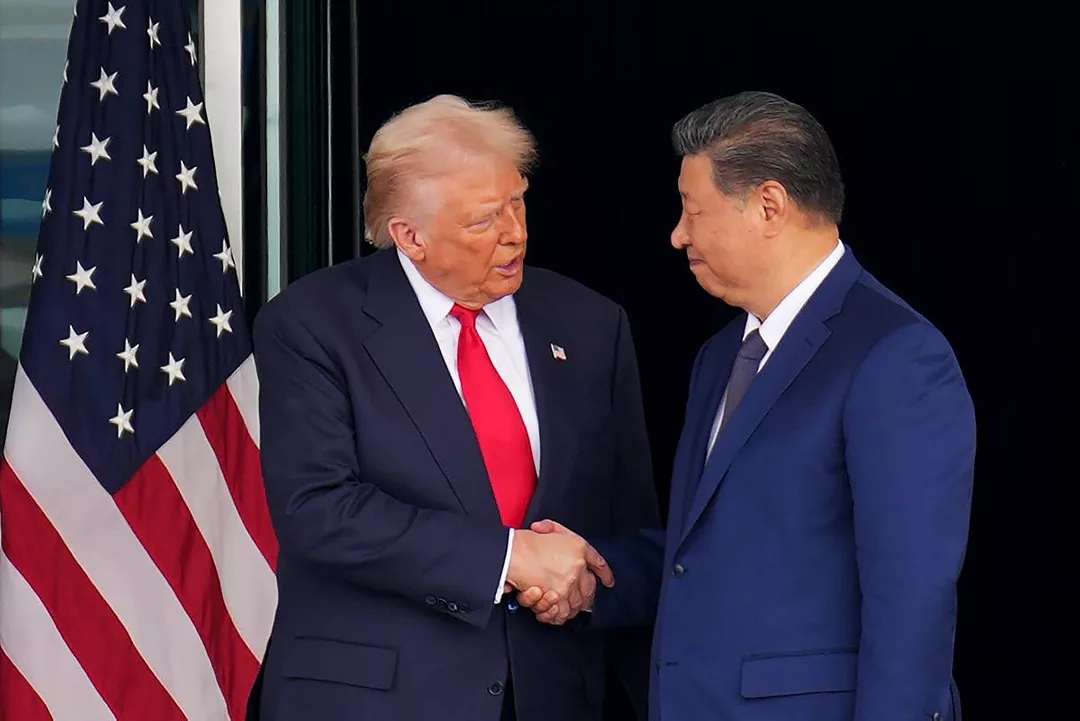
In a recent meeting aboard Air Force One, Donald Trump announced a temporary resolution regarding the contentious issue of rare earth exports with Xi Jinping, China’s president. This marked their first encounter since Trump returned to office in January 2023. Trump claimed the two nations had “settled” their differences, specifically regarding access to China’s critical minerals, which are crucial for various industries, including defense and technology.
During the meeting, Trump expressed optimism about the negotiations, stating, “There’s no roadblock at all on rare earth,” and suggested that the term would hopefully “disappear from our vocabulary for a little while.” This assertion followed China’s concession to delay the implementation of new, sweeping export controls for one year. Such measures are essential for numerous sectors, including the production of fighter jets, semiconductors, and electric vehicles.
Details of the Agreement
While Trump framed this agreement as a win for both the global economy and the United States, the situation remains complex. The existing export controls imposed by China are still in effect, meaning U.S. companies will continue to rely on Beijing for vital inputs. To facilitate this pause, the U.S. agreed to postpone its proposed expansion of an export blacklist that would have impacted thousands of Chinese firms.
Despite the apparent progress, U.S. Trade Representative Jamieson Greer acknowledged that the talks did not yield significant changes in China’s existing controls. He characterized the agreement as a continuation of previous negotiations rather than a substantial victory. Greer noted, “We have some rare earth controls from earlier in the year on magnets, where we got to a decent flow, but now we expect them to flow even better.”
Critics, particularly those wary of China’s growing influence, expressed skepticism about the outcome. Derek Scissors, a China expert at the American Enterprise Institute, pointed out that U.S. policy seems increasingly dictated by sectors dependent on China. He stated, “American policy since China’s April magnet controls looks like Germany’s long-term China policy: Both run by a few automakers which are dependent on China.”
Concerns Over Bargaining Power
The negotiations underscore the imbalanced bargaining power that China holds in these discussions. The U.S. has effectively linked its controls on high-tech exports, including AI chips, to China’s rare earth policies, raising alarms among some Washington hawks. Chris McGuire, a former National Security Council member, criticized this approach, arguing that the U.S. is setting a dangerous precedent by conceding to China’s demands rather than pushing back against their aggressive policies.
The recent deal represents a one-year ceasefire on new controls, but it primarily benefits China, given that U.S. measures are more targeted and frequently updated. Trump’s earlier threats of imposing a 100% tariff increase have now been retracted, alongside the halt of additional tariffs related to China’s involvement in the fentanyl trade. This shift may hinder Trump’s goal of reducing American manufacturing reliance on China.
As part of this negotiation, Trump refrained from authorizing the export of Nvidia Corp.‘s advanced Blackwell AI chips to China, despite initial indications that he might do so. Furthermore, there were no discussions regarding increasing Chinese investments in the U.S., a point of interest for the Trump administration in negotiations with other nations.
The upcoming series of meetings scheduled for 2026 will be crucial for determining the long-term implications of this agreement. However, industry experts warn that the promises made during this week’s discussions may not yield substantial changes for sectors reliant on rare earth materials.
The ongoing tension between the two nations highlights the complexities surrounding global supply chains and the persistent need for a more comprehensive agreement. Wade Senti, president of Advanced Magnet Lab Inc., remarked that little has changed in the military’s landscape since earlier this year, emphasizing that the focus on rare earths remains critical.
As the situation unfolds, the reality for industries dependent on rare earth imports shows that the landscape remains largely shaped by China’s export controls. While the temporary pause offers some relief, companies continue to face bureaucratic hurdles in obtaining licenses for essential materials.
In summary, while Trump and Xi’s recent meeting resulted in a temporary truce regarding rare earth exports, the broader implications for U.S.-China relations and global supply chains remain uncertain. As both nations prepare for future discussions, the balance of power will continue to play a pivotal role in shaping outcomes.