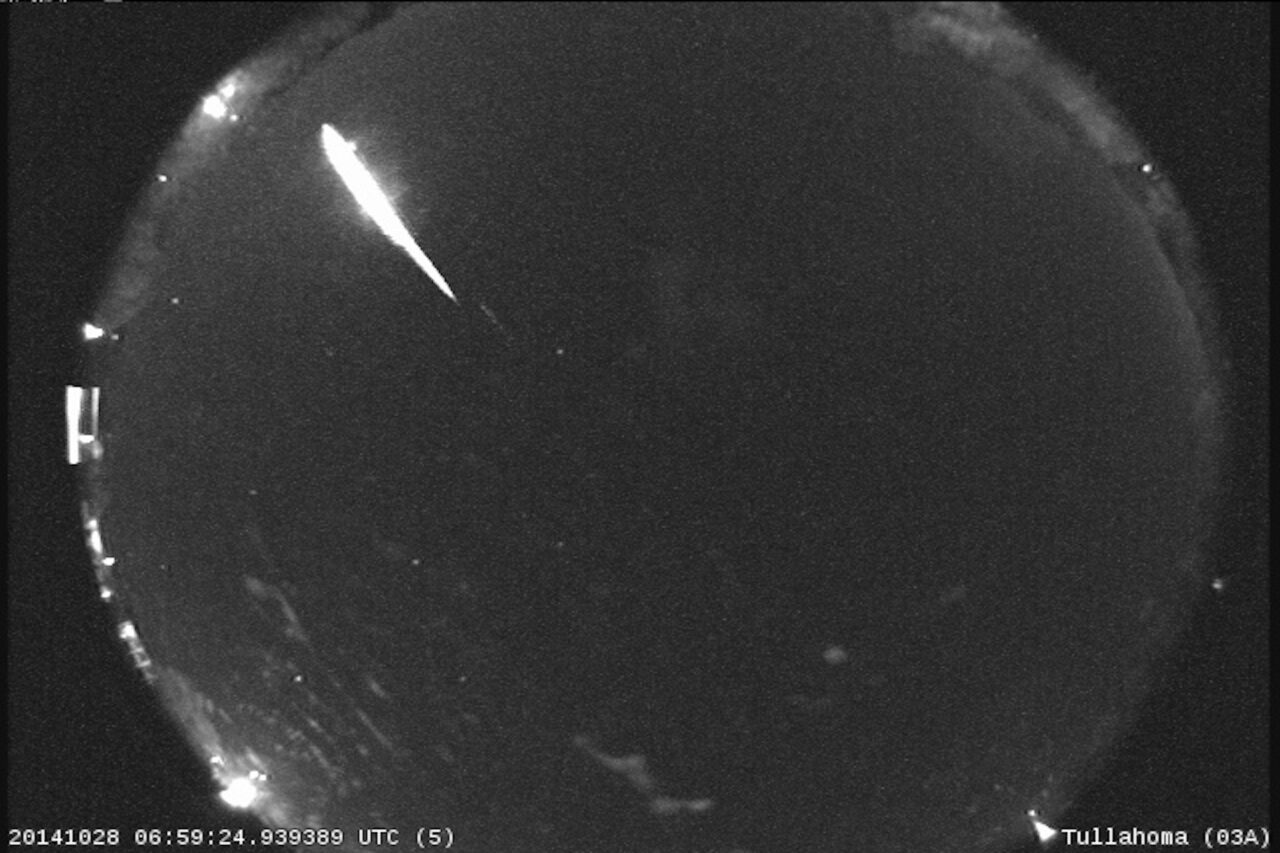
Each autumn, Earth travels through the debris shed by Comet Encke, creating stunning fireballs that illuminate the night sky. This annual event, known as the Taurid meteor shower, can become more intense as Earth encounters denser, pebble-sized fragments. However, a new study published in Acta Astronautica raises concerns about potential risks associated with larger meteor fragments impacting our planet during the upcoming years of 2032 and 2036.
The Taurid meteor shower, which typically peaks from late October to early November, radiates from the constellation Taurus. The parent comet, Encke, completes an orbit around the Sun approximately every three years, releasing dust and rock that Earth passes through twice a year. The more significant meteor activity occurs every three to seven years, coinciding with the presence of larger fragments in the debris field.
Researchers aimed to assess whether swarms of larger meteors could pose a hazard to Earth. Their study utilized observational data and planetary defense modeling to reveal that the risk of air-burst sized Near-Earth Objects is higher than previously thought. These objects are small enough to explode in the atmosphere, yet large enough to cause significant damage upon entering.
One of the study’s warnings focuses on the possibility of a Taurid resonant swarm, consisting of debris clusters influenced by the gravitational pull of Jupiter. The Taurid stream orbits the Sun seven times for every two orbits of Jupiter, leading to regular interactions that can result in dense clusters of debris.
Mark Boslough, a researcher at the University of New Mexico and lead author of the study, stated, “The resonant swarm is theoretical, but there is some evidence that a sparse swarm of small objects exists because bright fireballs and seismic signatures of impacts on the moon have been observed at times that the theory has predicted.”
If this hypothetical swarm occurs, it is expected to make a close approach to Earth in both 2032 and 2036, potentially increasing the risk of impacts during those years. Fortunately, researchers have time to monitor these clusters and devise mitigation strategies.
“We have the technology to test the Taurid resonant swarm by using existing telescopes for targeted sky surveys in 2032 and 2036 when the hypothetical swarm will make very close approaches,” Boslough added. “If we discover the objects with enough warning time, then we can take measures to reduce or eliminate the risk.”
Boslough emphasized that while the average probability of an impact remains extremely low, heightened risk still means that the chances of a strike are minimal. He noted that in 2036, fireballs will emanate from the direction of the Sun, making them less visible unless they are exceptionally bright.
As the annual Taurid meteor shower approaches, this new research highlights the importance of vigilance and preparedness in the face of potential cosmic threats. Observing and understanding these phenomena will be crucial to ensuring the safety of our planet in the coming decades.