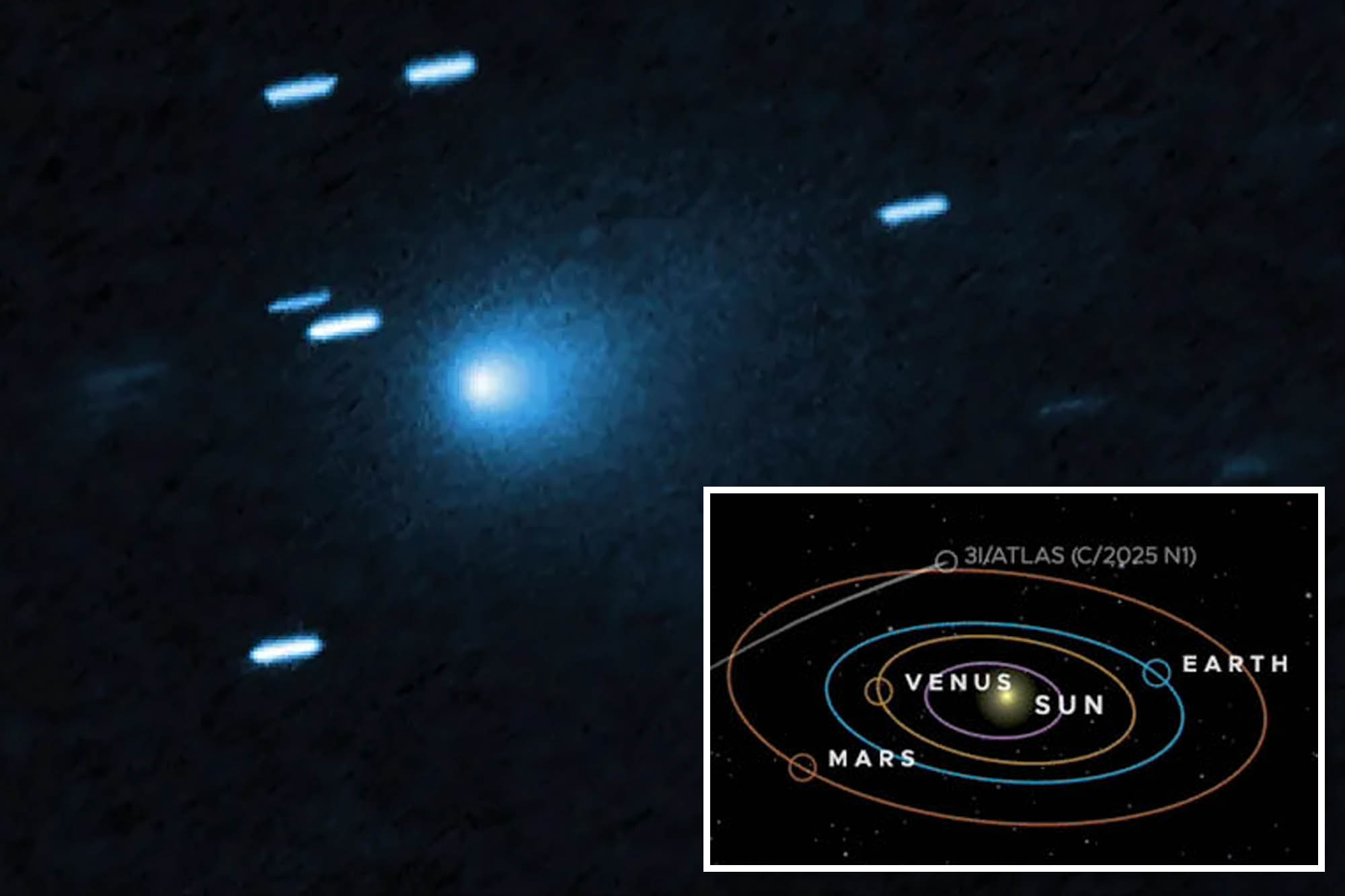
The interstellar object known as 3I/ATLAS has displayed unusual characteristics as it traveled through our solar system. According to Harvard astrophysicist Avi Loeb, the object has shown signs of non-gravitational acceleration and a color shift to a hue “bluer than the Sun.” These observations have sparked speculation that the object may be an alien craft or have some form of artificial propulsion system.
NASA reported this week that 3I/ATLAS was exhibiting dramatic outgassing, a phenomenon typically associated with comets. This outgassing could result in the object losing approximately half its mass and producing a significant plume of debris in the coming months. Loeb indicated in a recent paper that the combination of the object’s acceleration and its striking blue color could hint at an artificially constructed engine.
In a post on Medium, Loeb stated, “This might also explain the report on 3I/ATLAS getting ‘bluer than Sun.’ It could potentially be explained by a hot engine or source of artificial light.” While he acknowledged that these features might also represent a natural signature of a comet, the implications of an artificial source have captured public interest.
As 3I/ATLAS approached the Sun, it came within 172 million miles of our star. Unfortunately, Earth-based telescopes were not able to take direct measurements due to the position of the Earth on the opposite side of the Sun. However, several spacecraft orbiting the Sun managed to collect data that illustrated a “rapid brightening” of the object, which appeared “distinctly bluer than the Sun,” according to findings published by the US Naval Research Lab.
Loeb described this hue as “very surprising,” especially given earlier observations that indicated the object was red before shifting to green. The upcoming closest approach of 3I/ATLAS to Earth is scheduled for December 19, 2023, when it will pass at a distance of approximately 167 million miles. This event will provide researchers their best opportunity to determine whether the object is indeed a comet or a man-made craft.
Loeb expressed concern about the lack of images from the Mars Reconnaissance Orbiter, which was positioned to capture data during the object’s close encounter with the Red Planet in early October. Reports indicate that NASA will not release these anticipated images until the U.S. government reopens.
In response to the growing speculation surrounding 3I/ATLAS, Sean Duffy, NASA’s Acting Administrator, attempted to quell fears about potential threats. On social media platform X, he reassured the public, stating, “NASA’s observations show that this is the third interstellar comet to pass through our solar system. No aliens. No threat to life here on Earth.”
As the scientific community prepares for the upcoming flyby, the mystery surrounding 3I/ATLAS continues to intrigue both astronomers and the public alike. The findings and observations from this event could significantly enhance our understanding of interstellar objects and their characteristics.