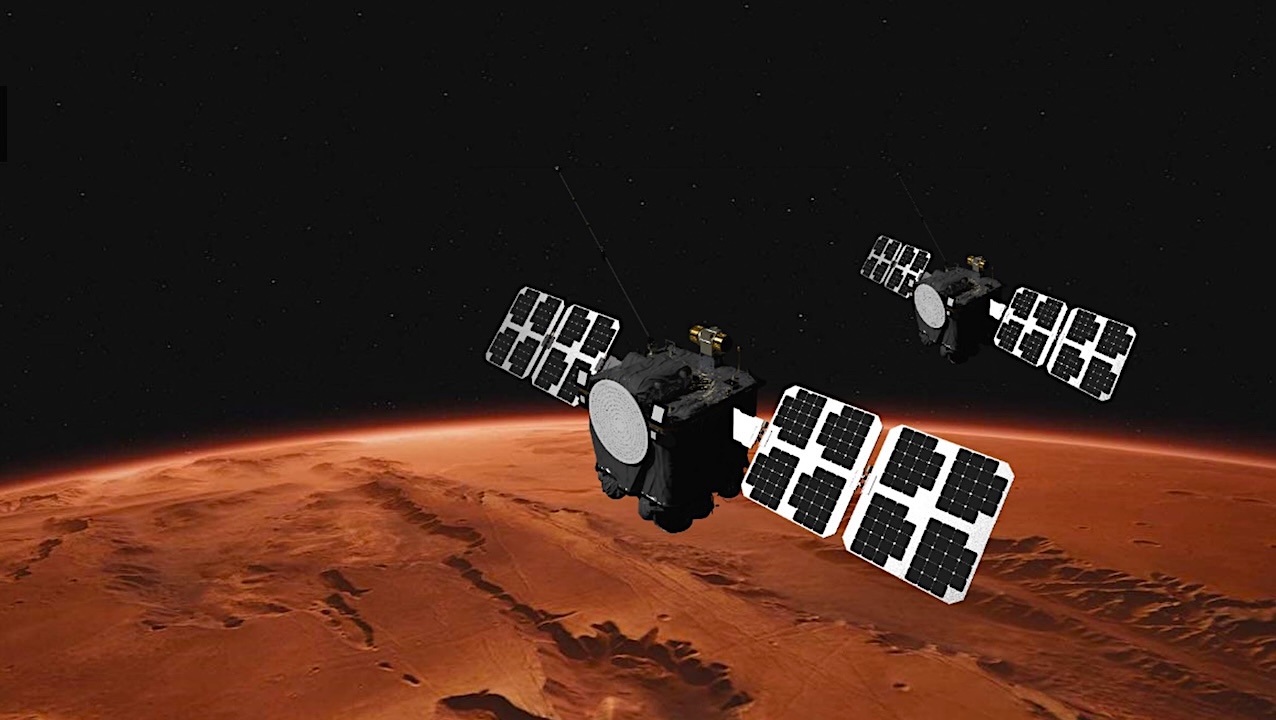
NASA is preparing for its pioneering ESCAPADE mission, which will mark the first dual-satellite endeavor aimed at exploring another planet. Scheduled for launch no earlier than November 9, 2025, from Cape Canaveral, Florida, this ambitious project will deploy two identical spacecraft designed to study Mars’ magnetic fields and upper atmosphere.
The ESCAPADE (Escape and Plasma Acceleration and Dynamics Explorers) mission is significant not only for its scientific objectives but also for its innovative approach to planetary exploration. Managed and operated by the University of California, Berkeley, the twin satellites will travel in formation, allowing for comprehensive mapping and analysis of Mars’ magnetosphere.
Scientific Goals and Significance
The primary goal of the ESCAPADE mission is to enhance our understanding of Mars’ atmospheric dynamics and its interaction with solar winds. By examining the planet’s magnetic fields, scientists hope to uncover how these forces affect the loss of atmospheric particles, a process that has implications for the planet’s climate history and potential habitability.
The two spacecraft will be equipped with advanced instruments capable of collecting data on plasma dynamics and magnetic field structures. This data is expected to provide new insights into the processes that shape the Martian environment, thereby filling existing gaps in our knowledge about Mars and its evolution.
Launch Preparations and Future Prospects
As the launch date approaches, teams at NASA and UC Berkeley are diligently finalizing preparations. The ESCAPADE mission is part of NASA’s broader strategy to expand its exploration of Mars, which has included various landers and rovers over the past decades.
With the successful deployment of the ESCAPADE satellites, researchers anticipate a wealth of data that could inform future missions and potentially guide human exploration of Mars. The mission underscores the importance of collaborative efforts in space research, highlighting the role of academic institutions in advancing our understanding of planetary science.
In conclusion, the ESCAPADE mission represents a crucial step forward in the quest to explore Mars, promising to deliver groundbreaking discoveries that may redefine our understanding of the Red Planet. As the launch window approaches, the scientific community eagerly awaits the insights that these twin satellites will provide.