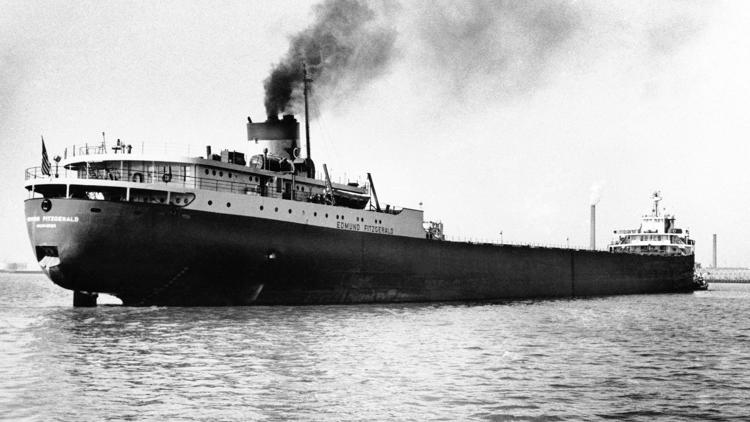
On November 9, 1975, the S.S. Edmund Fitzgerald sank in Lake Superior during a fierce storm, resulting in the loss of all 29 crew members on board. This maritime disaster remains one of the most notorious shipwrecks in American history, captivating public interest for half a century.
The Edmund Fitzgerald, named after the president of Northwestern Mutual Life Insurance, was launched on June 8, 1958. At 729 feet long and weighing over 13,000 tons, it was the largest vessel on Lake Superior for 13 years. On its final journey, the ship departed from Superior, Wisconsin, carrying a load of taconite to Zug Island in Detroit, Michigan. As the storm intensified, the nearby S.S. Arthur M. Anderson lost sight of the Fitzgerald on radar. The ship was declared missing the following day, leading to an extensive search operation. Although two lifeboats were discovered, all crew members were ultimately presumed lost.
The precise cause of the sinking remains a mystery. Captain Bernie Cooper of the S.S. Arthur M. Anderson speculated that the Fitzgerald had drifted dangerously close to shallow waters and began taking on water hours before its sinking. The U.S. Coast Guard’s official report, released in 1977, could not identify a definitive cause but suggested that massive flooding in the cargo hold led to the loss of buoyancy and stability. This flooding was likely due to ineffective hatch closures as waves crashed over the deck.
Over the years, various theories have emerged regarding the sinking. Some commentators have proposed that a structural failure in the hull contributed to the disaster, while others suggest that the ship may have been overwhelmed by a rogue wave.
The enduring fascination with the Edmund Fitzgerald can be attributed to several factors, including its relatively recent occurrence and the personal connections of the victims. Many families of the crew members still remember their loved ones. In a poignant conversation with Wisconsin Public Radio, Missy Clark-Nabozny reflected on her grandfather, John Simmons, who was aboard when the ship sank. “There was a lot of sobbing, a lot of crying. But it was quiet,” she recalled, describing the scene as “quiet chaos.”
The ship’s legacy has also been immortalized in popular culture, particularly through the folk song “The Wreck of the Edmund Fitzgerald” by Canadian singer Gordon Lightfoot, released in 1976. The haunting melody and evocative lyrics have made it a classic, ensuring that the story of the Fitzgerald lives on. In recent years, the song has seen a resurgence in popularity, especially on social media platforms like TikTok, where users have created videos retelling the ship’s tragic final voyage.
As the 50th anniversary of the sinking approaches, the story of the S.S. Edmund Fitzgerald continues to resonate, serving as a reminder of the dangers of maritime travel and the lives forever changed by this tragic event.