An international team of archaeologists has unearthed the remains of a significant Bronze Age settlement known as Semiyarka in the Kazakh steppe. This discovery, made by researchers from UCL, Durham University, and Toraighyrov University, offers new insights into urban life and metal production during prehistoric times in Eurasia.
Located dramatically on a 140-hectare site overlooking the Irtysh River in northeastern Kazakhstan, Semiyarka is described as one of the most remarkable findings in steppe archaeology in decades. The settlement, nicknamed the “City of Seven Ravines,” thrived around 1600 BC and showcases a sophisticated form of urban planning not typically associated with the region’s historical nomadic communities.
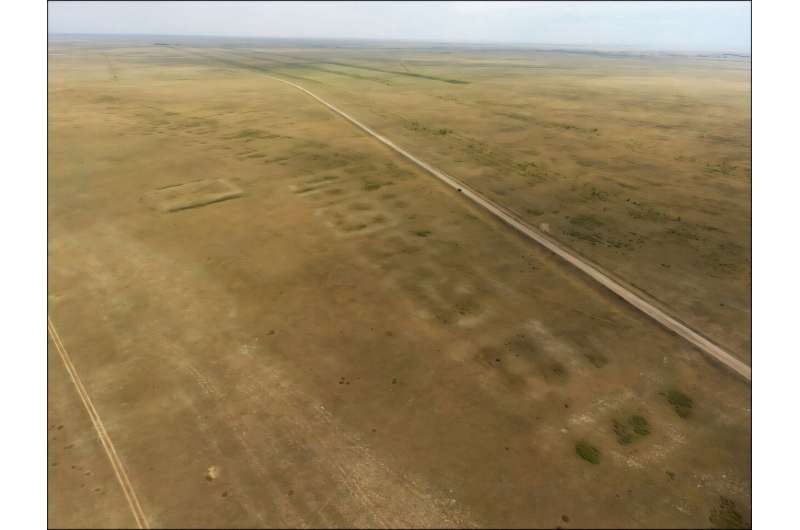
As excavations continue, archaeologists have identified features such as rectilinear earthworks, enclosed household compounds, and a central monumental building that likely served religious or governance purposes. A particularly striking aspect of Semiyarka is its industrial zone, dedicated to the production of copper and tin bronze on an unprecedented scale for this area.
Geophysical surveys and excavation efforts have revealed crucial artifacts including crucibles, slag, and tin bronze items, indicating the presence of complex metallurgical production systems rather than mere small-scale workshops. The strategic location of Semiyarka, positioned on a promontory that controlled movement along the Irtysh River valley, suggests it was a vital center for trade and regional power.
The team, led by Dr. Viktor Merz and Dr. Ilya Merz from Toraighyrov University, alongside Dr. Miljana Radivojević from UCL and Professor Dan Lawrence from Durham University, has published their findings in the journal Antiquity. Their work employs advanced methods to reconstruct the social and technological landscape of Bronze Age Kazakhstan.
“Semiyarka transforms our understanding of steppe societies,” states Dr. Radivojević. “It demonstrates that mobile communities were capable of building and sustaining permanent, well-organized settlements centered on large-scale metallurgical production—including the elusive manufacture of tin bronze, a cornerstone of Eurasia’s Bronze Age economy that has long remained absent from the archaeological record.”
Professor Lawrence adds, “The scale and structure of Semiyarka are unlike anything else we’ve seen in the steppe zone. The rectilinear compounds and the potentially monumental building show that Bronze Age communities here were developing sophisticated, planned settlements similar to those of their contemporaries in more traditionally ‘urban’ parts of the ancient world.”
Reflecting on the long-term research at the site, Dr. Merz remarked, “I have been surveying Semiyarka for many years, but this collaboration has truly elevated our understanding of the site. Working with colleagues from UCL and Durham has brought new methods and perspectives, and I look forward to what the next phase of excavation will reveal now that we can draw on their specialist expertise in archaeometallurgy and landscape archaeology.”
The city of Semiyarka remains a powerful testament to the urban ingenuity present in the open grasslands of Central Asia. This Bronze Age city stands proudly above the Irtysh valley, underscoring that it once shared characteristics with some of the most advanced civilizations of its time.
More information can be found in the article titled “A major city of the Kazakh Steppe? Investigating Semiyarka’s Bronze Age legacy” published in Antiquity, DOI: 10.15184/aqy.2025.10244.