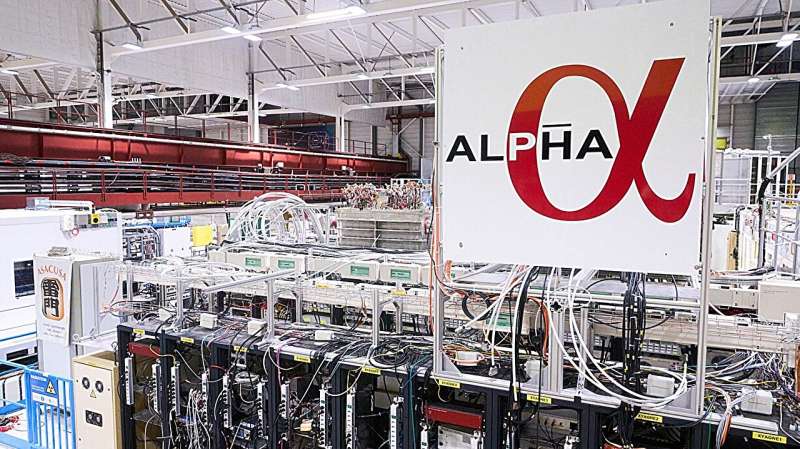
Physicists from Swansea University have announced a significant breakthrough in antihydrogen research at CERN, improving the trapping rate by a factor of ten. This advancement, part of the international Antihydrogen Laser Physics Apparatus (ALPHA) collaboration, has been detailed in a study published in Nature Communications. The new technique could help address a fundamental question in physics: why is there such a stark imbalance between matter and antimatter in the universe?
According to the widely accepted Big Bang theory, equal amounts of matter and antimatter were created following the universe’s inception. Yet, the world we observe is predominantly composed of matter. Antihydrogen, the counterpart of hydrogen, consists of an antiproton and a positron. Understanding its properties is crucial for physicists seeking to explore the fundamental laws governing the universe.
The process of producing and trapping antihydrogen has historically been complex. Previous methodologies required up to 24 hours to capture just 2,000 atoms, constraining the scope of experiments at ALPHA. The Swansea-led team has revolutionized this process. By employing laser-cooled beryllium ions, they successfully cooled positrons to below 10 Kelvin (approximately -263°C), a notable improvement from the previous cooling threshold of around 15 Kelvin.
This achievement resulted in a record trapping of 15,000 atoms in less than seven hours. The implications of this breakthrough are profound, allowing for a broader range of experiments and enabling more accurate tests of fundamental physics, such as the behavior of antimatter in gravitational fields and its adherence to the same symmetries as matter.
Professor Niels Madsen, the lead author of the study and Deputy Spokesperson for ALPHA, expressed his excitement: “It’s more than a decade since I first realized that this was the way forward, so it’s incredibly gratifying to see the spectacular outcome that will lead to many new exciting measurements on antihydrogen.”
Ph.D. student Maria Gonçalves, a key contributor to the project, remarked on the significance of their first successful attempt, which yielded 36 antihydrogen atoms and instantly doubled the previous method’s efficiency. “It was a very exciting project to be a part of, and I’m looking forward to seeing what pioneering measurements this technique has made possible,” she said.
Dr. Kurt Thompson, another leading researcher involved, highlighted the collaborative effort behind this achievement. “This fantastic accomplishment was realized through the dedication of many Swansea graduate students, summer students, and researchers over the past decade. It represents a major paradigm shift in the capabilities of antihydrogen research. Experiments that used to take months can now be performed in a single day.”
As the research continues, the ALPHA collaboration aims to delve deeper into the mysteries of antimatter, potentially reshaping our understanding of the universe. The implications of this breakthrough extend beyond the laboratory, as researchers strive to unlock the answers to some of the most profound questions in modern physics.
For further details, consult the research published in Nature Communications by R. Akbari et al, titled “Be+ assisted, simultaneous confinement of more than 15,000 antihydrogen atoms,” DOI: 10.1038/s41467-025-65085-4.