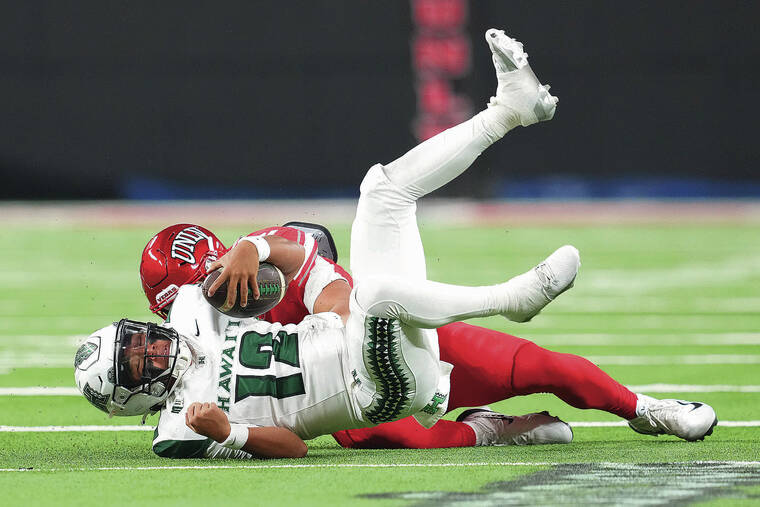
The University of Hawaii football team suffered a significant setback on November 24, 2023, with a 38-10 loss to the University of Nevada, Las Vegas (UNLV). This defeat, which took place at UNLV’s Allegiant Stadium, raises questions about the Warriors’ performance and future in the Mountain West Conference.
While the outcome was disappointing for Hawaii fans, there are larger implications for both teams. UNLV’s decision to remain in the Mountain West, rather than pursuing an opportunity in the Pac-12 alongside schools like Boise State and Fresno State, may have long-term benefits for Hawaii. Despite the painful loss, gratitude for this ongoing rivalry is warranted as it provides the Hawaii team with a competitive fixture.
UNLV’s Competitive Edge
As Hawaii fans grapple with the defeat, it is essential to recognize that UNLV’s stability in the Mountain West may strengthen the conference overall. The Rebels and Hawaii have met eight times recently, splitting the results evenly. This balance is critical as Hawaii continues to seek a reliable rival. UNLV’s established presence and financial backing could ultimately benefit Hawaii in the long run, especially as college football increasingly resembles a free agency format.
The Warriors had shown promise earlier in the season, notably with a 38-6 victory over San Diego State. Yet, the stark contrast in performance from that high point to the recent loss raises concerns. As the team prepares for its final games of the season, including a senior night match against Wyoming and a potential appearance in the Hawaii Bowl, consistency will be essential.
Challenges Ahead for Hawaii
The challenges for the University of Hawaii extend beyond the field. UNLV plays in a state-of-the-art NFL facility, while Hawaii’s home games are hosted at the Clarence T.C. Ching Complex, which accommodates significantly fewer spectators. The announced attendance for the UNLV game was 37,106, marking the largest home crowd of the year. In contrast, Ching Complex’s capacity stands at just 15,194, highlighting a considerable disparity in resources and fan engagement.
Despite these challenges, Hawaii can finish the season with a record of 9-4 if they secure a victory against Wyoming and perform well in the Hawaii Bowl. Such an outcome would be beneficial for recruiting efforts, particularly in retaining student-athletes in a competitive landscape where talent is increasingly mobile.
In conclusion, while the loss to UNLV stings, the broader context suggests that maintaining this rivalry could prove advantageous for the University of Hawaii. As they look to rebound from this defeat, the Warriors must focus on building a stronger foundation for future success.