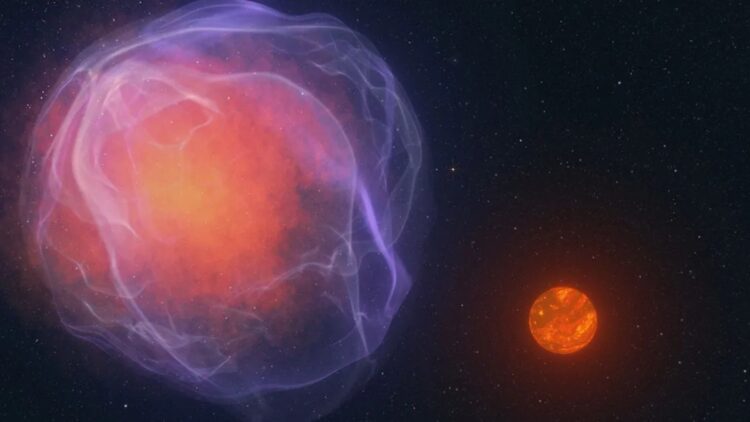
A team of scientists from NASA has made a groundbreaking discovery in the Milky Way—a red sphere known as CWISE J1249 that is traveling at an astonishing speed of over 1 million mph. This celestial body, detected by the WISE (Wide-field Infrared Survey Explorer) telescope, has raised significant questions about its classification and origins, marking a potential shift in our understanding of stellar objects.
Unusual Characteristics of CWISE J1249
The discovery was led by researcher Martin Kabatnik, whose team noted that CWISE J1249 possesses an unusually low mass and a metal content that is significantly below that of typical stars. This complexity complicates its classification; researchers are currently debating whether it should be categorized as a rogue planet or a different type of celestial body. While it has been identified as a rogue planet, the challenge lies in determining its origins and future trajectory.
Utilizing advanced observational technology, researchers examined the red sphere’s properties. The high velocity of CWISE J1249 initially caught the attention of scientists, but the findings from the W.M. Keck Observatory regarding its mass and metal content have added layers of intrigue to this discovery.
Theories on Origin and Trajectory
The remarkable speed and distinct characteristics of CWISE J1249 have led to two primary theories regarding its formation, although neither has been confirmed.
One theory posits that CWISE J1249 is a remnant of a white dwarf supernova. According to this hypothesis, the gravitational force from a violent explosion could have accelerated the red sphere to its current speed, resulting in the loss of much of its original mass.
Alternatively, some scientists suggest that it may be a failed star that never ignited or a rogue object ejected from its original stellar system due to gravitational interactions.
As researchers continue to investigate, they face two pressing questions: the origins of CWISE J1249 and its future path. Tracing its trajectory will be impossible without first identifying its point of origin. Currently classified as a rogue planet, it travels independently without orbiting a star.
The next steps in this research will involve searching for elemental evidence in situ and determining potential parent sources for CWISE J1249. Once these elements are located, scientists aim to expand their search for similar rogue objects, potentially reshaping our understanding of celestial dynamics.
As the investigation unfolds, the implications of CWISE J1249’s discovery could lead to a deeper comprehension of the universe and the various forms celestial bodies can take.