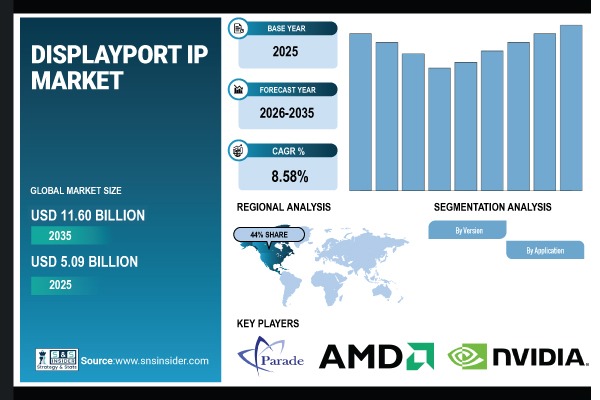
The DisplayPort IP market is set to experience significant growth, increasing from a valuation of USD 5.09 billion in 2025 to USD 11.60 billion by 2035. This expansion is projected to occur at a compound annual growth rate (CAGR) of 8.58% from 2026 to 2035, according to a report by SNS Insider. The surge in demand for ultra-high-definition content, including 8K video and high-refresh-rate gaming, is driving this growth as providers enhance data transmission speeds and power delivery capabilities.
The competitive landscape is evolving as manufacturers strive to meet rising consumer expectations. The increasing adoption of multipurpose cables—capable of transmitting power, data, and video—demands advancements in DisplayPort technology. This ensures compatibility with emerging standards such as Thunderbolt and USB-C. As a result, key players are investing heavily in research and development, boosting both market growth and technological progress.
Market Dynamics and Key Segments
In terms of applications, the consumer electronics sector held the largest market share, accounting for approximately 67% in 2025. This is attributed to the widespread use of DisplayPort technology in devices like laptops, monitors, and tablets. The automotive sector is anticipated to witness the fastest growth, with a projected CAGR of 13.21% during the same period. This growth is fueled by the increasing demand for advanced infotainment systems and user interfaces.
The report also highlights that the DisplayPort 1.0/1.1/1.1a versions dominated the market, capturing around 38% of the share in 2025. These versions offer compatibility with legacy devices and lower integration costs. Conversely, the DisplayPort 2.1 segment is expected to grow rapidly, with a CAGR of 11.49%, driven by its ultra-high bandwidth capabilities and improved power efficiency.
Regional Insights and Challenges
North America led the DisplayPort IP market in 2025, holding a revenue share of 44%. The presence of major technology companies and significant investments in research and development contribute to this dominance. On the other hand, the Asia-Pacific region is projected to experience the fastest growth rate of 10.27% from 2026 to 2035, driven by technological advancements and rising consumer electronics penetration.
Despite the optimistic outlook, the market faces challenges, notably high licensing fees and integration complexities. Manufacturers encounter substantial financial burdens due to these fees, which inflate product development costs. Additionally, the latest DisplayPort features require advanced technical skills for integration, leading to longer product development timelines and potentially affecting innovation. This poses particular difficulties for smaller companies and startups, hindering their ability to compete effectively in the market.
The report also notes recent developments in the sector. For instance, in March 2025, Parade Technologies announced its acquisition of key assets from Spectra7 Microsystems. This strategic move aims to enhance its high-speed connectivity solutions for data centers and AI computing.
As the demand for advanced DisplayPort IP solutions continues to rise, the market is expected to adapt and evolve, paving the way for enhanced user experiences across various industries.