Milan’s renowned Teatro alla Scala has opened its gala season with a performance of Dmitry Shostakovich’s opera, Lady Macbeth of Mtsensk, marking a significant cultural event for the second consecutive year since the onset of the war in Ukraine. This year, however, the atmosphere differs as a flash mob is set to demonstrate for peace outside the theatre, emphasizing the ongoing conflict’s impact on cultural expressions.
The performance, conducted by Riccardo Chailly, brings together notable figures from the worlds of culture, business, and politics, making it one of the most anticipated events in the European cultural calendar. Shostakovich’s 1934 opera, which explores the plight of women under Stalin’s oppressive regime, was famously banned shortly after its 1936 performance, coinciding with the start of the Great Purge.
A demonstration organized by the Italian liberal party +Europa aims to draw attention to the threats posed by Putin’s Russia to liberty and European democracy, while supporting the Ukrainian people. Initially planned for the square in front of La Scala, security concerns shifted the protest to a location behind City Hall.
Chailly, who has been collaborating with Russian director Vasily Barkhatov for around two years, expressed the importance of staging this opera, stating it is “a must.” He emphasized that the piece has endured significant challenges and deserves renewed attention. La Scala’s new general manager, Fortunato Ortombina, defended the decision to include Shostakovich’s work in a predominantly Italian repertoire, asserting that “music is fundamentally superior to any ideological conflict.”
American soprano Sara Jakubiak is making her La Scala debut in the lead role of Katerina, a character whose struggle against repression leads her to commit murder and face dire consequences. Reflecting on the challenges of her role, Jakubiak noted the demanding nature of the performance, which includes singing 47 high B flats in a single night. She described her partnership with Chailly as a harmonious alignment of artistic vision.
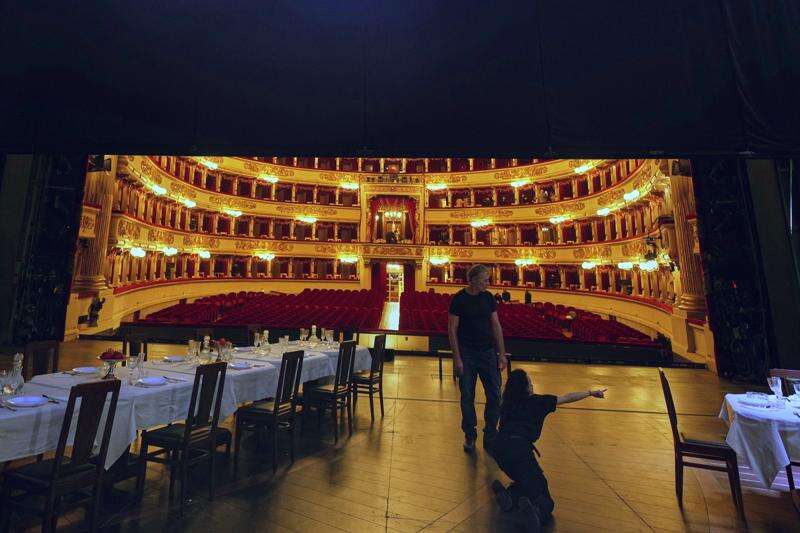
Barkhatov’s direction for Lady Macbeth of Mtsensk positions the opera in a 1950s cosmopolitan Russian city, aligning it with the end of Stalin’s rule rather than the original 19th-century rural setting. He views the opera as a personal tragedy rather than strictly a political narrative, and the staging reflects this interpretation through its Art Deco aesthetic and dynamic set design.
Despite the dark themes, Barkhatov characterized the narrative as a “weird… breakthrough to happiness and freedom,” while acknowledging the tragic realities that accompany such pursuits. As La Scala continues to navigate the complex interplay between culture and politics, the staging of Shostakovich’s work serves as a poignant reminder of music’s enduring power amidst strife.
With this season opener, La Scala not only celebrates its artistic heritage but also engages with pressing social issues, reaffirming its role as a cultural beacon in a challenging global landscape.