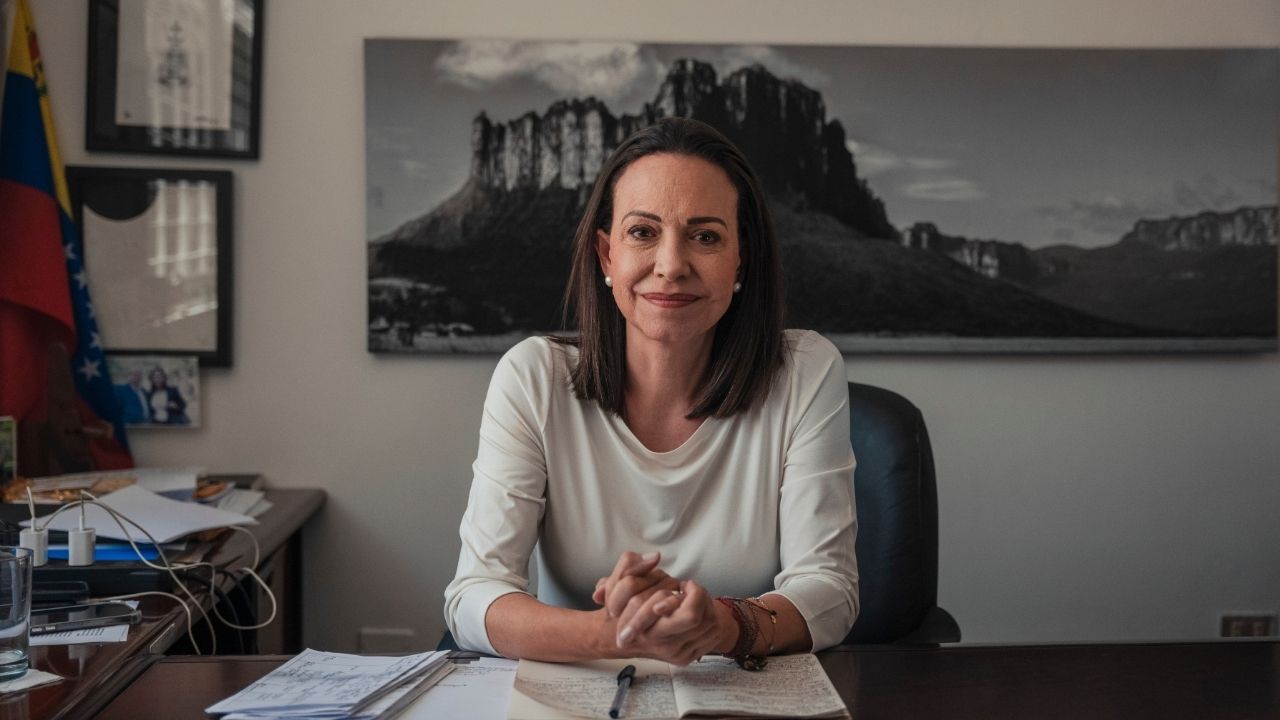
María Corina Machado, the Venezuelan opposition leader and Nobel Peace Prize laureate, presented her award to President Donald Trump during a meeting at the White House on March 15, 2024. This unusual gesture was framed as recognition of Trump’s commitment to promoting freedom in Venezuela. Following the meeting, Trump expressed his gratitude on social media, stating, “María presented me with her Nobel Peace Prize for the work I have done. Such a wonderful gesture of mutual respect. Thank you María!”
The White House shared an image of Trump holding the Nobel medal, which acknowledges his “Principled and Decisive Action to Secure a Free Venezuela.” However, the Nobel Committee clarified that the Peace Prize is not transferable, emphasizing that once awarded, it cannot be shared or revoked.
During a press conference after the meeting, Machado explained that she wanted to honor Trump for his dedication to Venezuelan freedom. This presentation follows months of Trump’s assertions that he deserved recognition for his role in the region, particularly following the U.S. military operation that led to the ousting of long-time authoritarian leader Nicolás Maduro. Machado has consistently praised this operation while remaining silent on the consequences of U.S. military actions, which have reportedly resulted in over 100 casualties.
Despite the symbolic nature of the meeting, it remains unclear what Machado hopes to achieve. Trump has previously declined to support her rise to power, suggesting that while she is a “very nice woman,” she lacks the necessary respect to lead Venezuela. Independent reports from the 2024 Venezuelan presidential election indicate Machado’s party received a substantial majority of votes, yet Maduro’s government declared him the victor amidst a crackdown on dissent.
Machado conveyed her appreciation for Trump’s understanding of Venezuela’s plight, stating she was “impressed” by his clarity on the issue. However, her alignment with Trump has drawn criticism in Norway, where the Nobel Peace Prize is viewed as a prestigious symbol of soft power. The Nobel Institute has found itself in damage-control mode following Machado’s comments about sharing the prize, reiterating the rules that govern the award.
Kristian Harpviken, director of the Nobel Institute, stated, “The prize is awarded on the basis of the laureate’s contributions by the time that the committee’s decision is taken.” Many Norwegians have expressed discontent with Machado’s actions, suggesting that the award is being politicized in ways that conflict with its original intent. Columnist Lena Lindgren remarked, “The prize is being used in a political game, a warlike game.”
In Venezuela, Machado’s visit to Washington elicited scorn from current officials. Delcy Rodríguez, Venezuela’s interim leader, criticized Machado, emphasizing her own integrity and commitment to leadership.
The controversy surrounding Machado’s presentation of the Nobel Prize to Trump highlights a broader misunderstanding of the award’s significance. Former Nobel Institute researcher Asle Sveen noted that Machado’s actions may be viewed unfavorably in Norway, especially given Trump’s contentious reputation. A pre-award poll from the Norwegian tabloid Nettavisen revealed that three-quarters of respondents opposed the idea of awarding Trump the Peace Prize, even if he played a role in facilitating peace agreements.
While some argue that Machado’s alignment with Trump compromises the integrity of the Nobel Prize, others see her as a courageous figure in the fight against authoritarianism. Marianne Dahl, research director at the Peace Research Institute Oslo, defended Machado’s actions, comparing her struggle against repression to past peace laureates who faced similar challenges.
As the situation in Venezuela continues to unfold, Machado’s presentation of her Nobel Peace Prize to Trump raises questions about the intersection of politics and humanitarian efforts. The implications of this meeting will likely resonate beyond the immediate context, reflecting the complex dynamics of international diplomacy and human rights advocacy.