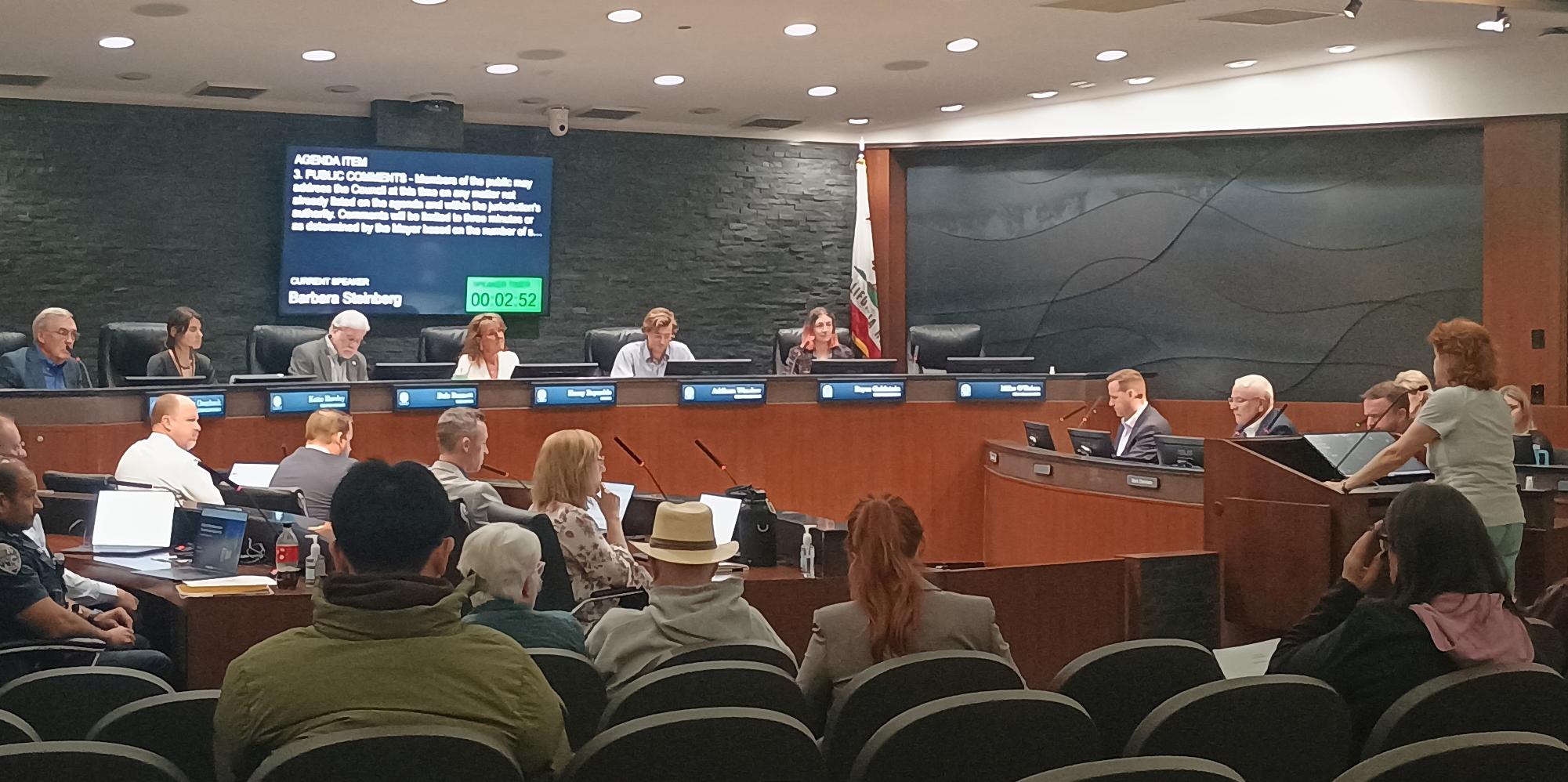
The Chico City Council voted on October 3, 2023, to approve a request from the Chico Police Department for military equipment. This decision follows Assembly Bill 481, which mandates that the police department submit an annual report detailing the use of military equipment from the prior year and any new requests. The term “military equipment” is somewhat misleading, as much of the gear is commercially available and designed specifically for law enforcement, according to the latest report under AB 481.
Councilmember Tom van Overbeek emphasized the arbitrary nature of the list, stating, “Most of them you can buy as a civilian.” Items classified as military equipment include drones, command vehicles, and less-than-lethal firearms, such as rubber bullets. The list also encompasses high-power rifles, long-range acoustic devices, and breaching tools.
Approval of the equipment request does not guarantee immediate purchase. The city council will finalize the police department’s budget in June, and there is a possibility that the approved items may not fit within the final budget. Dale Bennet, Vice Mayor and councilmember, acknowledged the tight budget constraints, stating, “Our decision tonight to support this is not necessarily [about] funding.”
Multiple council members highlighted that the police department receives nearly half of the city’s annual budget. Councilmember Katie Hawley expressed concerns about allocating excessive funds to the police, stating, “During budget season, that’s when I really want to advocate for not giving a crazy amount of money to the police department to spend on whatever toys they want.”
The council’s vote allows the police department to utilize funds from its allocated budget for the approved military equipment. While the budget may not have sufficient funds for all items, the department can still spend excess funds on equipment not restricted by AB 481.
Prior to the vote, Hawley proposed a motion to exclude seven SAR-15 patrol rifles from the request, while Councilmember Bryce Goldstein sought to exclude three command vehicles. Neither motion passed, resulting in the full request being approved by a vote of 4-3. Councilmembers Hawley, Goldstein, and Addison Winslow opposed the proposal, while Bennet, van Overbeek, O’Brien, and Mayor Kasey Reynolds supported it. Notably, O’Brien previously served as chief of the police department.
Van Overbeek countered Hawley’s assertion regarding the necessity of high-powered firearms, pointing out that the department currently has 73 SAR-15 rifles in its inventory. The Chico Police Department is budgeted for 106 officers, according to their recruitment page. He argued, “So we’re going to deny the police the same weapons that civilians have? That’s completely and utterly nonsensical.”
During the meeting, Winslow raised concerns that funding for police equipment detracts from improvements to the city’s roadways. In April 2023, Chico implemented Measure H, raising the city’s sales tax from 7.25% to 8.25%. A year later, 72% of the approximately $24 million in additional revenue was allocated to roadway improvements, as reported by the city. Winslow noted, “We’re almost down to about one-third of what we had in 2023 for streets and roads.”
Captain Omar Peña presented a slideshow to the council detailing items requested in the AB 481 report. Among the items, the police department is seeking three types of heavy-duty vehicles, including an aerial systems vehicle priced at over $500,000, intended to support drone operations. Hawley commented on the vehicle’s potential benefits, stating, “This [aerial systems vehicle] should allow officers to work more efficiently and to bring more gear.”
Police Chief Billy Aldridge underscored the need for the drone command vehicle, explaining, “The one that we really, really have to get is for our [drone deployment] team.” He highlighted the program’s success in past incidents, illustrating how drones can be used effectively in law enforcement situations. Aldridge provided an example where a drone helped de-escalate a tense situation, stating, “He threw the gun down and then came out to us.”
Community members were given two minutes each to voice their opinions before the council deliberated on the AB 481 report. Julian Zener, representing a local organization called Concerned Community for Justice, asserted that their group is often mischaracterized as anti-police. He advocated for the use of robotic equipment, noting its capability to breach buildings remotely, which reduces the need for traditional, more dangerous methods. “Just because it’s called military equipment doesn’t mean it’s bad,” Zener said. He expressed concern specifically regarding the need for larger incident command vehicles in a small college town like Chico, questioning, “If there are no major uprisings here, why do we need this large equipment?”
The council’s decision to approve the police department’s military equipment request reflects ongoing debates about law enforcement funding and community safety, a discourse likely to continue as budget discussions unfold in the coming months.