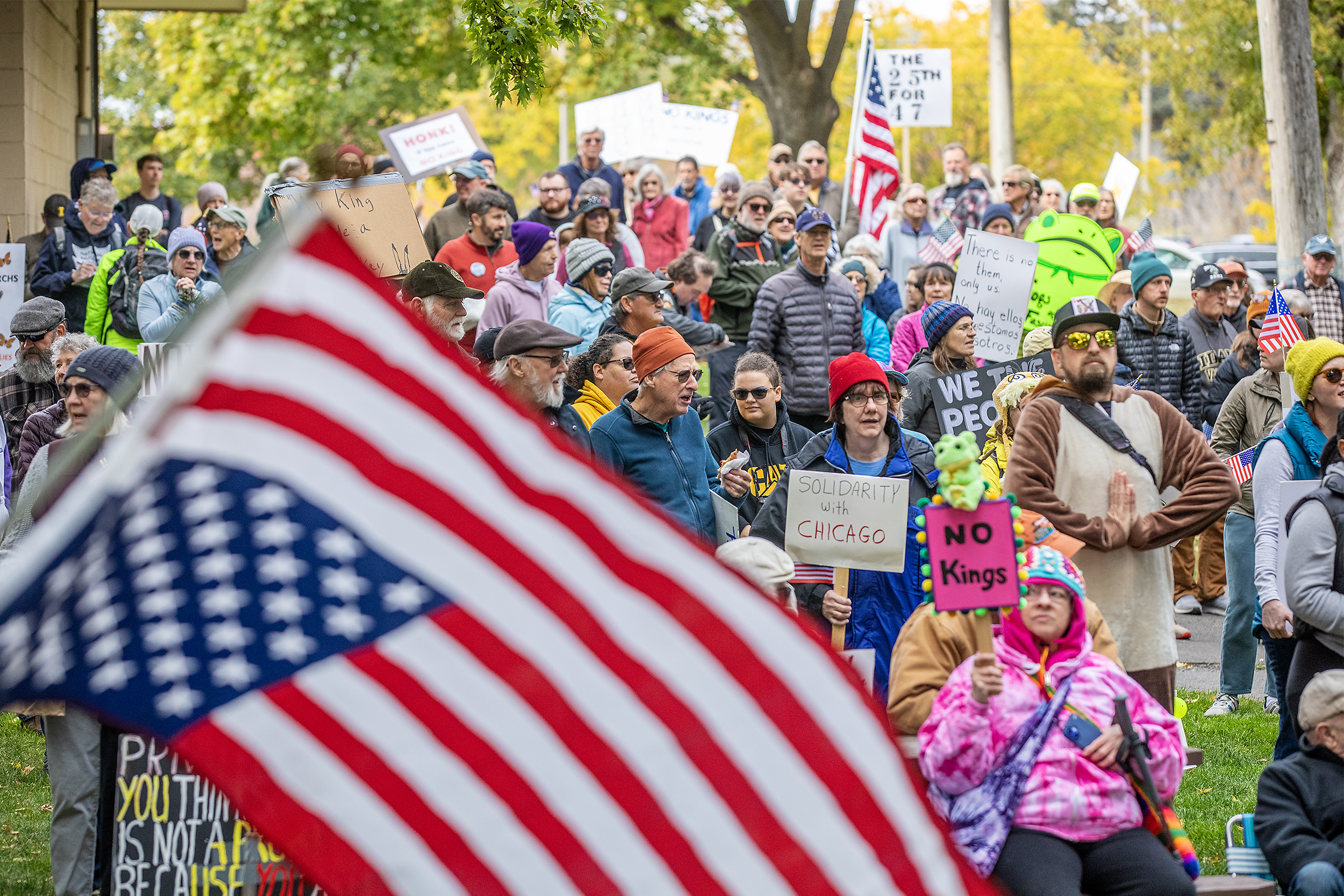
Demonstrators rallied in Moscow, Pullman, Clarkston, and Grangeville on Saturday, protesting against the administration of President Donald Trump. The “No Kings” protests, part of a larger national movement, attracted several hundred participants in Moscow alone as people voiced their grievances over various issues, including immigration policies and perceived attacks on free speech.
In Moscow, the protest marked the second in a series of events targeting the current administration. Attendees expressed a range of concerns, from immigration raids by Immigration and Customs Enforcement (ICE) to issues regarding reproductive health care access. Shana Hammett, a local resident, emphasized the urgency of the situation, stating, “They’re snatching people off the street. They’re masked. We don’t know who they are. We need to stand up and stop it.”
Many protesters criticized what they described as a lack of due process and the politicization of the Justice Department. Concerns were also raised regarding U.S. involvement in the Middle East, with some participants displaying symbols of solidarity with Palestine, including a Palestinian flag.
Megan Klemesrud, a long-time Moscow resident, articulated her frustration with recent legislative changes impacting her health care, saying, “Losing my health care, that’s a huge one. I’m on Medicare, so a lot of things are gonna change in that aspect.” The broader sentiment among participants was one of indignation at being labeled as anti-American by Trump and his supporters.
The President has often characterized protesters as “troublemakers” and has made unfounded claims that they are paid actors. In September, an executive order designated antifa as a “domestic terrorist organization.” Speaker of the House Mike Johnson also recently suggested that protesters “hate America” and are aligned with pro-Hamas sentiments.
Brenda Willett, a resident from Tekoa, Washington, spoke out against these characterizations, asserting, “We’re getting portrayed as hating America. And we love America. That’s why we’re here.” Lauren Howley, a senior at the University of Idaho, echoed this sentiment, stating, “I think what ICE is doing right now in our country is a disgrace to what we in America stand for.”
Marilyn Beckett, an organizer with Indivisible Moscow, highlighted the significance of exercising free speech during such turbulent times. “You can’t say that all the people that were out there on the street are antifa,” she pointed out, reinforcing the notion that the protests represented a diverse group advocating for various rights.
In Clarkston, over 300 individuals gathered at the intersection of Bridge and Fifth streets, many expressing their dissent through costumes and playful signs. Participants included Scott Funk, who dressed as Founding Father Thomas Jefferson, citing a quote from the Declaration of Independence: “A tyrant is unfit to be the ruler of a free people.”
Lori Clarke, donning a Statue of Liberty costume, stated, “I believe in liberty for all. I just feel like we the people need to take care of our country and not let it slip into authoritarianism.” While the atmosphere was generally peaceful, some participants engaged in heated discussions with passing vehicles.
In Grangeville, approximately 100 people gathered for what was the first anti-Trump rally in the area. Organizers, including Leta Strauss, expressed their desire to stand against perceived injustices. “I feel like everybody has the right to do whatever if they feel strongly about it,” she said, addressing the presence of Trump supporters across the street.
Among the protesters was 91-year-old veteran Spike Dorf, who expressed his discontent with the current administration, stating, “I’ve never seen anything in any of the countries I’ve lived in that compares to the disruptive things he’s done to our country.” Sister Elisa Martinez, representing the Center for Benedictine Life, focused on the plight of immigrants, reinforcing the need for continued advocacy.
As the protests unfolded across these towns, it became evident that the “No Kings” movement resonated strongly with many residents, who are increasingly vocal about their disapproval of the current administration’s policies and rhetoric. The events highlighted the ongoing national debate about civil rights, governance, and the future direction of the United States.