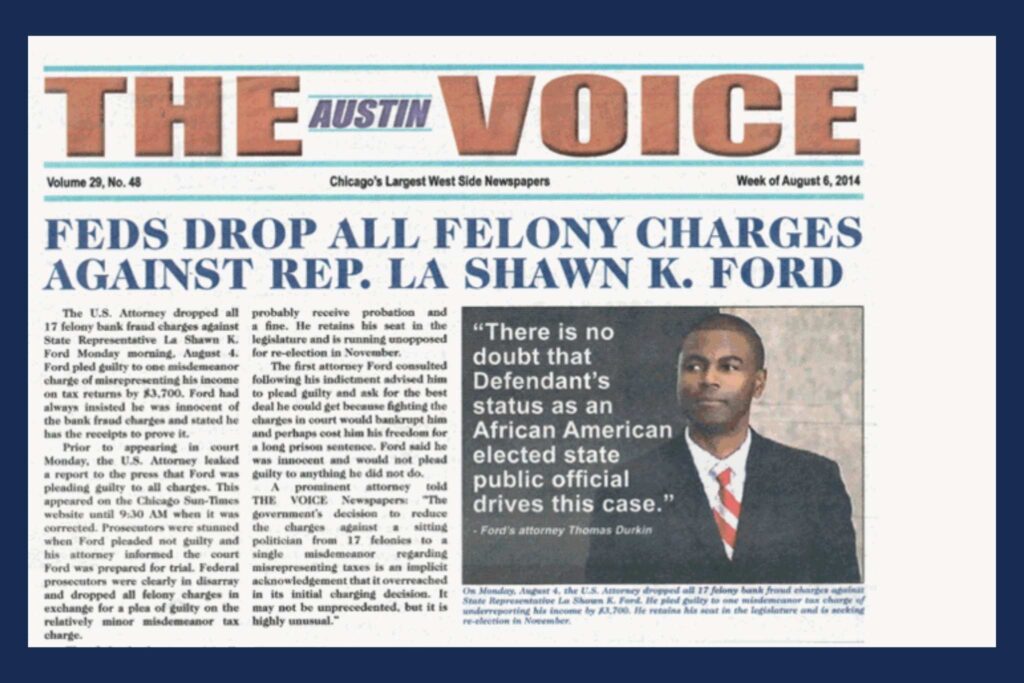
As the Illinois Democratic primary election approaches on March 17, 2024, questions surrounding the past legal troubles of State Representative La Shawn K. Ford have reemerged. Despite the dismissal of felony charges against the lawmaker more than a decade ago, these issues are being highlighted in political attacks aimed at Ford, who has represented the 8th District in the Illinois House of Representatives since 2007.
Court records reveal that the federal case against Ford concluded in 2014 when prosecutors dropped all charges before the trial commenced. Initially indicted by a federal grand jury in November 2012 on 17 counts of bank fraud, the allegations were related to financial dealings with ShoreBank, a community development bank based in Chicago that later collapsed during the financial crisis. According to the U.S. District Court for the Northern District of Illinois, Ford allegedly provided inaccurate financial information to secure a line of credit tied to numerous real estate investments.
Reports from WBEZ noted on November 29, 2012, that Ford was accused of misrepresenting financial data in order to obtain a larger credit line. Ford has consistently denied any wrongdoing, stating that the allegations stemmed from his business dealings with ShoreBank. The case lingered for nearly two years before it was set for trial in August 2014.
On the scheduled trial date, prosecutors chose to dismiss all 17 felony charges against Ford. The Chicago Sun-Times reported on August 4, 2014, that the dismissal occurred as Ford agreed to plead guilty to a single misdemeanor tax offense related to his 2007 federal income tax return. Following this plea, federal prosecutors confirmed the outcome of a two-year investigation, which concluded with Ford accepting responsibility for the misdemeanor tax charge.
The tax issue involved approximately $3,700 in underreported taxes. CBS Chicago reported that Ford was sentenced to six months of probation, fined $1,000, and required to perform community service. Federal court records affirm that the bank fraud counts were formally dismissed, meaning Ford was not convicted of a felony in this case.
This legal matter gained significant attention at the time, particularly because Ford was an active state legislator and one of the few elected officials in Illinois facing federal charges linked to business activities with ShoreBank after its collapse. An article by the Chicago Crusader published on October 18, 2015, further noted that Ford received documentation from the Internal Revenue Service indicating he had overpaid his taxes. “In 2014, Ford pled guilty to a single misdemeanor tax charge, admitting he underreported income on his tax returns,” the report stated.
In an interview with the Crusader, Ford expressed his perspective on the situation, stating, “They said I underpaid my taxes, but later the IRS sent me a check saying I overpaid.” He added, “I got a bad deal, but I came out a better person because now I can represent people who face injustices in our system.” During the investigation, Ford was engaged in legislative efforts to combat housing discrimination and inequitable lending practices.
Despite the resurfacing of these legal issues, Ford has remained active in the Illinois General Assembly and is now campaigning for the Democratic nomination in Illinois’ 7th Congressional District, aiming to succeed long-term U.S. Representative Danny K. Davis. Political analysts note that past legal controversies involving public officials often resurface during election cycles, particularly in competitive races.
It is essential to recognize the distinction between an indictment and a conviction. An indictment is a formal accusation from prosecutors, while a conviction occurs only after a guilty verdict or plea results in a criminal judgment. In Ford’s case, the public record shows that the felony charges from 2012 were dismissed in 2014, concluding with a plea to a misdemeanor tax charge.
As the campaign progresses, Ford continues to serve in the Illinois General Assembly, navigating the complexities of his past while addressing the needs and concerns of his constituents.